Showing posts with label Making. Show all posts

Sunday, March 7, 2021

Making Marks, Making a Mark on the World

 MUSEUM NOTES 

Jeanne Vergeront 
Vergeront Museum Planning 

 
Atelié Carombola Escola de Eduçao Infantil
Mosaic Marks, an exhibit from the Municipal Schools of Reggio Emilia

There are phrases or terms that sound almost strange the first time we hear them. If they also sound intriguing, we might pay attention to them, think about them, and notice when we come across them a second, third, or fourth time. After a while, we aren’t able to imagine not having these once odd phrases to help us observe, wonder, think, and make connections. 

Mark making struck me that way at first. I think it was related to a project of the Municipal Schools of Reggio Emilia (IT). A favorable association for me, it connected with the idea of the 100 Languages of Children, a metaphor for the coexisting ways of investigating relationships, using information, and representing ideas through materials, movement, words, drawing, and sounds. 

Nevertheless, the term mark making seemed imprecise and vague. Reflecting on the phrase however, I gradually appreciated its lack of pretension. Mark making both recognizes that the marks children make with their fingers, markers, brushes, bodies, and imaginations are significant in many ways and yet it leaves open possible ways to understand those marks. 

The Extraordinary Ordinary 
That same tiny finger that points to the family pet or favorite toy indicating, “look” or, “I want that” is the same tiny finger that begins to make marks. An extended finger draws in the snow, pulls a line through the spilled food, drags a strand of spaghetti, and finds an uncapped marker great for marking on a book or a wall. 

Mark making starts early in a child’s life and is a building block to brain functions, literacy skills, self-expression, relationships, and communicating. When that finger, stick, brush, or pen encounters paper, clay, or stone and leaves a trace, a lot is happening. The hand, body, and mind are engaged and coordinated. Small motor skills and eye-hand coordination are developing. 

Often unnoticed by busy parents or older siblings or referred to as “scribbles,” this noteworthy effort emerges from the child’s observing others using materials, an interest in communicating, and the joy of authoring a visible trace. From watching others around them write, children become aware that marks have meaning and are intent on recreating that sense of meaning themselves. They pretend their marks represent something. In these first marks is the start of children’s writing and drawing. With time and more mark making, the child makes new marks and realizes they are capable of changing marks. Random swirls become circles, possibly a head, a sun, a world. 

Young children’s marks are created with intense focus. I recall that when, as a pre-kindergartener I worked hard to make a mark that I now know as a lowercase cursive “e,” I was delighted by creating a recognizable mark. At six years, writing my name was a gift to my mother. Writing names certainly is an accomplishment in children’s mark making and identity. Yet it’s only one milestone in a larger, life-long process from the first dots and dashes, to forming recognizable letters, drawing a scene, telling stories, writing poems, composing a life. 

And while a precursor to writing, mark making is not a brief, linear, or automatic progression. Learning to control any mark making tool, such as a pencil, pen or paintbrush, is hard; it takes time, and requires many skills. Opportunities with marking tools, various surfaces, and approached from different physical postures encourage children who are developing skills at their own pace. Some children want and need to spend more time in a particular mark-making world. 

Making marks is not just about writing and is not limited to paper and markers. It unfolds over time, recruiting new capabilities, expressing feelings of connection, and building on memories. In this sense, mark making emerges from the immediate context perhaps creating a moment of joint attention, responding to what the materials and surfaces at hand make possible, expressing delight. Marks are an opening to something new. Few or many marks, bold colors or fine black lines, snow and black dirt may represent something, cover large areas, or transform surfaces. 

A drawing can change with the addition of each mark, a new color, an act of play, or a spill. If
Photo credit: Interaction Imaginations

we are paying attention, children will tell us. They talk as they develop their idea; their words offer glimpses into their thinking; they give clues about what these marks mean to them. An arrangement of lines or shapes across a page might be a fledgling idea for a code, a diagram showing how a seed grows, or a lost island. The meanings of these marks are not fixed, but likely change as the child encounters them again and experiences them in a new way. A child may describe a drawing differently now and tomorrow telling a parent, caregiver, teacher, or friend about the marks on the page or in the clay. That spiral is a sleeping cat today; tomorrow it’s a windstorm; the next day it’s a new galaxy. 

Making Marks, Making Ourselves 
Museums are full of meaningful marks. Collections, exhibitions, and programs interpret the languages of lines, patterns, texture, shapes, and material properties as drips, splashes, brushstroke, and etchings on canvas, plaster, stone, walls, the world. Deciphering the marks created through movement and sound, museums tell stories, reveal beauty, challenge thinking, and inspire new questions. They deepen our awareness of ancient and modern makers and offer glimpses into how marks create community, follow our families, and express our individuality. Museums honor the functional, ornamental, and spiritual marks of letters, documents, and decrees that celebrate our survival, voice our aspirations, and record our struggles. 

Even more than all of the meaningful marks that museums hold, share, and interpret are the ways in which they can nourish the human desire to leave a mark. Each time they develop an exhibit, display an object, set a tinkering challenge, facilitate a program, shape camp activities, or lead a tour, museums have an opportunity to support and extend the powerful disposition to create connections and transform a small part of the world. 

Children's Museum of Pittsburgh
This work emerges from an expansive idea of mark making. Grounded in an optimism about the capabilities of all of us, even babies as mark makers, this view understands swoops, patterns, and gestures as an extension of the mind, thinking, exploration, communication, and play. This work is advanced by: 
  • Focusing on the mark maker. 
  • Exploring the conditions that encourage, support, and expand the possibilities of mark making. 
  • Integrating mark making into a wide range of activities, experiences, and spaces across the museum. 
  •  Focus on the mark maker. Whether novice or experienced, an individual’s interest in the world and what it offers, and finding a place in that world is the impetus for mark making. Mark making nurtures the individual’s voice, ideas, and thinking. 
- Situate mark makers at the center of an experience. Who are they? What are they curious about? Allow flexibility for how children encounter, explore, and engage. 
- Frame questions around developing an understanding of mark making. How do children fill a space with their marks? What are intriguing forms for them? 
- Observe children’s attention to their mark making. What are their initial marks? How do they elaborate on them? How do they use instruments to explore, transform surfaces? What brings them delight? 
- Listen to children narrate what they are doing. What words do they use to talk about their drawing or project? Does a story emerge from the gestures? How does their telling change? 
- Reflect on how children respond to and use materials, surfaces, words, and feelings. How do they work with them individually? Together? How might children’s images, symbols, ideas, and efforts be extended to other experiences? 
- Document in words and photos insights into children’s thinking about their mark making in a format that serves as a tool for creating new mark making experiences.
  •  Explore the conditions that encourage, support, and expand the possibilities of mark making. A wider range and richer mix of materials invite a deeper exploration of mark making. Push the obvious limits to create new and wider openings for mark making; search beyond the art studio. Check the shed, shop, kitchen, or woods; look for both materials and ideas that prompt exploration. 
 - Think about all the conditions that encourage mark making: materials that modify color, texture, smell; tools, instruments, and media that shape and transform; surfaces that hold marks; ideas to explore; and time to engage and focus. 
- Select varied materials and objects: brushes, markers, pens; sticks, feathers, straws, yarn, cord, wire, fabric, torn paper; leaves, seeds, or petals; found objects; crayons, charcoal, chalk, paint, ink 
- Look around for tools, instruments, and media: an overhead projector, cameras, light, mirrors, circuits, hammers, saws, scrapers, and etchers. - Include surfaces for receiving marks may be textured, porous, or contoured: walls, rocks and stones, sand, the earth, mud, clay, bubble wrap, foil, fabric, sandpaper and wood planks. 
- Experiment. Some materials change with use or interact with other materials in various ways. Water evaporates, light creates shadows; creative accidents happen. Go big with rolls of paper. Add plant material. Select materials with special properties such as clear acetate; overlays invite children experimenting with backgrounds, foregrounds and combining drawings. 
- Above all, think how invitations to mark making that are a starting point for greater explorations. 
  •  Integrate mark making into a wide range of activities, experiences, and spaces across the museum. More than lines and shapes on paper and more than an art activity, mark making is an act of a person having an impact on the world. Recognizing the importance of this powerful, natural disposition acknowledges individuals, makes children’s capabilities visible, and enriches the museum experience for others. 
- Extend mark making invitations into exhibits, programs, and social spaces to invite new ways of looking and thinking. Put sketch pads at the top of the climber; roll out great lengths of paper on the studio floor; add materials to a light table; invite map making at the water table or the city building area. Add a friendly provocative question to initiate exploration. 
 - Vary the context for mark making activities to provide inspiration, new perspectives, or introduce varied conditions. Take mark making outside; vary the scale; go to new heights; incorporate natural materials; add music; use the whole body. 
- Incorporate mark-making into materials exploration, investigating light, shadow, color; building gizmos; imaginative play, STEM play, and nature exploration. 
- Showcase children’s work, using their images and drawings to help interpret concepts and express the museum’s value of thinkers and doers. 

Louisiana Children's Museum
Photo credit: Jeanne Vergeront

Just as the very first marks emerge from a child’s powerful desire to leave a trace, mark making throughout life is a response to a compelling invitation. Museums can extend that invitation everyday. Photo: LCM: children’s drawings 
  • A Traveling exhibit from Reggio Children, Mosaic of marks, words, materials will be in New Orleans in fall 2021. The exhibit is based on an investigation to gain a better understanding of the poetic interweaving between children’s drawings and words, in order to restore to drawing, to the instruments.

Thursday, March 2, 2017

Some Museum Trends


Museums create, follow, and sometimes are swallowed up by trends. Like trends in general, museum trends reflect directions in which movement or change is occurring. Trends might be related to changing demographics, the popularity of particular experiences with visitors, or changes on the horizon requiring preparation.

Often trends are associated with external factors over which museums have little control but which they do need to plan for like changes in funding sources, changing housing patterns, or birthrates. Sometimes focus on a social issue like social media can highlight how museums might be helpful to children, families and the community and to themselves. Still other trends emerge from excitement about something new one museum has tried, like rat basketball, which ripples from one museum to another.

There are past, current, and future trends; trends that are strategic, financial, operational, and programmatic. Trends come from and affect different types of museums–art museums, science centers, history museums, or children’s museums–differently. One example is a set of seven trends relevant to science centers world-wide that a group of science center leaders and researchers first explored at ASTC 2015 and then shared in an article in the Informal Learning Review (No. 136, Jan/Feb 2016). We also learn about trends from research and analysis that identify shifts that are occurring that might affect visitation.

Trends with long-term trajectories affecting museums are explored annually in TrendsWatch published by AAM’s Center for the Future of Museums. The just released forecasting report, 2017 TrendsWatch, explores how each trend plays out, implications for society and museums, and how museums are and might respond to them.

Whether followed diligently or not, trends inform and guide us. Trends help us shape a future and the museum we want. Studying them is helpful in planning and is often a preliminary step for strategic planning, preparation for a major capital project, or taking corrective action. Many museums attend to trends for inspiration, staying current, and being more attractive to visitors and supporters.

I look at and think about trends to push on my assumptions, organize information, share practices with others, and think about the future. I've gathered 11 trends I have been noticing. I hear colleagues talking about them and they are showing up in conference sessions, articles, studies, reports, and blogs. While these trends may not be completely new, shifts are occurring, perhaps spreading to more museums, assuming greater influence, and evolving. Several relate to larger trends identified in TrendsWatch.  

Museums can reflect on these trends and how they might play out in the context of their audience, museum, and community. Of course every trend is not necessarily a good fit for every museum but there are often ways to approach or incorporate a trend to increase its relevance. In what ways are these trends playing out in your museum?

1.     Extending the Museum’s Age Range. Over the past several years, science centers, natural history, art and history museums have been reaching down to serve a younger audience, while children’s museums have been reaching up. Some of this may be encouraged by reports like IMLS Early Learning  that highlight the value of early experiences and the role museums and libraries can play. A growing focus on family learning encourages keeping families–often with children of several ages–together. Finally, extending the age range either way, promises attendance growth. Museums reaching out to new audience groups will want to be prepared for planned and unplanned shifts and reactions. Museum Notes: Managing Multiple Museum Audiences 

2.     Awareness of Informal Learning. While museums have long identified themselves as places of informal learning, they are increasingly intentional about their roles and opportunities. In free-choice or informal settings, learning is social, learner-motivated, voluntary, tool and object-based, and contextual. Occupying an important niche in their local learning ecosystems, museums have distinct opportunities to accommodate non-traditional learners, develop talents, model active learning for local schools, and contribute to educational reform. As more studies highlight the benefits of informal learning and their settings, museums are increasingly able to use these qualities in planning learning experiences and encouraging learners to extend their learning over time. Museum Notes: The Dance: Informal and Formal Learning

3.     Collaborative Experiences. Museums are finding that collaboration works at many scales: with members of the community, with other organizations, internally among staff, and among visitors in exhibits and programs. A 21st century skill valued for both individuals and groups, collaboration engages different perspectives, amplifies new voices, shares expertise, and extends resources. Collaborative efforts allow a museum to accomplish goals for its learners, itself, and its community that it could not otherwise accomplish from enriched experiences to being more inclusive and increasing impact. Any museum that has been engaged in collaborative efforts will know that along with the benefits come challenges of time, trust, and managing change. From the Field: Growing Bigger, Staying Collaborative

4.     The Power of Place. Place is more than physical setting, an address, geography, weather, or an historical marker. It is something we experience directly, physically, and intensely through our senses, experiences, and emotions. As daily life becomes more global, museums are recognizing that being local is increasingly valued. Experiences grounded in place connect with what an audience finds distinctive and meaningful; builds on local knowledge; and deepens a sense of connection and identity. As a museum looks for ways to distinguish itself, tell its story in new ways, and deepen its roots in the community, it is likely to find some direction from the power of place. From the Field: Places of Invention:  Museum Notes: Place Matters 
                 
5.     Authentic Materials. Real-world stuff–tools, utensils, natural materials, building materials, fabric, biofacts, and everyday objects is full of information about the world, how it works, and how it is likely to work. Materials motivate, hold stories, express possibilities, and deepen our understanding of concepts. Museums recognize that in a world of increasingly virtual experiences and objects that may not actually be made of what they appear to be, direct experiences with authentic materials are critical for our understanding of materiality and how our body gathers information and how it understands. Using authentic materials can be staff intensive and requires adequate, convenient storage.  Museum Notes: Managing Materials for Making and Tinkering   

6.     Nice + Necessary. Increasingly, museums realize they must be outstanding at being both nice + necessary. They must be inviting and attractive and they must matter. A museum is nice, a pleasant place to spend time, to bring friends from out of town, or to celebrate. A museum is necessary in strengthening community, contributing to a more robust regional infrastructure around well-being, or playing a critical role in early literacy. Like 2 sides of a coin, nice + necessary need one another. Nice provides credibility and brand recognition for being necessary which in turn confers credibility and confidence about the museum's long-term value. Museum Notes: Unpacking Nice + Necessary

7.     Visitor Engagement. More museums are finding more ways to plan and work with as well as for their audiences. They are inviting citizen insights into their community into the museum, crowdsourcing ideas; and co-curating projects with visitors. Visitors help research and prototype exhibits. Besides enriching museum experiences and offerings, visitor input adds new voices, expands perspectives, increases relevance, shares authority, and broadens ownership of the museum. Many museums are experimenting with this bottom up approach, finding ways to increase engagement, personalize interactions, and stay in touch. To manage well and respect visitor input, museums need clear goals for what the engagement is intended to accomplish and how input will be used. From the Field: What Is Engagement, and When Is It Meaningful?

8.     From STEM to STEAM. A concern about STEM literacy especially for girls, underrepresented groups, and the workforce pipeline has been bubbling for years. A shift from STEM to STEAM, integrating the arts–music, visual arts, language, sculpture, dance–into STEM learning experiences addresses some of these concerns by increasing entry points and motivation for exploring STEM concepts. At the same time it welcomes creativity in science, imagining what’s possible, and application of design skills. Just as science centers and museums are adding the arts to STEM learning, art museums are adding science to arts exploration. From the Field: Artlab+Q?rius Art-Science Workshop Series Evaluation2015 

9.     Maker Spaces and the Maker Movement. Making brings puttering and crafting in from the garage, basement, shed, or knitting circle. It’s a DIY, from scratch, messing around mindset that amps up the self-directed learning, level of interactivity, and social engagement we are now seeing in museums, libraries, and community centers. Experiences in maker spaces, facilitated by prepared staff, are able to serve a wider range of ages and visitors, from young children through adults while providing access to a range of materials and tools. Maker spaces draw on high-and low technologies and engage makers in a variety of processes including material exploration, designing, and building. As the larger "maker movement," grows to more settings, how will museums distinguish their maker spaces? From the Field: Learning to Make in the Museum   

10.  Technology Everywhere. There isn't an area of the museum where new technology is not well established: mobile giving, social media, mobile apps, augmented reality, depth sensors...and more. TrendsWatch over the last 4 years has more or less documented this. Engaging new technologies are dramatically changing the museum’s relationship with members, donors, and the community. With new technology, visitor and gallery experiences increase learners' access to content, combine physical with digital experiences, and help in visualizing complex ideas and relationships. Museums of all sizes are struggling with technology adoption, needing to develop a museum-wide digital strategy, manage the demands placed on resources, and keep pace with technical infrastructure. From the Field: NMC Horizon Report 

11.  Places of Research and Evaluation. Research and evaluation activity has been growing across the museum field. Not so long ago, few museums conducted more than an occasional program evaluation or summative evaluation as required by a funder; a museum rarely conducted research. As a maturing field expected to demonstrate its value, museums have been growing internal and field-wide capacity. Field-wide research agendas have guided studies and supported research networks and research exchanges. Educators, evaluators, developers, designers, and researchers at museums, small and large, are developing their own research agendas, framing questions, and connecting theory and practice that is meaningful in their museums. Most likely, some of the results of this research will generate coming trends.  From the Field: Developing a Research Agenda Aimed at Understanding the Teaching and Learning of Science at a Natural History Museum. 

What trends would you add to this list? How do you use trends in your museum? What's helpful in using them?

Photo credit: Nuernberg Installation by Markus Linnenbrink

Tuesday, October 14, 2014

Making Makers

Years ago in Minnesota Children’s Museum exhibits department, we found ourselves hiring fabricators who had grown up on farms. They could weld, wire, and work with wood. They could take things a part and put them back together in the same, or different, ways. They found that interesting and engaging. They might have also had an MFA or mechanical engineering degree and sometimes they were a furniture maker or had picked up graphic design skills along the way. At heart, however, they were farm kids and makers and that’s what we cared about. 

There was a time, when many people were makers. They did hand work and crafts with their hands. Dads and older brothers fixed their own cars, built go-karts and ham radios, and wired the house. Women knitted, sewed, did needle work, baked bread, pickled and canned. Children built forts, made doll furniture, fashioned small weapons like slingshots, and watched their parents, grandparents, aunts, uncles, and neighbors make things.

If our inclination to be makers is activated by our parents, it is to my mother I owe my making predilections. My mother has always loved working with her hands and figuring things out. She sewed, laid sod, hung wallpaper, and laid floors. For 50 years she took woodworking classes and made furniture. She only quit when she figured her woodworking teachers were born after she’d started taking classes. Over the decades she has built a tree house, a half-dozen doll beds, several trellises, a picnic table, 5 chests of drawers for 5 of her grandchildren, and a new fireplace mantle from her own designs, often with my father’s congenial assistance. At 89 years she laid a brick sidewalk and at 90 she allowed my brother and sister help her build a fence. With our mother as an example, it’s not surprising that all seven of us children would be considered makers. And the best of them went off to work on a ranch; he would have made a very fine fabricator.

Becoming Makers Again
Now, it seems, we are hoping to become makers again. My copy of a fresh look at making just arrived. Making Makers is by AnnMarie Thomas, a maker herself as well as an engineer, educator, and parent. An engineering professor at St. Thomas University in St Paul (MN), Thomas brings an important, but often-overlooked, perspective on how to encourage active, creative life-long learners, in this case, makers. Interviewing 39 adults accomplished in many areas about what they were like as children, it is clear they were all makers as children.

The makers she interviewed are writers, technologists, artists, designers, engineers, inventors, professors, and researchers. Leaders, founders, and entrepreneurs, they work in business, academia, community programs, restaurants, arts, and museums. Their creativity and making is expressed as clothing, robots, pipe organs, furniture, and medical devices. Many, if not most, straddle interdisciplinary areas and multiple contexts. All are introduced in the book.

Childhood as a formative time for makers threads throughout the book. The interviewees remember learning from books, magazines, and catalogues as children. They had access to real and varied materials, working tools, and projects of their choosing. They were intent on doing, making, and figuring things out: building, programming, repurposing, or drawing. Few dreams were too big for these children who worked to build a submarine, an airplane from a fallen log, a rocket, or a miniature golf course. We know these makers from photos of them as children, just as we know their childhood creations­: a plane, map, diorama, and home-made Tesla coil from photos, descriptions, and memories. They testify undeniably to the formative and durable nature of childhood in making makers, thinkers, and problem solvers.

Maker Mindset
We are often careful to balance the importance of a finished hands-on product with the value of the process. Less often, however, do we consider the traits and dispositions that support engagement with both process and product. Thomas does this, in fact, focusing on these traits in children. She distills and expands on a set of eight maker-relevant attributes that recur throughout the interviews.

Organizing anecdotes from childhood, Thomas connects the youthful spirit and enthusiasm that powered early maker projects with life-long dispositions and interests. No small coincidence, her list maps onto the non-cognitive skills critical to success in school, work, and life. Equally significant, several qualities–curiosity and playfulness, risk and persistence–are synonymous with children’s joyful, active engagement with their world.

The message is clear: To give children the best chance to be innovative thinkers, playful doers, persistent dreamers, responsible collaborators, make it easy for them to pursue their maker predilections.
• Curiosity. All children are curious but they are not all curious about the same things. Particular curiosities and interests fuel children’s desire to know, to try, to question, to find out, and to follow possibilities.
• Playfulness. Freely following their interests and ideas, children delight in manipulating sound, numbers, circuits, stories, clothing, and expressing possibilities that they joyfully pursue in many directions.
• Risk. Trusted with tools, free to set their own challenges, learning their limits from small injuries and unexpected results, children gain new skills and competencies from near misses, respect danger, and learn safety procedures.
• Responsibility. Entrusted to take on a meaningful role in making something bigger happen, helping others accomplish their goals, and accepting consequences build confidence, a sense of accomplishment, and pride.
• Persistence. Guided by a belief that they can figure out how to make just about anything, maker children keep trying in the face of setbacks, use multiple approaches to work around challenges, and iterate to get it right.
• Resourcefulness. Inspired by bits and bobs, undaunted by scarcity, improvising with what’s available, and developing a fluency with materials and tools children recognize and access the potential in what–and who–is available to move ideas forward.
• Generosity. Excited to try something new or hard, children often need and enjoy help from a more, older, or differently experienced maker. Exchange and connection, however, often go in many directions with children proudly sharing their skills, knowledge, tools, plans, and time.
• Optimism. Through making children leave a visible mark on the world, their mark. This act of making represents a delight in the possibility of change, a belief in making a difference, and concern for what comes next. 


Raising Makers
Children may be natural-born makers, but the adults in their lives are key partners in encouraging, supporting, extending, and inspiring children to become life-long makers, learners, tinkerers, and thinkers. Thomas provides a brief set of suggestions for adults who want to raise children who are makers. Parents, friends, teachers, neighbors, museum developers, designers, and educators need to be around and supportive, but don’t need to do the work of maker children. Sometimes adults may need to remove an obstacle a child could not; for instance, let Luc keep a 50-gallon oil drum in his bedroom. But, generally, adult support is indirect through:
• Sharing their passions
• Letting children follow their own interests
• Stepping back
• Teaching the importance of safety and responsibility
• Letting children get messy
• Not knowing all the answers
• Making something

Making Makers carries several messages. The one I find strong, clear, and compelling is that the maker experience for children is the stuff of childhood. It is the raw material for building life-long skills and the source of the directory for future makers, doers, thinkers, and problem solvers.

Related Museum Notes Posts

Saturday, June 15, 2013

The Play Outfitter


For those concerned about the presence of play in children’s lives, the recent appearance of books, studies, and reports that promote to play and its benefits should be encouraging. Here are just 3 highlights.

• The American Academy of Pediatrics recently revised its 2007 clinical report, “The Importance of Play in Promoting Healthy Child Development and Maintaining Strong Parent-Child Bonds.” It affirms that play is essential to the social, emotional, cognitive, and physical well-being of children beginning in early childhood.
• Alliance for Childhood will be publishing “Adventure: The value of risk in children’s play” this summer which looks at the importance of risk for children’s healthy development.
• American Journal of Play from The Strong explores play in its fullness, deepens our understanding of its dimensions and value, and brings a credibility to play with academic and international perspectives.

A lot has been happening on the play front in about the last 5 years. These and other studies and resources are making abundantly clear that children’s free, self-directed, play enhances resilience, creativity, social understanding, emotional, and cognitive control, and resistance to stress. This is not a tepid endorsement for the value of what children love to do and do naturally. For some reason, however, this not so secret strategy for success struggles to find broad, gripping traction.

Mounds of mud for play
Having over-scheduled children’s free-time and scoured our yards and playgrounds of loose parts for safety and convenience, we may now need to back up and revisit what, at its most basic, could readily engage children in play. Perhaps if children had lots of loose parts, mounds of mud, messy garages, piles of junk holding up an outbuilding or two, or tinkery basements where they could harvest stuff, they would be playing in that whole-hearted don’t call us in until dark spirit of play. Unfortunately, too few children are able to do that.

Always and Forever in Play
Every so often I come across lists of what people consider the best toys or play objects for children. I am interested in scanning the lists and thinking about the nature of the items–how universal, commercial, educational, natural, nostalgic, novel, everyday, ubiquitous, or adult-defined they are. How are these objects likely to engage children’s play? In what ways do they extend children’s play that other toys are less likely to? What do these lists say about play and, more specifically, about our view of children’s play?

One list I made note of was that of Howard Chudacoff, author of Children at Play: An American History and a professor at Brown University. In an interview with the American Journal of Play, he said he is often asked to name the 3 best toys. His choices are a:
• Stick • Ball • Box

Wired’s GeekDad posted 5 time-tested and child-approved items that no child should be without. These items fit easily within any budget and are appropriate for a wide age range. He recommends a:
• Stick • Box • String • Cardboard Tube  • Dirt

On Providence Children’s Museums’ Playwatch listserv a reader responded to GeekDad’s list with 5 items:
• Water • Blanket • Chair • Bubble Wrap • Tape

Princess Summerfall Winterspring added a seasonal variation with:
• Shadows and Silhouettes • Leaves • Snow and Ice • Mud

Thinking about  the children in the family daycare she runs with her sister and what they will play with always and forever, Nina listed:
• Tape • Boxes • Blocks

Paula Meijerink of WANTED Landscape considered outdoor play at the recent InterActivity 2013 in mentioning:
• Dirt • Critters • Matter that Deteriorates

Loose Parts and True Toys
Little hands, big hands at play
The items on these lists are not just sweet, familiar, or harken back to simpler times. They also have substantial play value. Children get a lot of play out of boxes, tubes, tape, string, and sticks. The collection can be extended to water, wire, fabric, wood pieces, rubber bands, paper, blankets, and clothespins. Easily moved, lifted, transformed, combined and recombined, these are loose parts that activate and engage a child’s disposition to play. Their play possibilities elicit a full range of play–sensory, constructive, imaginative, large motor–individually and sometimes richly blended in extended play episodes.

The American Academy of Pediatrics’ report refers to "true toys,” ones that engage children’s interest, invite them to use their imaginations and ingenuity, and hold their attention. “True toys” leave room for children to direct their own play and tend to develop with the child; they are not strongly gender specific. 

This was very apparent recently in how children 18 months to 8 years, and both boys and girls who I was observing used tape, tubes, fabric, sticks and string for building and making. Comfortable in multiple contexts, children work wonders on cardboard boxes indoors and out; in small city spaces, suburban lots, and rural landscapes; in yards, schools, daycares, and museums. These play materials are everyday, easy to round up, and, as GeekDad points out, affordable.

Step Right Up At The Play Outfitter
Traces of taping
Outfitters provide specialty equipment, supplies, and gear for canoeing, hunting, fishing, skiing, and trail riding so the experience is top notch: safe, easy, enjoyable, and without unnecessary interruptions. Those who enjoy a sport or hobby–their type of play–enjoy it even more when well prepared and well outfitted. It is no different for children's play. Why not a play outfitter? 

The play outfitter fills a hole in the high-quality experiences we hope children will enjoy in the backyard, nature center, park, bedroom, garage, attic, playground, museum, beach, barn, cabin, cottage, campsite, or classroom. Many people can, and should, fulfill the role of play outfitter: a mom, dad, aunt, uncle, grandparent, daycare provider, nanny, teacher, babysitter, friendly neighbor, or scout leader. Actually, there’s no reason children themselves cannot be play outfitters.

Well-supplied at the Play Outfitter's
Working with the lists above, expanding on them, drawing on previous experience and observation, and responding to preferences, a play outfitter might stock up on cardboard tubes, string, dirt, tape, clothespins, buckets, and fabric. They might make water, scissors, grommets, or paper and pencils available. Consideration is always appropriate about whether to offer a wide variety of play objects and materials or a few in larger quantities. A play outfitter takes cues from the players they are serving.

The play outfitter would be a strong addition to a variety of settings. Imagine the Play Outfitters at a museum as part of a building zone, maker space, or outdoor play yard. Children step up and inspect what’s available. They select interesting play supplies that they are curious about or choose specific materials they need to explore an idea or make something. Their requests, describing what they need, estimating necessary quantities, and naming related gear and tools offer new ways for them to direct their play as well as expanding on and enriching the play experience.

Perhaps The Play Outfitter could become a new version of the grocery store exhibit as a place where children buy the cardboard tubes, clothespins, boxes, sticks, string, and fabric that they need for another aspect of their well-being–their play.


“….magic is in the child’s mind rather than in the toy…”

Yi-Fu Tuan in Passing Strange and Wonderful

Tuesday, November 13, 2012

Managing Materials for Making and Tinkering


Although museums are no longer cabinets of curiosity, filled with rocks, relics, artifacts, and instruments, they continue to be characterized by authentic objects and materials at all scales and classifications and across museum types. Art, science, history, natural history, and children’s museums are object and material-rich environments that are also distinguished by the opportunities for object-based learning that they offer. 

Everyday in large museums and small, educators, exhibit techs, explainers, docents, playworkers, and facilitators are at work checking, distributing, and replenishing materials in galleries, exhibits, classrooms, and studios. They stock activity carts with sketchbooks, pencils, viewfinders, and magnifiers and pack bins for outreach programs. They refill exhibit components with metal washers, eyedroppers, and paper cups; reunite puppets that have migrated; and restock the grocery bins. Someone checks for missing pieces, small objects, and choke-hazards; another staffer checks the wire cutters. A group of staff assemble to offload flattened cardboard boxes that have just arrived. Perhaps a disbelieving colleague second-guesses the written directions as to whether 10,000 sticker dots to ‘dot the space’ are really intended.

Enthusiasm for found, reclaimed, and re-purposed materials has been building in museums, assuming many forms. Tinkering, maker spaces, and DIY initiatives are inspiring activities, creating exhibit-program hybrids, and putting authentic materials and tools in the hands of children and adults. My delight with the recent rise in material-rich experiences and settings is probably no surprise considering my expressed enthusiasm here for loose parts, good messes, and exploring materials. Yet, as promising as these trends are for visitor engagement, creativity, thinking, and learning, importing massive amounts of materials into museums also exerts new pressures such as encroaching on limited space, adding new tasks to full workloads, and affecting operations. Quantities of materials can also dilute the quality of projects or just produce such a jumble to make materials hard to find, use, or unappealing.

Judging from the opportunities and challenges I see more of in museums and hear about at conferences and also reflecting on my own experiences in this area, it’s clear that managing– perhaps curating–materials sits at the heart of successful tinkering, DIY and maker efforts in museums. Managing materials is a complex, multi-part, and collective process, more like a set of systems. Tapping the possibilities of materials requires extensive organization, system support, and appreciation for the beauty of materials.


Layers of Material Management
In the early 80’s, I worked at The Teachers’ Workshop, a teacher center for professional development in Madison (WI) that included, along with other resources, a recycled materials center. Housed in a double-classroom, it was filled with bins, barrels, and shelves of discards and by-products from area businesses and industry as well as teacher contributions. Displays by teachers and students using these materials from math manipulatives, to games, to art projects, added to the material richness, intensity, and sometimes, scrappy mess of the space. The push of gathering, sorting, storing, displaying, and restocking materials was relentless, inspiring, and rewarding. Looking back, I see that too often we were simply thrilled to get stuff, less driven to be resourceful with storage, and only occasionally attuned to presentation.

At that time Boston Children’s Museum had a recycle center store. On visits to Boston, we carefully noted the museum’s inventive and practical solutions for storage, display, and access to wooden game pieces, foam shapes, plastic caps, and many objects that eluded labels. The museum’s ingenuity and design expertise helped broker the competing demands of a recycle center. Storage solutions not only accommodated bulky and unusual shapes of objects, but also allowed children and adults to experience and explore materials, accentuated the delight of discovery, and contained the chaos of abundant stuff.

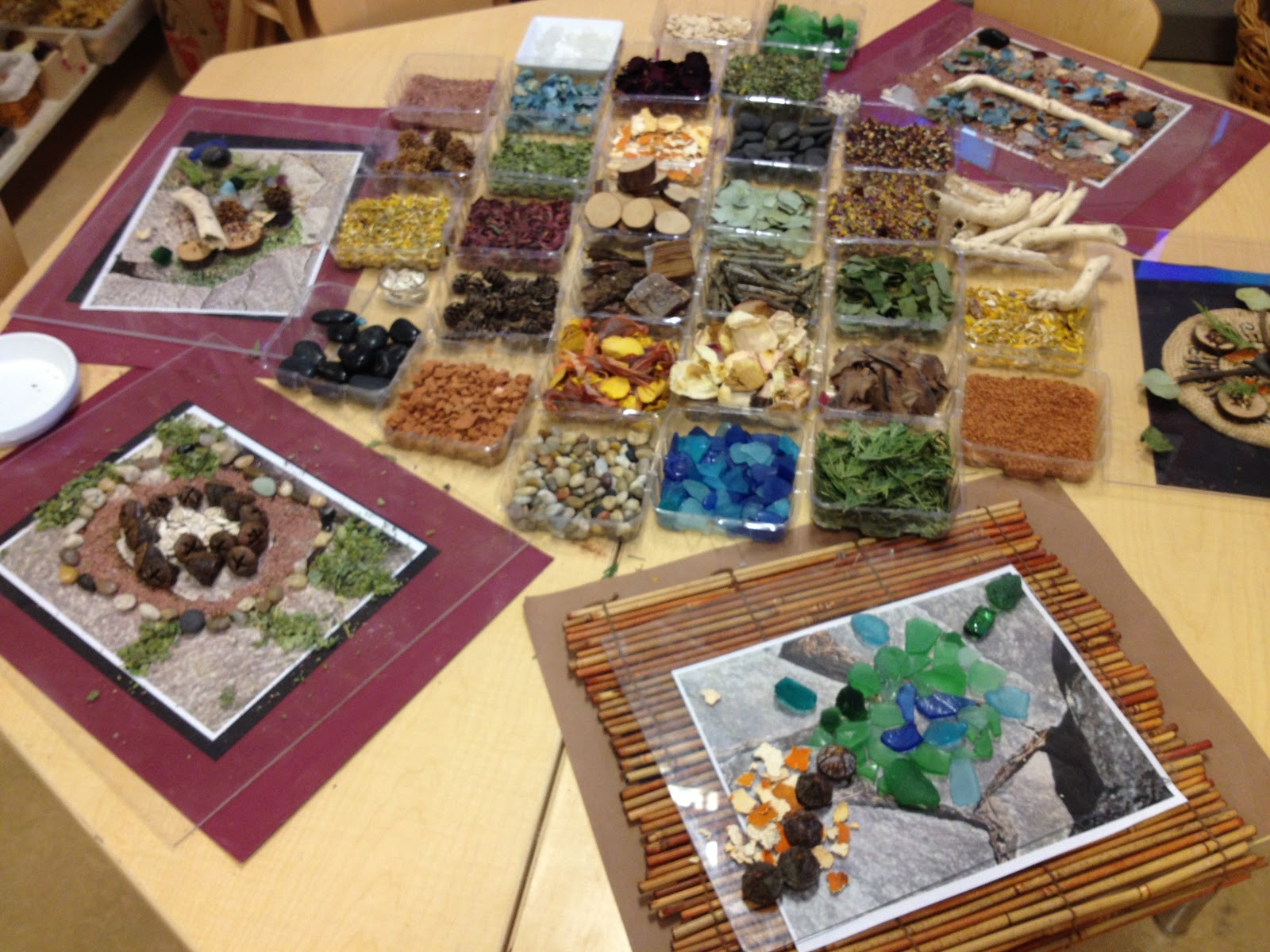
Managing materials is also part art. Along with quantity, variety, and smart storage, order and beauty are necessary to convey the materiality and possibilities of materials. Nowhere is this more apparent than in the material rich ateliers, or studio spaces of the Municipal Infant-Toddler Centers and Preschools in Reggio Emilia (IT). A tightly connected, coherent pedagogy rests solidly on a set of principles including the environment as the third teacher, creativity and aesthetics, and an appreciation of materials to engage children’s investigations of the sense and meaning of things and explore their own creativity. Attention to detail, arrangement of objects on shelves and tables, light from windows, mirrors that reflect children, small surprises, and displays of children’s thinking in their work contribute to the beauty of the spaces. Remida, the creative recycling center in Reggio, is a joint project of the Centers and Schools and Iren Emilia, a multi-utility working in neighboring provinces. When I visited in 2000, I shouldn’t have been surprised to find that Remida also had an artist-in-residence as one strategies for fostering new opportunities for communication and creativity with materials. Had we only imagined that at The Teachers’ Workshop!


Curating Materials
Enthusiasm for massive amounts of materials is not evenly distributed across a museum or even within a department. Last year I overheard two people from science museums talk about integrating loose parts into an exhibit on which their museums were collaborating. Their conversation went: “Loose parts are not going to happen at our museum; maintenance will see to that.” The other person replied, “They’ll just have to get over it at our museum; loose parts are what we need.”

Amping up material use or introducing loose parts requires building ownership, collegial consultation, developing systems, anticipating others' concerns, and good manners.

There was much buzz and enthusiasm from self-identified “material nerds” at the recent ASTC 2012 about managing materials for maker spaces, tinkering studios, and take-apart labs. Some suggestions were more obvious than others, but ingenuity and trial and error with materials, storage, presentation, and collegiality had clearly gone into clarifying relevant steps, managing stuff, and figuring out solutions in the material stream. Steps, like sorting, happen repeatedly: in gathering, as part of storing, preparing activities, and putting materials out though the focus shifts.  At every point, order, beauty, visibility, and findability guide decision making. In the  practices below that I found helpful, naming the steps is somewhat arbitrary.

Gather materials, re-used and upcycled, physical resources and digital media resources, from multiple sources. Post signs at work asking co-workers and repeat visitors to bring in materials. Place a bin for drop-off, specifying requirements such as clean recyclables. Work with pre-school teachers. Take things apart such as timepieces and toys. Check out on-line sources, find the local recycling center, and locate scrap exchanges in the area.

Store materials based on clear, shared criteria. Frequency of use is a basic one with two broad categories. Back-up storage holds large quantities of materials that are drawn down to replenish at-hand storage for easy access during activities. The next challenge is finding the right containers within these two categories to hold objects and make them visible. Smart solutions use a systems approach: containers fit within and next to containers efficiently and can be prepped ahead of time. For instance, hotel steamer trays hold materials on tables and carts, are easy for visitors to use at worktables, and can be filled in the morning for quick resets. Milk crates hold smaller containers like tennis ball tubes hold stacked portion cups–and are easy to carry.

Tracking materials, or monitoring the constantly fluctuating quantities of materials that a museum has/doesn’t have/needs/the available quantities is the trickiest part of the process. A binder can include things that are needed and ordered. A dry erase board, used at ¡Explora!, can show when an item is “out”, but it doesn’t show what’s available now. Development of a searchable database is underway at the Exploratorium.

Preparing or gathering materials for a project is often based on a list of materials required for the project that have been tried ahead of time. The material nerds recommend that projects are framed and prototyped so that the materials and tools are scoped, materials are collected, bagged, and organized to support and deepen the tinkerer's investigation. Estimating quantities and planning for easy at-hand storage happens here. Set-up involves putting out materials in ways that are visually inviting and recognizable, accessible, and suggest possible starting points. A partially set up project can suggest where one tinkerer went with the materials or encourage a newcomer to capitalize on it, repeat, or jump off in a new direction.   

Projects on display require plenty of forethought and preparation. Encouraging tinkerers to leave something behind that has value to them (and perhaps to the museum) can be difficult. Prompts may be required to suggest that visitors label their project and leave it behind with, “This is my gizmo.” Visitors might scan their creations and publish them on the museum website. Staff may also move around and photograph what’s happening and ask visitors to comment on photos, and display images and comments. Notably, questions persist about how to encourage tinkerers to document their own projects.

Return to the material stream. The recycle life cycle of yogurt containers, hanks of wire, paper, corks, and cardboard tubes is evolving. While initially extended by recycling for tinkering, it can be further extended by dismantling reused materials and sending them back to storage. Other materials will meet their end in the museum’s trash until someone finds better uses for them at the tinkerers' table. 


More for Tinkering and Making
The enthusiasm of these tinkerers reflects a love of materials, an appreciation for solutions that accomplish multiple objectives, an interest in persistent challenges, and a generosity–including these tips.
• Think through every step and what visitors need, how to keep a tinkerer focused on the project and not distracted by string rolling away.
• Both variety and abundance of materials are needed to get the right “dooda”to deliver the best solution in an activity.
• Look for inspiration in managing quantities of materials in settings that do it well: Ikea, container stores, Remida, Reggio studios, and hardware stores.
• To find out more about the data base that Lianna Kali at the Exploratorium is developing, contact her at: lkali@exploratorium.edu

 Also, check out Paul Orselli's recent blog, Good Bye Columbus, Hello Makers, on ExhibiTricks