Showing posts with label Exploratorium. Show all posts

Wednesday, February 6, 2013

A Disposition to…


In the world of learning, whether in museums or schools, we often hear about skills, knowledge, and proficiencies. We seldom, however, hear much about dispositions. Disposition might be a bit of an old-fashioned word and doesn’t enjoy great use. Perhaps that is because disposition lacks the crisp currency of skill with its sharp edges that lend it to being tested and measured.

Disposition, however, is a useful and underutilized concept, especially in museums with an interest in inviting thinking, engaging learners, and supporting life-long learning.

A disposition is a habit, an inclination, or a tendency to act in particular way.  With a focus on frequent and voluntary patterns of a behavior or activity, dispositions differ significantly from skills and knowledge. Acquiring a specific skill or knowledge on a particular subject does not guarantee it will be used or applied. A disposition makes use of that skill or knowledge more likely. We might say someone has a disposition to be curious if she typically and frequently responds to the setting by exploring, investigating, and asking questions about it. Simply having the skills to ask questions, however, does not assure that she will do so.

Lillian Katz who has been writing and talking about the role of dispositions in children’s learning for 30 years defines disposition as a “pattern of behavior exhibited frequently . . . in the absence of coercion . . . constituting a habit of mind under some conscious and voluntary control . . . intentional and oriented to broad goals.” In Cultivating a Culture of Thinking in Museums, Ron Ritchhart of Harvard University’s Project Zero refers to a dispositional perspective on thinking as not only the ability to think but also the disposition to think. Patterns of thinking not only can be used, but also are used.

Dispositions can be social. Someone may have a disposition to be friendly, helpful, or cooperative. Other dispositions are intellectual such as a disposition to ask questions, to read, to gather information, to observe, to weigh evidence. Not all dispositions are positive. Consider a disposition to be bossy or complain.

Dispositions can be developed and are more likely to be developed when other people, such as parents, grandparents, teachers, siblings, peers, model them. Even so, developing a disposition requires time, time for it to be enculcated, practiced and strengthened. Environmentally sensitive, dispositions are acquired, supported, or weakened by the conditions of the environment, the interactive experiences in settings with significant adults and peers.

Unpacking Dispositions
The qualities characterizing dispositions set them up as a good fit for museums in creating experiences for children and adults. Dispositions can be modeled. Museum educators, floor staff, facilitators can be (and often are) trained to model certain behaviors: asking questions, noticing patterns, or checking assumptions. As museums prepare environments and exhibits with particular objects and activities to invite and encourage learners to use skills and draw on understandings, they can also encourage certain dispositions. Many dispositions relate precisely to the kind of behaviors and actions we want learners to engage in: to notice, to try, to ask questions, to gather information, to be creative. Some dispositions relate strongly to certain areas, like science.

Three related aspects of dispositions make them even more useful in museum settings. First, focusing on dispositions reinforces a learner-centered focus. The learner is the subject, the agent, the person likely to try, to read, or to ask a question. Second, planning that encourages certain positive dispositions builds on strengths and puts abilities into play. Someone is likely to do this; a parent wants to answer a child’s question. Finally, dispositions are associated with action and doing. They lend themselves to active engagement; and this aligns with museum interests. Considering what people are likely to do in an exhibit or at a component based on the conditions created (or that can be created) becomes a worthwhile exercise, reinforcing museums as places to exercise choice and preference. Discussion shifts from learner outcomes and what a child or adult will do or will learn, to what a child or adult can do or is encouraged to do.


Dispositions in Museums
The experiences and environments museums create are powerful mediators of thinking, doing, and learning. Bringing a dispositional perspective to planning these experiences alters the focus from skills and content to learners, and to framing experiences that encourage dispositions relevant to broad project goals. I have been reading, searching the Internet, checking old files, and talking with colleagues to find out how a dispositional approach to providing experiences is being used in museums. I found several references to and examples of dispositions being used in museums.

Dispositions are sometimes mentioned along with skills, knowledge, and attitudes as foundations for science learning in museums as they are In Learning Science in Informal Environments: People, Places, and Pursuits. Ron Ritchhart, mentioned above has been exploring and writing about a dispositional approach to thinking in schools and bringing that approach to museums as places for nurturing students’ awareness of and inclination for thinking. Boston Children’s Museum has brought a dispositional approach to interpretation in Science Playground. Graphic panels invite children to "Notice, wonder, question, play” throughout the exhibit’s three areas. Habits of Mind call out basic dispositions and their relevance to learning about the world.

The Exploratorium deliberately uses and supports the concept on disposition in the Tinkering Studio. Cultivating a “tinkering disposition” is the Tinkering Studio’s approach to engaging visitors in using their hands to investigate phenomena, materials, and tools. In this case, a tinkering disposition is “a proclivity for seeing the word as something that can be acted upon and building confidence in one’s ability to do so”. The Tinkering Studio focuses on space, activity, and facilitation as the conditions that encourage tinkering. A welcoming studio space anticipates and provides for interactions, access to materials and tools, and for tinkerers’ comfort and concentration. Activities are thoughtfully designed to support tinkerability, emphasizing, for instance, hand-made materials, making processes visible, and revealing easy entry points. Facilitators are prepared to be alert, helpful, and unobtrusive in encouraging tinkering.

These examples are varied and interesting but are too few. The people I have talked to about dispositions, while unfamiliar with them, recognized the promise this approach has in museums. If you know of work being done in this area, please share it. If using a dispositional approach to creating museum experiences inspires or interests you, I hope you will get going and get in touch. In any case, please spread the word. 

Tuesday, November 13, 2012

Managing Materials for Making and Tinkering


Although museums are no longer cabinets of curiosity, filled with rocks, relics, artifacts, and instruments, they continue to be characterized by authentic objects and materials at all scales and classifications and across museum types. Art, science, history, natural history, and children’s museums are object and material-rich environments that are also distinguished by the opportunities for object-based learning that they offer. 

Everyday in large museums and small, educators, exhibit techs, explainers, docents, playworkers, and facilitators are at work checking, distributing, and replenishing materials in galleries, exhibits, classrooms, and studios. They stock activity carts with sketchbooks, pencils, viewfinders, and magnifiers and pack bins for outreach programs. They refill exhibit components with metal washers, eyedroppers, and paper cups; reunite puppets that have migrated; and restock the grocery bins. Someone checks for missing pieces, small objects, and choke-hazards; another staffer checks the wire cutters. A group of staff assemble to offload flattened cardboard boxes that have just arrived. Perhaps a disbelieving colleague second-guesses the written directions as to whether 10,000 sticker dots to ‘dot the space’ are really intended.

Enthusiasm for found, reclaimed, and re-purposed materials has been building in museums, assuming many forms. Tinkering, maker spaces, and DIY initiatives are inspiring activities, creating exhibit-program hybrids, and putting authentic materials and tools in the hands of children and adults. My delight with the recent rise in material-rich experiences and settings is probably no surprise considering my expressed enthusiasm here for loose parts, good messes, and exploring materials. Yet, as promising as these trends are for visitor engagement, creativity, thinking, and learning, importing massive amounts of materials into museums also exerts new pressures such as encroaching on limited space, adding new tasks to full workloads, and affecting operations. Quantities of materials can also dilute the quality of projects or just produce such a jumble to make materials hard to find, use, or unappealing.

Judging from the opportunities and challenges I see more of in museums and hear about at conferences and also reflecting on my own experiences in this area, it’s clear that managing– perhaps curating–materials sits at the heart of successful tinkering, DIY and maker efforts in museums. Managing materials is a complex, multi-part, and collective process, more like a set of systems. Tapping the possibilities of materials requires extensive organization, system support, and appreciation for the beauty of materials.


Layers of Material Management
In the early 80’s, I worked at The Teachers’ Workshop, a teacher center for professional development in Madison (WI) that included, along with other resources, a recycled materials center. Housed in a double-classroom, it was filled with bins, barrels, and shelves of discards and by-products from area businesses and industry as well as teacher contributions. Displays by teachers and students using these materials from math manipulatives, to games, to art projects, added to the material richness, intensity, and sometimes, scrappy mess of the space. The push of gathering, sorting, storing, displaying, and restocking materials was relentless, inspiring, and rewarding. Looking back, I see that too often we were simply thrilled to get stuff, less driven to be resourceful with storage, and only occasionally attuned to presentation.

At that time Boston Children’s Museum had a recycle center store. On visits to Boston, we carefully noted the museum’s inventive and practical solutions for storage, display, and access to wooden game pieces, foam shapes, plastic caps, and many objects that eluded labels. The museum’s ingenuity and design expertise helped broker the competing demands of a recycle center. Storage solutions not only accommodated bulky and unusual shapes of objects, but also allowed children and adults to experience and explore materials, accentuated the delight of discovery, and contained the chaos of abundant stuff.

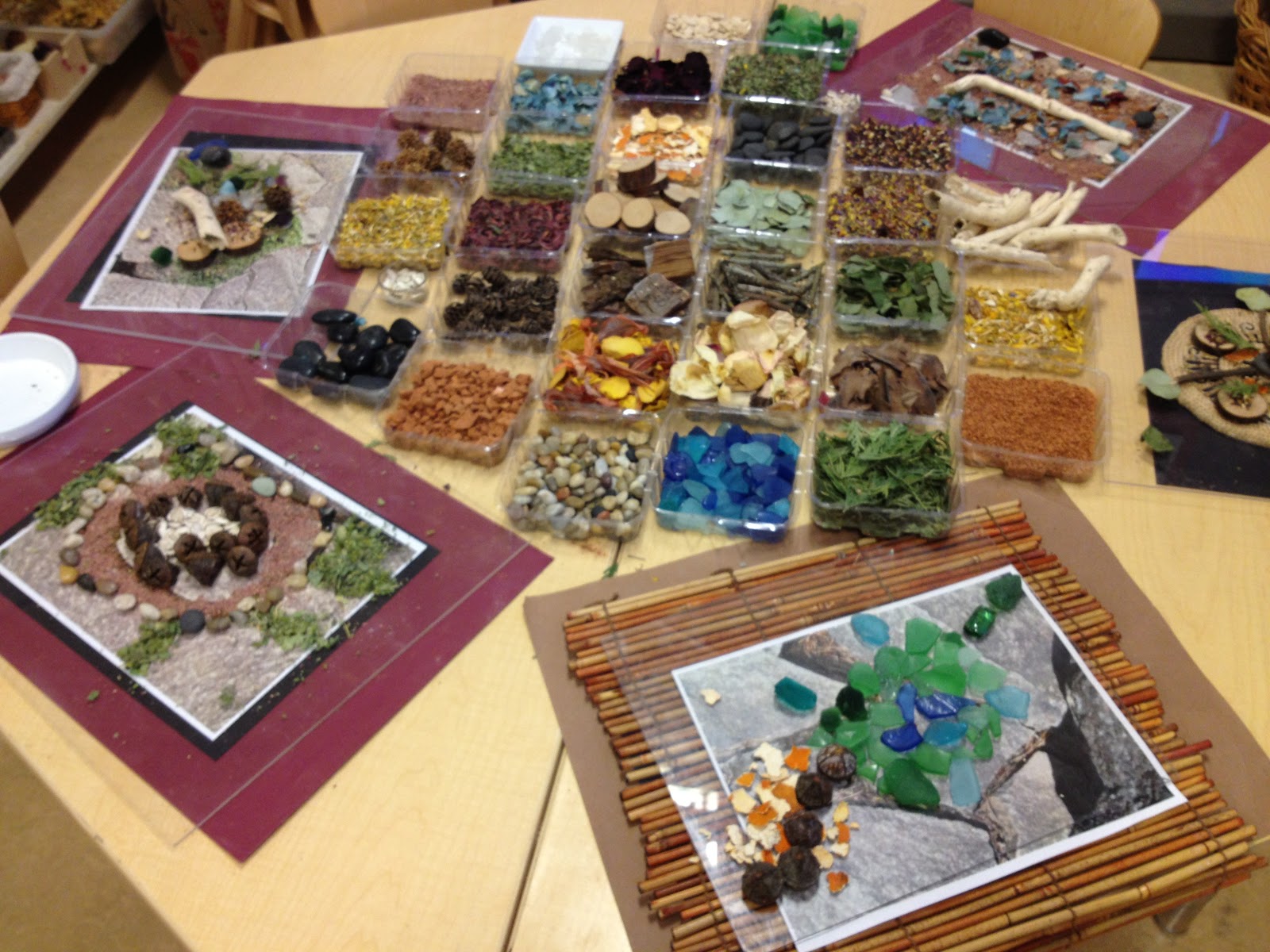
Managing materials is also part art. Along with quantity, variety, and smart storage, order and beauty are necessary to convey the materiality and possibilities of materials. Nowhere is this more apparent than in the material rich ateliers, or studio spaces of the Municipal Infant-Toddler Centers and Preschools in Reggio Emilia (IT). A tightly connected, coherent pedagogy rests solidly on a set of principles including the environment as the third teacher, creativity and aesthetics, and an appreciation of materials to engage children’s investigations of the sense and meaning of things and explore their own creativity. Attention to detail, arrangement of objects on shelves and tables, light from windows, mirrors that reflect children, small surprises, and displays of children’s thinking in their work contribute to the beauty of the spaces. Remida, the creative recycling center in Reggio, is a joint project of the Centers and Schools and Iren Emilia, a multi-utility working in neighboring provinces. When I visited in 2000, I shouldn’t have been surprised to find that Remida also had an artist-in-residence as one strategies for fostering new opportunities for communication and creativity with materials. Had we only imagined that at The Teachers’ Workshop!


Curating Materials
Enthusiasm for massive amounts of materials is not evenly distributed across a museum or even within a department. Last year I overheard two people from science museums talk about integrating loose parts into an exhibit on which their museums were collaborating. Their conversation went: “Loose parts are not going to happen at our museum; maintenance will see to that.” The other person replied, “They’ll just have to get over it at our museum; loose parts are what we need.”

Amping up material use or introducing loose parts requires building ownership, collegial consultation, developing systems, anticipating others' concerns, and good manners.

There was much buzz and enthusiasm from self-identified “material nerds” at the recent ASTC 2012 about managing materials for maker spaces, tinkering studios, and take-apart labs. Some suggestions were more obvious than others, but ingenuity and trial and error with materials, storage, presentation, and collegiality had clearly gone into clarifying relevant steps, managing stuff, and figuring out solutions in the material stream. Steps, like sorting, happen repeatedly: in gathering, as part of storing, preparing activities, and putting materials out though the focus shifts.  At every point, order, beauty, visibility, and findability guide decision making. In the  practices below that I found helpful, naming the steps is somewhat arbitrary.

Gather materials, re-used and upcycled, physical resources and digital media resources, from multiple sources. Post signs at work asking co-workers and repeat visitors to bring in materials. Place a bin for drop-off, specifying requirements such as clean recyclables. Work with pre-school teachers. Take things apart such as timepieces and toys. Check out on-line sources, find the local recycling center, and locate scrap exchanges in the area.

Store materials based on clear, shared criteria. Frequency of use is a basic one with two broad categories. Back-up storage holds large quantities of materials that are drawn down to replenish at-hand storage for easy access during activities. The next challenge is finding the right containers within these two categories to hold objects and make them visible. Smart solutions use a systems approach: containers fit within and next to containers efficiently and can be prepped ahead of time. For instance, hotel steamer trays hold materials on tables and carts, are easy for visitors to use at worktables, and can be filled in the morning for quick resets. Milk crates hold smaller containers like tennis ball tubes hold stacked portion cups–and are easy to carry.

Tracking materials, or monitoring the constantly fluctuating quantities of materials that a museum has/doesn’t have/needs/the available quantities is the trickiest part of the process. A binder can include things that are needed and ordered. A dry erase board, used at ¡Explora!, can show when an item is “out”, but it doesn’t show what’s available now. Development of a searchable database is underway at the Exploratorium.

Preparing or gathering materials for a project is often based on a list of materials required for the project that have been tried ahead of time. The material nerds recommend that projects are framed and prototyped so that the materials and tools are scoped, materials are collected, bagged, and organized to support and deepen the tinkerer's investigation. Estimating quantities and planning for easy at-hand storage happens here. Set-up involves putting out materials in ways that are visually inviting and recognizable, accessible, and suggest possible starting points. A partially set up project can suggest where one tinkerer went with the materials or encourage a newcomer to capitalize on it, repeat, or jump off in a new direction.   

Projects on display require plenty of forethought and preparation. Encouraging tinkerers to leave something behind that has value to them (and perhaps to the museum) can be difficult. Prompts may be required to suggest that visitors label their project and leave it behind with, “This is my gizmo.” Visitors might scan their creations and publish them on the museum website. Staff may also move around and photograph what’s happening and ask visitors to comment on photos, and display images and comments. Notably, questions persist about how to encourage tinkerers to document their own projects.

Return to the material stream. The recycle life cycle of yogurt containers, hanks of wire, paper, corks, and cardboard tubes is evolving. While initially extended by recycling for tinkering, it can be further extended by dismantling reused materials and sending them back to storage. Other materials will meet their end in the museum’s trash until someone finds better uses for them at the tinkerers' table. 


More for Tinkering and Making
The enthusiasm of these tinkerers reflects a love of materials, an appreciation for solutions that accomplish multiple objectives, an interest in persistent challenges, and a generosity–including these tips.
• Think through every step and what visitors need, how to keep a tinkerer focused on the project and not distracted by string rolling away.
• Both variety and abundance of materials are needed to get the right “dooda”to deliver the best solution in an activity.
• Look for inspiration in managing quantities of materials in settings that do it well: Ikea, container stores, Remida, Reggio studios, and hardware stores.
• To find out more about the data base that Lianna Kali at the Exploratorium is developing, contact her at: lkali@exploratorium.edu

 Also, check out Paul Orselli's recent blog, Good Bye Columbus, Hello Makers, on ExhibiTricks

Monday, February 21, 2011

Exploring Geometry Playground

Exploring the Gyroid


Geometry Playground is unusual in at least two respects. First, it focuses on math, a topic that is underrepresented in museum exhibits. Second, it’s a traveling exhibition committed to integrating a highly experiential approach. Produced by the Exploratorium and funded by the National Science Foundation, Geometry Playground was at the Science Museum of Minnesota in January 2011 when I saw it just before it traveled on. 

As an advisor on the project I was inclined to like it. I had been fascinated as I  watched exhibition ideas and components evolve over several years. Yet, I was impressed by how well project goals about geometry; social interaction; learning through immersion; and playground design came together coherently and strongly. In the playground spirit, Geometry Playground (GP) is physical, playful, and social. And it does it with geometry.

Stack of Stars
Mind and body work together all the time to provide us with information about the world. In GP, minds and bodies work together to explore familiar and novel geometric shapes at multiple scales. Children climb on, squeeze through, and peek into the tunnels of the 12-foot tall Gyroid structure. They clamber up and over and perch on the Stack of Stars climbing structure. This experiential, immersive exploration provides children with direct, first-hand experience of shapes, features, proportions, and scale. Moreover, it does so while maintaining in-tact physical and spatial relationships basic to understanding geometry. As a result, the super-sized Stack of Stars and Gyroid structure are not just a fun call to children and tweens to scramble and stretch across a novel structure. Spatial skills as well as social and motor skills are being exercised when a child shouts to others, “Come on! I know a short-cut to the top.”

Developing a whole-body appreciation of the stars (stellated rhombic dodecahedrons) comes from climbing on them and squeezing through openings between them. At the edge of the structure’s platform are also sets of smaller stars producing a side-by-side comparison of scale and new perspective on both units. As hand-held manipulables, the stars can be lifted, rotated, and fit together in Space Filling Blocks giving a concrete sense of how the star’s features fit together. Alternative ways to explore space-filling shapes extend beyond scale. Diagrams show how these not-so-familiar stars are formed from another shape by manipulating features. Nearby, turning the wheel at the Stellator shows a dodecahedron transform into a stellated dodecahedron. In addition, along the climber’s platform, photos of everyday space-filling shapes place them and geometry in the context of daily life.

In keeping with an experiential approach to geometry, exhibit messages are integrated into surfaces and structures and are encountered by moving in and through space. Text on the floor in front of the giant Distorted Mirror reassembles miraculously into instructions. Text on the face of the Projected Puzzle becomes readable when the puzzle pieces align. Challenges for exploring the Gyroid follow the smooth curving surfaces of the tunnels precisely where children will–and must–look as  they reach and climb. 


Playful Exploration
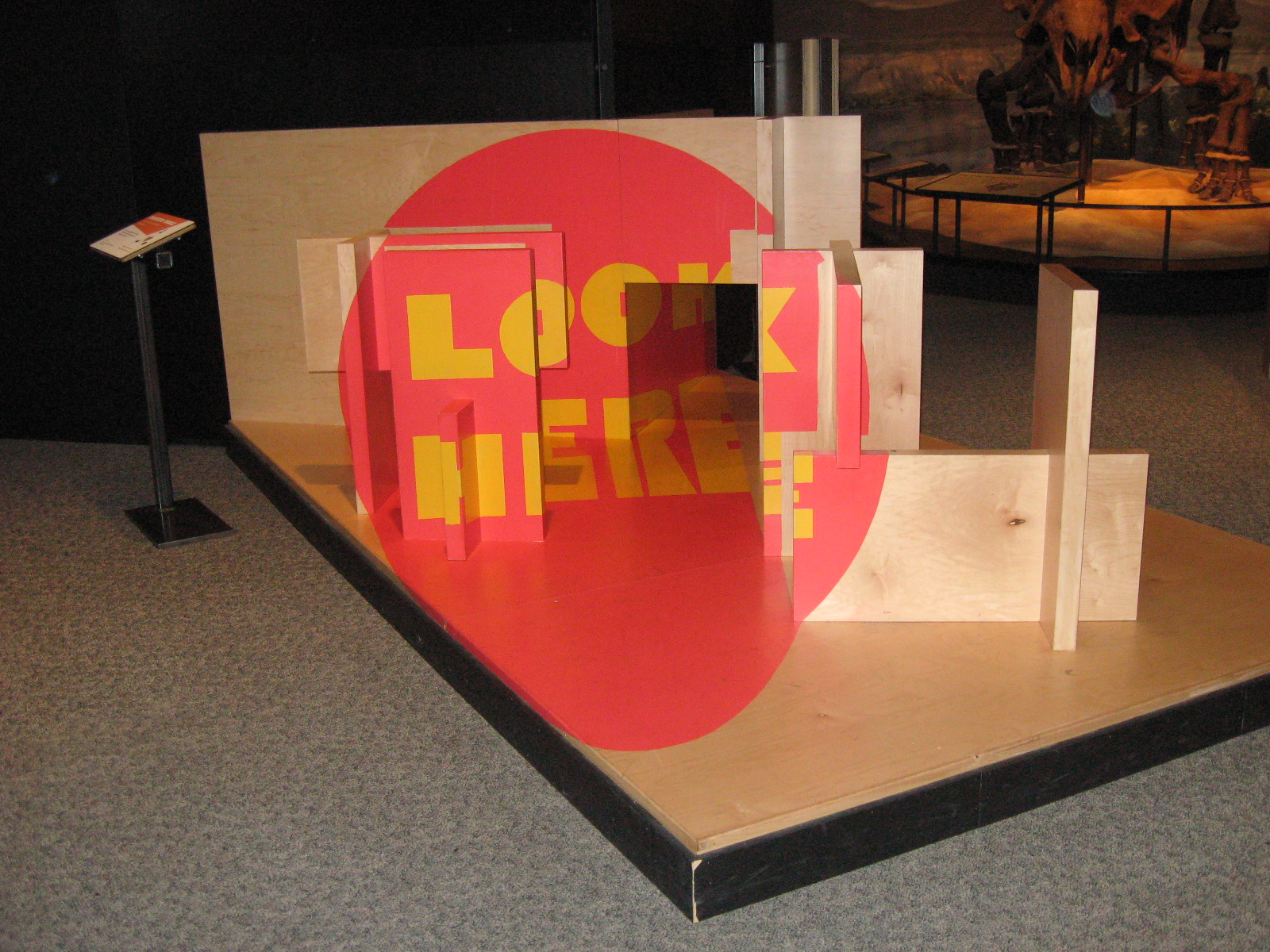
Projected Puzzle proclaims, "Look Here."
A playful, minds-on exploration of shape, perspective, distance, and distortion complements the lively navigation of the innovative climbing structures. Lining up with the pieces of the Projected Puzzle prompts several tilts of the head to read, “Look Here” and finally gets a smile. The distorted mirror changes our relationships with familiar objects and makes them look surprising or funny. Variations on the geometry of looking into a distorted mirror produce perplexing results.  A conical mirror flips images inside out. A foot-tall cylindrical mirror transforms a radial pattern into a grid so drawing letters on the grid produces scrunched and scrawly letters to (stifle a) laugh at. Then there is the tall cylindrical mirror that wondrously squishes an elongated chair and the people on it to normal proportions. 

Distorted Chair reassembled in the mirror
 
Geometry as Social Space
Living large ...inside a globe
Several classes of students 11 or 12 years old seemed to enjoy themselves and each other as they scampered up, across and over the Stack of Stars; they talked, called out, and chatted with one another. Tweens perched on the Gyroid and wormed through its tunnels. In both cases, the structures were social space, a kind of space often absent from their settings. The novelty of this structure made hanging out on a playground cool or, perhaps, irrelevant. Here they moved, they talked, and they teased on a pile of geometry. At the hexagonal Distorted Drawing table members of a class shared tips and laughed at slip-ups. Classmates squeezed into and chatted inside a familiar object–a globe–experienced in a not-so familiar way, at a giant scale and from the inside. 

"You just find these four corners."
Workstations with seating located along the railing of the Stack of Stars platform invited exchanges among visitors, including me. Eleven year-old Mohamed paused to fit a space-filling block in a tray. Not immediately successful, he seemed ready to take off. Pointing to the block he held in his hand, I asked him about the four pyramids on one side. Just enough of a clue, it turns out. He fit the block into the tray with only a try or two. Fitting in the next few blocks went faster. I heard Mohamed say to himself, “It gets easier and easier.” When Abdullah, a classmate, stopped by, Mohamed gave him a tip: “You just find these four corners and the block fits. Like this.” The two boys worked together fitting in several more blocks so there was no wasted space. When Mohamed’s teacher passed by she asked, “Mohamed, would that be a tessellation?” Mohamed paused and answered, “It’s a tessellation. Yes! There are no gaps. Yes! I filled it up!”


… and Beautiful
Geometry Garden
Those not called to explore the exhibition’s geometry with exuberant physicality, might be attracted by its beauty. One area, Geometry Garden, is a cabinet of geometric curiosities–everyday objects, natural, sculptural, topological models, spirals. They call attention to geometry’s presence everywhere, in many forms, and often beautiful. The cases create almost a room-like space with a quiet, contained feel for lingering and appreciating the thoughtfully selected, artfully displayed and wonderfully lit objects.  Highlighting the beauty of the geometry comes through in many, smaller, more subtle ways in all parts of the exhibition as well. The space-filling blocks literally glow as they rest in back-lit trays. The lighting also illuminates the blocks’ faces, accentuating the surfaces and features.  The imposing scale of the Gyroid and Stack of Stars and selection of materials make them more like sculptures. The smooth, polished surfaces of the wooden Rotating Squares (ovals and triangles) work as striking sculptural pieces as well as artful seating, and an irresistible crawl-though tunnels.


Geometry Playground lives up to its name as a playground for geometry. 

 During my visit, toddlers through tweens in school groups and family groups filled Geometry Playground. Children were all over and inside the climbing structures. Class and family groups clustered together to build a Sculpture That Moves, design at the Tile Designer, Geometron, and draw at Distorted Drawing. Pairs of students and adults worked at the stellated rhombic dodecahedrons. Small groups of adults as well as students and teachers strolled among the lighted cases of Geometry Garden.

The lay-out at SMM seems to suggest that finding enough space for a floor-plan that builds on geometry is a real challenge. At 5,500 square feet with 12-foot tall structures, Geometry Playground is a big exhibition. It requires both significant volume as well as a huge area; it won’t fit into just any space. The solution at SMM was to locate parts of the exhibition on two separate floors. The exhibition’s flow was interrupted and many visitors likely spent time on only one floor.

The exhibition is the major part of a bigger project that included two visitor research studies, the addition of some geometry structures on playground in San Francisco. The exhibition will travel to The Ruben H. Fleet Science Center (San Diego, CA) for summer 2011 to summer 2012.

For more information visit Geometry Playground