Showing posts with label Family Learning. Show all posts

Friday, February 7, 2014

Children in Museums


There are children’s museums and then there are museums children visit with parents, grandparents, and school groups. From a museum perspective–children’s museums on the one hand and traditional museums children visit on the other–having children as visitors can have quite different meaning. For children, however, the experience between one type of museum and another might be less than museum people generally assume.  

Memories of Museums from Childhood
Before there were children’s museums in most cities, children went to museums, liked museums, and remembered them. In my experience, they still do; and there are good reasons for it. 
The Wood Gatherer
My friend Mary grew up in Milwaukee and remembers vividly going to the Milwaukee Art Museum with her friends Jimmy and Linda, on their own, without adults. Frequently, even weekly in the summer, they would walk down Astor Street and cross Juneau Park and get into the Art Museum for free. They would always visit their favorite paintings. Mary’s was The Wood Gatherer by Jules Bastien LePage. Then they’d each get an ice cream sandwich at the canteen for 10 cents. Fifty years later, Mary was at the Musee d’Orsay in Paris and came face-to-face with her favorite painting, on loan from the Milwaukee Art Museum. It stopped her in her tracks, brought back a flood of childhood and neighborhood memories, and made her trip. 

Sweden’s Nobel prize-winning poet Tomas Tranströmer, writes in Memories Look at Me, A Memoir about going to museums as a child in Stockholm. He starts off, “As a child, I was attracted to museums. First the Natural History Museum. What a building! Gigantic, Babylonian, inexhaustible.” (Translated from Swedish by Robin Fulton) Tranströmer was first taken to the museum when he was about 5 years old. At the entrance were 2 elephant skeletons, “…guardians of the gateway to the miraculous.” Inspired by what he saw, Tranströmer visited every second Sunday, started his own collections, and one day, met a professor, “…one of the guardian angels who appeared now and then in my childhood and touched me with its wings.”

While children visit children’s museums now, they also visit “big museums.” I was at a café in St Paul last year and overheard a mother and her 3 boys ranging from 3-8 years talking about going to the museum. Since we were several blocks from Minnesota Children’s Museum, I asked if they were headed there. The middle child said they were going to the Minneapolis Institute of Arts to see the Terracotta Warriors. His brother added with emphasis that it was their third visit. A friend says his sister takes her 4 grand children to the local art museum. Each of the children has a favorite painting and insists on visiting it on every visit. Ranging from 5-10 years, they have lively discussions about the merits of their paintings.

In late 2013, 12- year old Jake caught the attention of many museum professionals as he posted, “21 ways how I would create an amazing museum” on his blog, Jake’s Bones. His list about making museums awesome for everyone, especially for children, not only demonstrates extensive museum going, but also reveals an engaged and incisive observer and thinker about the museum experience. His astute, visitor-centered ideas take children, their interests, and capabilities seriously with recommendations such as, “Don’t hide the experts,” “Link exhibits to things in the real world,” and  “Have information for all levels of knowledge.”

Recently I watched as 2 sisters and their parents explore the extensive Degas collection at the Norton Simon
In second position before Degas
Museum
in Pasadena. Moving through several galleries, the girls took turns, pausing at every painting or statue. Each one spent time looking the dancer and then carefully assumed the same ballet pose as her sister and parents looked on. The girls moved to the next painting. 

These are only my examples and no doubt many others could add theirs. Some may stand out as exceptions; clearly a 12-year old blogger with a book contract is unusual. Even as a small sample, however, they show children as enthusiastic museum goers, engaged with art, collections, and people in museums. Their visits are sources of durable experiences with life-long significance. This challenges several notions about children in museums: museums can’t reach children; children aren’t ready for “real” museums until they are older; and children only like some museums–natural history and not art.

Children Ready for Museums
Children are constantly making connections between what they see and hear and the experiences they have accumulated in even the first few years of life. Evidence of children’s interest in museums and varied expressions of their interest is apparent in the examples above. In museums children interact with people; they ask information-seeking questions about novel objects and their functions; they borrow language from others; they make meaning they carry forward to new experiences. With rich environments, great volumes of space, interesting finishes and surfaces, and real objects at actual size (very big, very small and in between), museums invite children to notice, explore, ask questions, think, and follow their interests.

Museums are simply great places for children to learn how to learn and enjoy learning. Programs, anecdotes, and studies illustrate how children–from babies to school-aged children, in museums of every type–are open to and benefit from museum experiences.

Young children’s capacity to enjoy and learn from museums is foundational for the Smithsonian Early Enrichment Center (SEEC). For 24 years, SEEC has offered museum-based learning in an early childhood program for children 2 months to 6 years at three sites in Washington, DC. While it draws on The Smithsonian’s extensive collections, SEEC’s object-based approach also builds on children’s curiosity, eagerness to make connections, and willingness to go beyond what they see. Children explore objects and exhibits in art, history, and science museums. They interact with curators, scientists, artists, and cultural historians, along with museum educators to learn about the world, get ideas, and build a positive perspective of museums.

Museum fellow, Susan Erdman, writes about taking her toddler to museums now.  She recognizes the value of her son seeing real things and making meaningful connections between objects–vehicles and animals–that he has seen in books and sees at the museum or zoo. Size, color, sound, and smells contribute information and deepen his understanding about what he’s noticing, what’s going on, how things work, and what people are talking about. She knows his brain is already absorbing concepts and museums help build those concepts. The Toledo Museum of Art offers docent-lead monthly baby tours. Based on research by Dr. Kathy Danko-McGee, the Museum’s director of education, the tours for 2-to-18 month-olds focus on interesting shapes, lines and colors. Caregivers are encouraged to name and describe different characteristics in a work of art supporting connections about shape, colors, symbols, and language.

Large objects, with strong, accessible, contextual links
In one of the few studies to look at children in museums, Piscitelli and Anderson explored children’s perspectives and past experiences of museums. The study of 77 children 4-6 years old in Brisbane (AU) indicates that children have extensive experience and positive perspectives about museum settings they visited. They regard museums as places full of exciting opportunities to learn and get new ideas. Exhibits with large objects and strong, accessible, contextual links to previous experiences and knowledge stand out in children’s recollections. Their visual recall and verbal descriptions of exhibits and architectural features are remarkably accurate. 

Children bring to museums a disposition to notice, get ideas, and make connections between what they see and hear and their experiences and interests.

Museums Ready for Children
While children seem ready for museums, museums–other than children’s museums–do not necessarily seem to be ready for children. It’s not that art, history, natural history, or science museums don’t admit children. Many, if not most, do­­. Rather, many museums don’t really value children as children and museum goers. Consequently, they aren’t prepared to serve them in ways they serve adults, experts, tourists, etc.

A typical explanation for a museum deciding to serve children relates to audience development: reach more young families and grow membership. Confusing a museum's need to grow with what an audience group needs is unfortunate. Serving children means serving them well: valuing them, recognizing the significance of early experiences, and welcoming young children as additions to public spaces. Rather than adding an admission category and hosting toddler Tuesdays, a museum must be prepared to welcome children and delight them.

MOHAI (Seattle)
Museums intending to serve children well have staff interested in and prepared to interact with and engage children. From security, to guest services, to educators, developers and designers, and housekeepers, staff should be as pleased to see children, as children are to see them. Serving children well means granting them the greatest reasonable access to galleries, rooms, and exhibits while considering the needs of the objects and building, something that can require creative thinking. One historic house on a very large property didn’t allow children under 10, until it recognized that the gardens and out buildings were great places for children to explore.

Museums committed to serving children well adopt a set of practices suited to children in every museum, regardless of type: multi-sensory, hands-on learning strategies; facilitated and mediated experiences; and child-centered environments. (In fact, the UK has a manifesto for kid-friendly museums.) Supporting these practices is a child-centered pedagogy that recognizes children as competent and full of potential, as active agents in their own learning.

While museum professionals and researchers may be convinced that young children's benefit from visiting museums include learning, they actually know very little about these experiences and museums’ impact on children and their learning. Mary Ellen Munley’s 2012 literature review of research conducted in museum settings focusing on young children’s learning concludes that this research is lacking. Prepared for the Smithsonian Institution’s Early Learning Collaborative Network and SEEC, Munley’s review notes that museums do provide distinct and positive environments to foster young children’s learning; and young children are interested in artifacts and exhibitions in traditional museums where they learn disciplinary-specific information (history or biology) before being exposed to those disciplines in school settings.
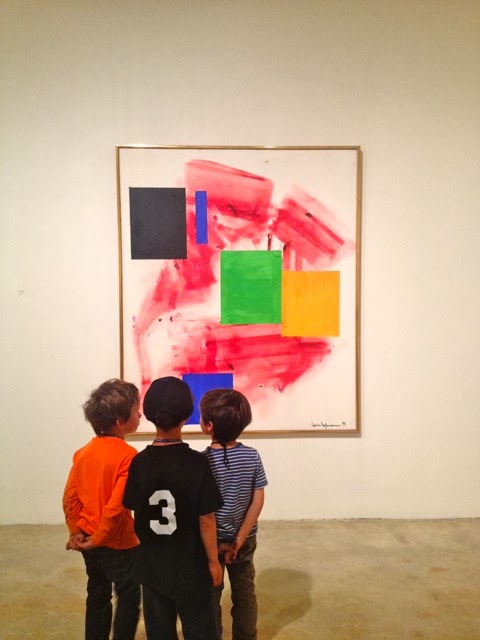
Ezra and friends at the Berkeley Art Museum
For museums interested in serving children well, the limited research on children in museums, and children’s learning in museums in particular, is challenging. It is not, however, surprising. The increase in serving children in programs and initiatives in traditional museums, also highlighted in Munley’s review, is relatively recent. Equally significant, however, is how young children’s learning is viewed. Children’s learning often looks different from older children’s and adults’ learning and may miss being studied. 

Children as receptive viewers of contemporary art may not look like adults being viewers of contemporary art. Children intrigued by dinosaurs may role-play in front of the Triceratops while adults are unlikely to do so. Ideas for stories, investigating, or building come from what children see in a painting, a sculpture, a diorama, skeleton, or people in the museum. As long as learning is viewed as content, concepts, and data calibrated to the school curriculum, what children actually are learning in museums will be overlooked. In Stay Behind the Yellow Line in Curator (56/4), Clarkin-Phillips, Carr, Thomas, Waitai, and Lowe describe a study of 3 and 4-year olds’ constructing knowledge about being a museum visitor and exhibitor. The children’s activities demonstrated their ability to develop an appreciation of art and an understanding of the purposes of museums and art galleries.

Children– Knowing– Museums – Knowing – Children
There are children’s museums and then there are traditional museums that children visit . A good number of museums are somewhere in between. These are museums with a family learning focus, museums that understand that a mission of supporting life-long learning begins with babies, and museums that more-or-less ignore the distinction completely. In this group might be the:
Increasingly more museums of all types welcome children to their galleries, exhibits, programs, and events. We know, or at least believe and hope to show, that a full range of museum experiences for children are valuable: children visit museums in their communities and as they travel; they actively pursue interests; they become museum goers and engage in learning at every stage of life. Museums make children want to explore and to learn. Hopefully children are making museums want to learn about them as well.

Related Museum Notes Posts

Wednesday, October 24, 2012

Updating Learning Frameworks

 
Completing a learning framework is a heady, almost triumphant, feeling of accomplishment and relief. At this point, a museum has explored the convergence of its strategic and learning interests, consolidated its most important ideas about learning, and clarified its potential to create learning value for its visitors and community. A museum team has brought together, organized, and made explicit a set of powerful, attractive, and tacitly-held ideas and assumptions about children and adults learning in informal settings, and specifically in their setting.

A framework externalizes and makes plain what a museum values. Exchanges among thinkers, learners, and practitioners create shared meaning around significant ideas to put everyone on the same page. Through lively discussion and diligence, the team resolves areas of persistent ambiguity or tension. For instance, is the museum’s focus the history of science or science and history? This considerable work shapes a tool that supports planning and evaluation efforts across all of a museum’s learning services: exhibits, programs, collections, film and multi-media, research, a school or nature center, and its on-site, off-site, and web presence.

Yet, as much as finishing a learning framework (or an educational or interpretive framework which all consolidate and organize learning interests and approaches) feels like an ending, it is truly a beginning. Applying the framework to do good and useful work that advances a museum as a recognized and valued community resource is the true purpose and what justifies the hard work of developing it.


Updating a Learning Framework is Inevitable
In 3, 5, or 8 years, a framework should be more useful in some ways and less useful in others than when it was freshly minted. Museum accomplishments, economic challenges, audience composition, emergent community trends, changes in staff, and new research all spotlight shifting information and perspectives relevant to the framework and its tasks. They point to new questions, practices, and opportunities and to inevitable changes to the framework.

Museums exist in environments that are dynamic both externally and internally. Shifts in a region’s population, community priorities, and funder focus bring new perspectives to a museum’s learning interests. Recent findings in neuroscience and executive brain function, landmark studies in youth development, applications of new technologies, and changes in the discourse across the museum field prompt changes to the framework to maintain its relevance. Organizational priorities realign perhaps to serve new audience groups, build on better information about their interests and expectations, and target ways to engage them more deliberately. 

No less important are the changes that come from regular, and hopefully vigorous, use of the framework itself. Application of the framework by multiple users doing the museum’s everyday work over time tests, changes, and ultimately grows its capacity to be tough enough for day-to-day realities. As staff read, discuss, refer to, and apply the framework, they give it meaning, find new meaning, and discover where to hone meaning. A great insight or connection while developing a framework initially serves as a shared touchstone; it then generates new insights and subsequently points to the value of finer distinctions which were not initially apparent. Staff might agree that learning rather than educating better characterizes people as active agents in constructing knowledge rather than as passive recipients receiving information. With time and use, this distinction may lead staff to new insights about learners and to other ways of shaping experiences and considering impacts.
  
Framework limitations as well as strengths are revealed through use by varied groups, across a range of contexts–exhibits, programs, collections, audience initiatives–and from pre-planning through evaluation. Experience criteria that work for programs may not work equally well for exhibits. Framing criteria to work for both, however, can yoke these two complementary and valued experience modes together rather than separate and silo them. Situating outcomes to work for public programs as well as school programs and for both programs and exhibits may take repeated efforts. It’s worth it. Getting to a shared set of outcomes increases the possibility of the museum having greater impact. Registering both the alignment and the disparities across functional areas are important; both provide useful clues for future updates.


Revise, Add, Delete
Like a building’s framework that may be modernized or expanded at some future time, a learning framework can be updated with revisions, additions, and deletions. With time and active use, all three are likely to occur, through informal and formal updates, by individuals or a team.

Revisions, or minor changes to an existing framework, are common and helpful. They capture and incorporate results of regular use of the framework to keep it current and precise. Definitions matter because differing terms undermine efforts. Moreover, the meaning of words changes with use; new words and terms surface. During complex projects, grant and report writing, and decision-making, the benefit of distinguishing between terms like thinking and learning or defining roles of parents and caregivers become apparent and perhaps a regular practice. A glossary of terms (an “initiative is…”, “learning at our museum is understood as…”) makes the most of these accomplishments.

Updates assure that the most current and relevant information is assembled in a single guiding document. The names of current programs and initiatives, results of the museum’s projects and studies, references to curriculum standards, white papers in the appendix, and articles in the references are in one place.

No two frameworks have the same parts, but four components are basic and have worked with many museums: community context, learners, learning focus, and museum and learning experience. Sometimes an addition or two to one of more of these parts is a better solution than smaller revisions.
A museum might bring a deeper, more systematic approach to identifying and distinguishing among stakeholders in the community context as part of understanding a city’s or region’s priorities related to learning.
• Additions might strengthen the framework’s focus on the learner and play out the implications of a learner-centered framework by: adding information about learner groups and identifying more targeted strategies for engaging specific audience groups–such as families, youth, experts, or teachers.
• In the framework’s learning focus that describes the learning territory a museum is interested in occupying, add conceptual frameworks for situating a museum’s learning interests. Other additions might include clarifying the museum’s valued and complementary learning assets.

Ultimately, a learning framework can’t anticipate every eventuality. It should, however, be flexible and adaptable enough to respond to small tweaks and large modifications that arise from the learning life of a dynamic institution. Along with absorbing changes within components, a framework can have portals to new components. Like the other components, new components are aligned with the framework’s foundational ideas and build on its focus. Every component does so in ways that stretch with and support a museum’s growing interests and the field’s changing practices.

A portal to a new component links firmly with and is anticipated in the museum’s mission or learning purpose such as being a multi-dimensional learning resource, or a center for creativity. As a museum conducts exhibit and program evaluations, fields visitor research, follows research in specific areas, and responds to a results-oriented approach to funding, research and evaluation may justify being a separate framework component. Some reshuffling is involved in creating a research and evaluation agenda. Bringing together relevant conceptual frameworks and outcomes and developing a logic model shape a focus on what success looks like and how visitors will benefit from various museum and learning experiences, as Marianna Adams suggests in “Where do We Need to Go Next?” in a recent issue of the Journal of Museum Education.

Eventually some parts of a learning framework need to be deleted whether due to the life cycle of projects, new priorities, or a clearer vision of the museum's learning value. 


Evolving Frameworks
A strong vital framework is not only aligned with museum priorities and informed by evidence, it also reflects current practice and keeps pace with staff growth and reorganization. Often master planning, a major expansion, or a move is an opportunity to tune up a learning framework. Examples from three museums illustrate typical circumstances and the nature of framework updates.
The Bakken Museum, a one-of-a-kind science museum in Minneapolis, has a humanistic focus that integrates science, history, and the arts. In 2009, parallel planning processes involved both strategic planning and development of a learning framework that subsequently guided development of an exhibit master plan. The learning framework clarified the museum’s learning focus and involved unpacking and hammering hard on the meaning of key phrases like, for social good and people of science. Eventually, the learning focus expressed the richness of the museum’s learning interests as four layers: content, perspective, process, and approach. The framework served as a tool 3 years later when the Bakken developed a proposal to a major agency to produce one of the exhibits in its master plan. The evaluation plan for the grant grew from a logic model that used the framework and the audience groups and outcome areas identified. That process also revealed how much the museum had continued to update, refine and make its learning focus richer and more precise.

• In response to its first decade of growth, Stepping Stones Museum for Children in Norwalk, CT began preparing for a significant capital expansion in 2009. To guide planning of new galleries and programs and strengthen the connection between learning intentions and impact, the museum chose to update and further develop its 2003 learning framework. Over 5 years, the framework had enjoyed regular use with occasional additions such as background information on learning theory. Five years also offered significant practical experience with the framework to yield lessons and point to areas for development. In updating the framework, the museum shaped a more learner-centered tool informed by research and theory. A set of four learning principles grounded the framework in current research and theory. The audience profile became a learner profile that framed a view of the learner and identified learner groups with related experience goals and supporting adult roles. The original learning approach shifted from being primarily content focused to a package of learning strategies, an interdisciplinary approach, and a set of discovery tools. Finally, learner outcomes and related indicators were identified to help channel the museum’s work towards specific impacts.

• For 12 years, the Creative Discovery Museum (CDM) in Chattanooga, TN has been guided by a learning framework developed in 2000 as part of its first exhibit master planning process just 5 years after opening. The museum has been engaged over the last two years in a round of organizational planning. Updating its learning framework is integrated into that extended process. CDM fielded a strategic plan in 2011 and conducted a facilities master plan in 2012. In preparation for the exhibit master plan scheduled for early 2013, CDM is reviewing and updating its 2000 learning framework. A museum team of core and specialist staff is reviewing the framework to identify how framework components have been used; how they have been helpful; which parts should be carried forward; and what changes to the framework will make it more relevant and robust. Some modifications to the framework will be accomplished by the framework team such as developing essential experiences and articulation of a museum experience. A museum-wide workshop will revisit the learning focus and explore a new area like impacts and indicators.

A growing number of museums seem to be developing and updating learning frameworks and museum-wide interpretive plans. An extensive and well-documented process is that of the Dallas Museum of Art's Framework for Engaging With Art. Please share examples at your museum or others that you know of.

Monday, July 16, 2012

Learning + Literacy


Several years ago, as part of developing the master plan for the Minneapolis Central Library’s Children’s Library, I researched and summarized connections between learning and literacy. I wasn’t surprised to find connections, but seeing how closely learning and literacy map onto one another was striking.

While I developed this for a library, the close connections between museums and libraries and the relationship between learning and literacy also brought the public value of museums into sharper focus. The same life-long, active, social, meaning-making process that characterizes both learning and literacy is very much at the foundation of what museums do that matters. Engaging with objects, art, artifacts, in family, school, and community groups are the active ingredients of learning and literacy. These activities and experiences are fundamental to the 21st century learning of museum-goers as well as to the long-term priorities of communities. Every day in museums, millions of people look, point, talk, remember, imagine, and question; they listen, observe, notice, wonder, compare, investigate, reflect, build, and create. In these countless moments are the opportunities for museums to build and strengthen the life-long arc of learning for a five-year old in Cranston, a 12-year old in Norwalk, a family in Bozeman, grandparents in Madison, and couple in Los Angeles.

The interactions between literacy and learning in museums are more than just interesting. They point to where we need to pay close attention, understand and follow the connection, and deliberately shape experiences that invite, encourage, support, extend, and document moments of learning and the span of  learning across a lifetime.

Learning
Literacy
The early years last a lifetime. From birth to five, children rapidly develop foundational capabilities on which later development builds.i. Research on early brain development indicates that organic changes in the brain and environmental effects work together.ii The neural system is activity-dependent, affected by smell, touch, movement, social interaction, talking, singing, cooing, and reading. The adults providing nurturance and support, security, predictability and encouragement are essential for infant learning.iii
Early experiences with language lay the foundation for later literacy iv. Children take their first critical steps towards reading and writing very early in life.v From birth, babies are learning: developing knowledge about spoken language from the sounds they hear, hearing their names repeatedly and listening to simple songs. The sounds and touch that go with speaking and reading to infants and toddlers expand neural connections that are used in reading and writing years later.


Learning begins at home. Long before children arrive at school, the foundation for learning and reading is established. In asking and answering questions, taking children to libraries and museums, spending time on homework, parents convey the value of learning. Dispositions, the tendency to exhibit frequently and voluntarily a pattern of behavior, are more likely to be acquired through modeling by the people around children than by didactic processes.vi
Parents play a key role in raising readers. From early interactions with their parents, children hear sounds, use words, identify letters, and process letter-sound relations–all before entering school. The young child who hears and enjoys many stories is also beginning to read, from learning how to hold a book, to knowing where to begin to read the text, to developing early concepts about print, to understanding narratives.vii


Learning is an active process. Learning is not the passive acceptance of knowledge that is out there but involves the learner in engaging with the world. Learners use sensory input to construct meaning.viii
Literacy skills develop through active exploration in settings rich with images, words, objects, views, and people to talk with.ix  Wider access to books, and objects, exploring spaces that are engaging, varied and sensory rich, and using authentic props and materials that extend engagement encourage children’s language.x


We learn to learn as we learn. Learning is both building meaning and building systems of meaning. For instance, learning a chronology of dates of historical events also teaches the meaning of a chronology.xi
The more we hear and read, the more we know. Hearing more language and richer language, enhances children’s language development xii. Talking to and reading to children increase their language development xiii  that in turn encourages reading and talking.


Constructing meaning is mental. Making meaning happens in the mind. Hands-on learning and other physical activities may be necessary for learning, especially for children. But learning must engage the mind as well as the hands.xiv
Language is essential for making meaning.
Language gives order to thought. Many types of talk help the child to make connections between the meanings and language forms of text and his actual experiences, including the use of language in other familiar contexts.xv


Learning involves language. Language and learning are inextricably enmeshed; language does not just express thoughts but actually helps form thoughts. Learning is mediated by language, socio-cultural context, artifacts, and people.xvi
Talking, reading, and writing build literacy skills and broader understandings. Being read to introduces young children to the parts of a book, to new people and places, ideas, and possibilities. Reading and playing engage children with spoken and written language in a constant back and forth between thought and word.xvii


Learning is a social activity. Learning does not occur in a vacuum but in a social realm in which ideas are shared and shaped through expression and discussion.xviii From the very start, children’s social relationships affect their learning.
Positive social interactions related to reading create a disposition to read. Language, the foundation of reading, is by nature a social activity.xix Parents talking to their infants; a young child being read to in a parent’s lap; a new reader reading aloud to a grandparent; and readers of all ages talking about stories and characters develop and strengthen the habit of reading.


Learning takes time. Over time, meaning is built up layer upon layer, bringing greater depth to understanding.xx  Revisiting an idea; pondering it, playing it out and connecting it with other ideas; testing, reflecting and putting ideas to use take time.
Early, regular, and on-going exposure to language and books builds literacy. Even with very young children, reading a story takes time: time to read, talk about the story, letting the child hold the book.xxi


Motivation is essential to learning. Learning is associated with movement toward an optimal level of neural stimulation.xxii Rewarding activity, a balance between challenge and success and an understanding how knowledge can be used help encourage the effort required to learn.
Personal interests motivate people to find out what they want or need to know.xxiii Interests in hobbies, sports, vehicles, crafts, arts, music, or travel are starting points for reading, finding books, asking questions, and looking up references.xxiv An otherwise reluctant reader may be motivated to read to learn about flight, look up amazing facts, or read about a sports champion.
 
 Now What?
After you have looked over these learning and literacy connections, consider what you might do as you: develop an exhibit, write the annual report, greet a visitor, talk to your board, set materials out for an activity, sell a membership, hire staff, write a proposal, speak at a school board meeting, orient new staff, cultivate an organization to partner with, write job descriptions, introduce an activity in a program, evaluate staff performance, write label copy, develop the budget, update the museum’s FaceBook page, plan a donor event, answer a parent’s question, develop project goals, revise membership benefits, orient interns and volunteers, work with faculty at a college or university, evaluate an initiative, talk to the Chamber of Commerce, convene advisors, or visit your state representative or town councilor. 

______________________________
i Shonkoff, J. P., & Phillips, D. (Eds.). (2000). From neurons to neighborhoods: The science of early child development. Washington, DC: National Academy Press.
ii Shonkoff, J. P., & Phillips, D. (Eds.). (2000). From neurons to neighborhoods: The science of early child development. Washington, DC: National Academy Press.
iii Vygtosky, L.N. (1962) Thought and Language. MIT Press: Cambridge, MA. (As cited in Hein, George. (1992). Proceedings from ICOM/CECA Annual Conference, 1991. ICOM.)
iv Neuman, Susan B. and Donna Celano, (2010). Every Child Ready to Read. Public Library Association., American Library Association: Chicago, IL.
v Zero To Three: Early Literacy. (2003). www.zerotothree.org/child-development/early-language-literacy/earlyliteracy2pagehandout.pdf.
vi Katz, Lillian G. Dispositions as Educational Goals. ERIC Digest. 1993.
vii International Reading Association and The National Association for the Education of Young Children. (1998). Learning to Read and Write: Developmentally Appropriate Practices for Young Children. Young Children. Young Children. Washington DC.
viii Hein, George. (1992). Proceedings from ICOM/CECA Annual Conference, 1991. ICOM.
ix Roskos, Kathleen and James Christie. (2001). “On Not Pushing Too Hard: A Few Cautionary Remarks About Linking Literacy and Play.” Young Children: 56:64-66.
x Roskos, K., & Neuman, S. B. (2001). Environment and its influences for early literacy teaching and learning. In S. B. Neuman & D. Dickinson (Eds.), Handbook of early literacy research (Vol. Volume I, pp. 281-294). New York: Guilford.
xi Hein, George. (1992). Proceedings from ICOM/CECA Annual Conference, 1991. ICOM.
xii Hart, B., & Risley, T. (1995). Meaningful differences. Baltimore, MD: Brookes.
xiii Huck, Charolotte S, Susan Hepler, and Janet Hickman. (1989). Children’s Literature in the Elementary School. Harcourt Brace Jovanovich College Publishers. New York.
xiv Hein, George. (1992). Proceedings from ICOM/CECA Annual Conference, 1991. ICOM.
xv Wells, Gordon. (2003) Children Talk Their Way Into Literacy. In J.R. García (Ed.) Enseñar a escribir sin prisas…pero con sentido. Sevilla, Spain: Publicaciones M.C.E.P.
xvi Lee, C. D. and P. Smagorinsky (Eds.), (2000). Vygostkian Perspectives on Literacy Research. New York: Cambridge University Press.
xvii Forman, George E. (1992). Research on Early Science Education. In Seefeldt, Carol (Ed.) The Early Childhood Education Curriculum. Teachers College Press. New York.
xviii Lally, J. Ronald. (1998). Brain Research, Infant Learning and Child Care Curriculum. Child Care Information Exchange. 5/98. Redmond WA.
xix Zero To Three: Early Literacy. (2003). www.zerotothree.org/child-development/early-language-literacy/earlyliteracy2pagehandout.pdf.
xx Hein, George. (1992). Proceedings from ICOM/CECA Annual Conference, 1991. ICOM.
xxi Huck, Charolotte S, Susan Hepler, and Janet Hickman. (1989). Children’s Literature in the Elementary School. Harcourt Brace Jovanovich College Publishers. New York.
xxii Huck, Charolotte S, Susan Hepler, and Janet Hickman. (1989). Children’s Literature in the Elementary School. Harcourt Brace Jovanovich College Publishers. New York.
xxiii Falk, John H. and Lynn D. Dierking. (2002). Lessons Without Limits. Altamira Press: Walnut Creek, CA.

Monday, September 26, 2011

Strengthening Parent Engagement


Over the summer I’ve been working on several museum projects that are framed around reaching and engaging parents. By parents, I mean not only mothers and fathers, but also other significant adults in children’s lives­: step-parents, foster parents, grandparents, aunts, and uncles. For simplicity, though, I’ll refer to this large, loving, and important group as parents.

These projects and their museum’s interests emerge from what research and experience show about the critical role of parents in children’s lives including, pre-natally and right on through, well maybe,  forever.

•            Strong attachment between a child and parent, or caregiver, nourishes a child’s emotional development, fostering development of a healthy sense of belonging, self-esteem, and well-being.
•             Parents are children’s first teachers, supporting early language and literacy development, problem solving, and dispositions to learn, for starters.
•            Parent participation in their child’s play and learning extends to the prosocial and independent behaviors in the classroom. 
•             Increased parent involvement in children’s education is associated with a child’s improved achievement in school. 

Children and museums need parents in order accomplish their goals for richer engagement
Museums, like schools, libraries, early childhood programs, health and social service agencies, businesses, colleges, and universities need parents in order to reach their goals for children and for the community. Every one of these groups needs to reach parents, engage them, and communicate with them, share or reinforce messages about their critical role in children’s growth and development. While this may be especially true for children facing multiple challenges, all children need the solid foundation for a good start in life that parents offer. In museums, we also know that children engage more and in more complex ways in exhibits with parent involvement.

The Parent Imperative
The imperative for effective parent involvement in museums is clear. The strategies for doing so are less clear. After recently immersing myself in reading research, writing and mostly re-writing, thinking, and talking with colleagues about how to reach and engage parents, I am struck by how museum efforts are not stronger and more comprehensive than they seem to be. New efforts at engaging parents are hopefully percolating through museums right now. With few exceptions, however, we seem to be using limited strategies for accomplishing a challenging, complex, and sensitive goal.

From my scan, approaches seem to rely on text panels with parent tips though I am aware of several promising exceptions.
•            One is the exhibit Wonder Years: The Story of Early Childhood Development at the ScienceMuseum of Minnesota and reviewed on Museum Notes in July. It covers lots of information well.
•            The Adult Child Interaction Inventory is an assessment tool that can be used for evaluation or development of exhibits where the role of the adult in the child’s experience is significant to the exhibit project. Developed by Boston Children’s Museum with researcher Lorrie Beaumont, the tool assists in identifying what key design elements of the exhibit support adult-child interactions. The ACII is also useful as a training tool for museum staff.
•             Along with Lorrie Beaumont, other researchers have been looking at parent-child engagement as a part of their studies on children’s learning, literacy development, and family learning. A good, but by no means exhaustive, list includes: Maureen Callanan; Kevin Crowley; Jessica Luke; Suzanne Gaskins, Doris Ash, Steven Guberman, Kirsten Ellenbogen, Lynn Dierking, and Cheryl Kessler.
•            I have also been involved with projects and hear of more that are using visitor panels and focus groups to explore parent interests and questions about their children and using this information to inform exhibit design, develop parent information strategies, and plan programs.

Listening to parents and children at Louisiana Children's Museum
Text Traps
Relying on text to communicate important and sometimes subtle messages to parents in a setting planned to engage their young and active children is problematic. I struggle with the following challenges and find it hard to sidestep them. I encounter these traps labels I write and those currently in exhibits.

•            Getting a parent’s attention when she is attending to her children, with whom we want her to interact.
•            Coming across as telling a parent she should be doing more.
•            Being congratulatory about parental efforts, but not too much.
•            Seeming to suggest that the information is intended for another parent and his child.
•            Over-simplifying information about brain-development, play, talking to your child, etc.
•            Sounding too bossy, jargony, breezy, or clever; being too wordy or too elegant.

I recently wrote, “Play is joyful exploration. Add a spirit of inquiry and building play becomes science play.” A colleague noted that this elegant turn of phrase was not what parents are interested in while they watch their child hustle to the top of the climber. His comment woke me up and I hit the delete button. But knowing what to write instead was the next challenge.

Be Positive, Think Strategically, Act Collaboratively
Museums may not have the same kind of opportunities that schools and childcare centers have to connect with parents on a daily basis, at-pick-up-and-drop-off times, and at conferences. They do, however, have distinct opportunities they can exercise more fully and effectively than they currently do. Parents visit museums with their children rather than sending them off to school by themselves. The relationships museums want to focus on walk in the door everyday. With objects, interaction, a lively social context, and active exploration, museum settings accommodate a wide range of exploratory approaches. And because they are not grading children’s performance–or the parents–parents can relax in museums.

After 10 days of mucking about in search of parent engagement strategies and thinking about our ambitions for reaching and involving parents, I have a beginning list of promising strategies to assist museums in supporting and strengthening the connection between parents and their children.
•            Be positive and assume the best. Parents want to do their best on behalf of their children. Many factors overwhelm parents’ intentions to be actively and intentionally engaged with their child during a museum visit and in the everyday moments of their lives. Parent involvement strategies should build on good intentions, strengthen parents’ positions, and support their relationships with their children.
•            Frame a clear set of goals. Be clear about what you are trying to accomplish through parent engagement and why it’s important: does it relate to local issues? has it been identified as a priority for the audience? is there a gap in local resources in this area?
•            Focus on strategies and actions that evidence suggest makes a difference for a child. I have realized I need to follow the research more closely. In combing research, a useful focus might be on behaviors and situations that are relevant in an informal learning environment around asking questions, participating in play, everyday moments– rather than about homework, for instance.     
•            Get to know parents. Parents are a diverse group even when “parents” is not a placeholder for a much larger group of step-parents, foster parents, grandparents, aunts, and uncles. Within any group are smaller, but distinct groups, who might benefit from being engaged in particular ways or who have preferences for how to be approached. There are members and first-time visitors; mommy bloggers and weekend dads; new parents and parents who are uncertain about their role in museums; out-of-town grandparents and custodial grandparents. A parent segmentation scheme might be in order.
•            Identify and employ multiple engagement strategies. By its nature, facilitating parent involvement with their children is a complex negotiation. Adding a museum's agenda to the mix means 3 agendas are at play: the parent's, the child’s, and the museum’s. Navigating this means considering all approaches–text panels, facilitation, parent programs, film and video, hand-held media; it also means borrow and invent more. 
•            Engage more often, more directly, and in more varied ways with parents. This calls for some imagination and research. For instance, is there a voice parents are more likely to want to hear in text and even from facilitators? I wonder if there’s an “Aunt Judy” voice? A trusted, helpful, warm, yet firm voice. Could a museum recruit a cadre of trained volunteers to serve as Aunt Judys and Uncle Peters who engage parents in conversation, focus observations, share insights, ask questions? What about parent play sessions with staff who scaffold with and for parents?
•             Build museum capacity around parent engagement. Increasing capacity comes in all forms at every organizational level. It could be a staff person who serves as a parent advocate. A team gathers input from parents, summarizes and introduces parent perspectives into exhibit planning and program development. Someone coordinates staff training like Wakanheza that enhances parent involvement at the museum.  Partner organizations also have expertise to leverage and build capacity.
What might an Aunt Judy or Uncle Peter do to encourage engagement?
•            Expand on research and tools with practical applications like the Adult Child Interaction Inventory. Projects like Making Playful Learning Visible (2006 by Thomas Siobhan and James Bradburne) is an example of a project that accomplishes many of the above ideas. (Unfortunately, the report used to be available at www.ngf.org.uk/mplv/index.htm; it is now referenced but not available at: www.londonmobilelearning.net/aigaion2/publications/show/566.) Museums will hopefully also consider collaborative research projects to explore their questions about parent engagement with other museums and among cross-setting partnerships with libraries, schools, early childhood programs, etc. 

Getting Better Together
I hope this list is only a start. There's lots to be done and undoubtedly more than I know of is happening.  
  • How is your museum engaging parents?                
  • What strategies are working well?                 
  • In what are areas are you most interested in making changes? Why?                  
  • What have you learned that might be helpful to other museums?               
  • Are there other researchers and projects in this area to share with others?