Saturday, March 30, 2013

Creativity and Museums


Rashad Alakbarov
Creativity is an area of significant interest and importance to museums and to the museum field. 

We view creativity as enhancing our quality of life and prosperity as individuals and as a society. Considered a critical human resource, creativity provides us with skills we need to navigate the present and adapt to the future. Everyday we are exposed to messages about how the next generation’s success hinges not only on what they know, but also on their ability to think and act creatively as global citizens.

Museums reflect this importance and give it visibility with creativity in their names, missions, and brands. Museum missions aspire to develop creativity in our citizens, nurture creative thinkers, and inspire creative thinking. The works of artists across many forms inspire exhibits. Artists themselves facilitate participants in exploring the creative process. Visitors celebrate their creativity with the projects they make. Position titles highlight staff responsibility for creativity and innovation in exhibits, education, and programs. Museums see creativity as a way of being relevant and attracting visitors.

An interest in creativity is also evident across our field. AAM’s Brookings Paper on Creativity in Museums invited papers that "describe examples of creativity in any aspect of museum operations, from collections, programs and exhibitions to finance, marketing and administration–or anything in between." Independent museum professionals, Linda Norris and Rainey Tisdale, are writing a book on creative practices in museums, sharing the process on their website and blog, Museums and Creative Practice.

Museums are exceptionally well positioned to cultivate creativity in visitors, learners, staff, volunteers, and even across their communities. They are rich in objects that often have emerged from the creative energies of artists, inventors, and innovators. Delightful and intriguing combinations of objects are presented in their innovative and compelling settings. Museum experiences allow learners to engage in open-ended and self-directed exploration of settings and exhibits based on personal choice and interests. In fact, museums regularly and often do creative things through the work of creative people.

Aligned for Creativity
The need, interest, and capacity for museums to be agents for creativity seem to be present and well aligned. Yet, in spite of this, I have found little evidence of the underlying work that provides the clarity and accountability for museums to promote themselves as centers for creativity or their offerings as cultivating creativity. What conceptual frameworks are providing the philosophical or research backdrop to support and guide a museum’s wholehearted commitment to creativity? Are museums with creativity in their names, missions and values also articulating the nature and extent of their interest in creativity, its value to their community, and connecting their response? Are museums with centers for creativity or programs that build creativity confidence or offer creativity resources for teachers guided by creativity frameworks grounded in research, that articulate their specific approach, describe what creativity looks like for their audiences, or identify their intended impact?

Where I am able to find evidence of this kind of background work, it is interesting and focused. Given the emphasis on creativity across so many museums–history, art, natural history, science, and children’s–including museums of creativity and innovation, however, the examples feel slim.

Since the early 1950’s creativity has been central to the pedagogy of the Municipal Infant-Toddler Centers and Preschools of Reggio Emilia (IT). Based in theory, reinterpreted through various perspectives, and alert to myths surrounding creativity, the schools value creativity as emerging from daily experience, a characteristic of thinking, knowing, and making choices. For more than 60 years, the schools have been following a set of ideas to understand how they might be revised and how they might be expressed through children’s creative thinking and creative behavior. These ideas, while evolving, are touchstones for significant work.

The Bay Area Discovery Museum (CA) has an expressed commitment to nurturing childhood creativity that is stated in its mission. The Museum’s rationale for focusing on childhood creativity, its definition of the creative process, perspective on creativity, and related research are posted prominently on its website. The relationship of creativity to other key ideas, including child-directed play and place-based learning, is clarified in the Museum’s Interpretive Framework and is woven throughout.

Addressing the question of clarity and accountability about creativity in another way, a group of researchers in the UK have been exploring the gap between the significant potential of exhibits to stimulate children’s creativity and an actual design methodology that fosters children's creativity.

Addressing Creativity
Museums are well positioned to be catalysts for creativity in the lives of their visitors and communities. Realizing those opportunities, however, rests on considerable work that integrates significant ideas into the life of the organization. An initial step is likely to be a set of lively conversations among staff and trustees and with partners about why creativity is valued and how it is integral to the museum’s mission, vision, and values. Informing these discussions and choices might be a literature review or a white paper on about creativity in informal learning settings. Before going very far, a museum is likely to find helpful a working definition of creativity and a shared vocabulary, even if they change with time. A museum seriously interested in advancing its interest in creativity might explore the following questions.
  • How does creativity relate to other organizational priorities like science learning, art, nature, play, or natural history?
  • What work on creativity is currently being done by local colleges or universities?
  • What myths of creativity persist and might interfere with creativity in your museum?
  • How does your museum currently encourage creativity?
  • What does creativity look like in your museum–for different age groups and visitor groups (i.e. school, family, community)?
  • How might staff interact with children and families around creativity?
  • What partners could leverage and add value to your museum’s efforts in creativity?
  • What could creativity look like as part of your museum’s everyday experience?
  • What areas of intended impact around creativity are of greatest interest to your museum?
  • What should a framework for creativity with related practices cover?
  • How might a wholehearted commitment to creativity change your museum, its staff and culture?
  • How deep is your museum’s commitment to stand for creativity?
Moving Ahead
In 2005, Chicago Children’s Museum completed a two-year study to develop Standards of Excellence in Early Learning: A Model for Chicago Children’s Museum. That process and the resulting document created significant changes at Chicago Children’s Museum by consolidating the Museum’s interests in early learning, grounding its work in research, and engaging important sectors of the local and national early childhood and children’s museum communities. Perhaps equally as significant, the project generated ripples of change in practices across children’s museums by setting an example of what articulating a deliberate focus on a community and museum priority requires.

Now, almost 10 years later, could this be the time for a similar project on creativity in museums?

Saturday, March 23, 2013

Unpacking Nice + Necessary


Only 3 words, Nice and Necessary, is so compact, it might sound like a slogan. In fact, it encapsulates a surprisingly rich and useful perspective on museums and their positions in their communities, Many museums work to be both nice and necessary. They work to accomplish community level change and also remain welcoming, compelling, and delightful places to visit.

Since first coming into currency in the last 5 years, the concept of nice to necessary has been useful across a range of planning and professional contexts. It has helped spark museums in considering their public value, in working to increase their impact in targeted areas, and in sharing their work with colleagues at conferences. For some museum leaders I have talked with, nice and necessary has produced a significant shift in perspective and in articulating museum strategy.

Twists, Traps and the Necessity of Nice
Regardless of a promising start in working with nice and necessary, the need to probe its potential to advance museums’ value to their communities became apparent. What first seemed straightforward hid some interesting, frustrating, but eventually useful insights.

Linking words that are seemingly opposite or at least appear to be at odds with one another is initially intriguing. Challenges inevitably surface in determining how these ideas relate to one another. From nice to necessary, the phrase I recall hearing originally, generated an image of a continuum with nice at one end and necessary at the other. It suggested a progression with necessary in a decidedly superior position to nice. Could being nice be something to avoid?

In general it is easy for museums to be nice, while they want, of course, to matter and be necessary. But even organizations and agencies, like the fire department, police, or the food shelf that are decidedly necessary, want to be nice. The food shelf tries to be warm and welcoming. The fire department enlivens parades with fire trucks and welcomes kindergartners on firehouse field trips. Representatives from the police department show up at National Night Out block parties. Nice has a way of being necessary.

Shining a brighter light on the either/or implication of nice/necessary suggested that by becoming nicer, a museum might subtract from being necessary. Amping up ways to welcome and delight–an added outdoor bubble area, a well-outfitted face painting cart, and jugglers to entertain families standing in long lines–would seemingly pull from the contribution of conducting research on informal learning, public lectures, or a science career ladder for youth. An approach structured around from/to and either/or would interfere with a museum moving the dial on being both nice and necessary.

Fortunately, representation of the complementary–not either/or–nature of nice and necessary came into focus. Imagining nice and necessary mapped separately to show their individual strength along with their interaction opened up new possibilities. Plot them on an x/y axis to capture a museum’s role as a destination experience and as a recognized and valued resource. A museum can focus on ways to contribute to a more robust regional infrastructure around health and well-being as well as being the best place for celebrating birthdays, making mudpies, or skating in socks. In fact, plotting where a museum currently lands as nice and as necessary can be a useful exercise for a board or staff during strategic planning; locating where it was 5 years ago and hopes to be in 5 years invites valuable discussion. 

Two Sides of the Museum Coin
Nice and necessary serve as two valued and complementary lenses for viewing a museum, the roles it plays in its community, and how it pursues its goals. Recently, in preparing for a strategic planning retreat, I decided to look into how this is expressed across different dimensions of a museum. I found 6 principles operating pretty solidly.

Nice + Necessary each express the museum’s mission. Each is a response to community priorities in ways that advance the mission. A museum is nice as a distinct place or set of experiences that promise special or memorable times for children and adults, families and friends. It becomes necessary by honing its relevance with targeted resources and expertise in ways that complement other community resources to help a community, if not solve, then manage its problems.  

Nice is stronger in the early years of a museum’s growth.  Organizations move from self-interest in the early years to an increased awareness of and commitment to the common good. Building the capacity to consistently deliver a well-choreographed museum experience takes time and capacity. This, however, becomes the platform for understanding and reaching new audiences, cultivating long-term partners, and developing approaches to address community issues from early literacy development to water quality to workforce development to health and well-being.

Nice provides credibility and brand recognition for Necessary. Being outstanding at being nice–being safe, fun, convenient, knowing children and families by name, and being mission-driven–provides the foundation– the visibility, credibility and brand recognition–for being necessary. Educators, funders, and policy makers are more likely to have confidence in a museum’s capacity to reach teen moms, engage girls in science, or impact health outcomes if it has a successful track record in other areas.

Nice + Necessary support complementary strategies. Nice and necessary open up and connect with different opportunities and strategies for growing and sustaining a strong organization in, for instance, diversifying revenue, cultivating support, and expanding audience. A community foundation is likely to be more interested in supporting a youth development program for low-income teens while the CVB’s interests might run to hosting a summer festival.    
  
Necessary has low visibility. Recognizing the special events, beautiful building, or FaceBook photos that characterize nice is relatively easy. The visibility of being necessary, however, is low as well as hard to reveal. Closing gaps, changing conditions, and turning communities around take time, resources, and sustained commitment. Highlighting change as it does occur is a start with dynamic, engaging, and varied methods including research, evaluation, documentation, and stories.

New territory for both Nice + Necessary opens up. With time, experience, new partners, lessons from peers, and changing community priorities, museums recognize and explore new opportunities for being both nice and necessary. By being deliberate in being nice and necessary and through building the capacity to be effective in both realms, museums find themselves pursuing opportunities they would not have recognized or have been capable of pursuing previously.

Thursday, March 14, 2013

Opening Up With Questions


I facilitate a lot of workshops and planning sessions both on my own and with other planners. Sometimes I work with museum teams I know fairly well and sometimes I work with new groups. No matter what the agenda or how short or long the process, starting off on a good footing is critical to inviting lively discussion, strengthening the group, and developing comfort with and confidence in the process.

I know, because sometimes a workshop starts off just plain wobbly and requires a whole lot of energy to get it back on kilter. Preparation and lots of pre-workshop communication is critical as is a well-developed, timed agenda with outcomes. More and more, however, I find that opening questions have an unaccountably large and favorable impact on how the 4 hours or 3 months can go. They can accomplish what a timed agenda, perfect slides, and good treats cannot.

Opening questions have a lot in common with good questions and with hard-working questions. But positioned early in a workshop and cast as they are, opening questions act as a catalyst moving the group and the work forward in relatively brief time.

For Openers
While questions are commonly used throughout many types of workshops to invite people to think and dig into the work at hand, they can serve other purposes when they launch a session. They help create a sense of community among people who need to work well together as a group on projects that require open back-and-forth, sharing perspectives, and collaboration. Opening questions can also become an informal way of gathering data in areas relevant to the work at hand.

Opening questions are folded in with introductions at the start of a workshop. Invited to respond to a question crafted for the topic, each person around the table offers something from his own experience that brings him into the group and into a frame of mind for the workshop. Sharing at the very beginning builds relationships and begins to weave a group culture. An opening question is an invitation to participate and one that everyone can accept and respond to in a personal and meaningful way.

Offerings contribute to a shared experience for the group and sometimes have a strong presence throughout the process. Often, during the course of the session, someone will illustrate a point or propose an idea and link it explicitly to a feature in one of the opening stories. In a workshop of several hours or a strategic planning process of 6 months, a sense of connection strengthens the group, encourages lively exchange, and helps in navigating the inevitable rough spots along the way. Even with a tight agenda, this is time well spent.

There’s no formula for selecting opening questions. A few considerations, though, have been helpful to me in developing and using them.

Cue questions to the work at hand. Doing so brings participants into the area or topic the workshop is exploring and in ways they might not have considered. For strategic planning, orient questions to the museum’s track record or its position in the community. For learning frameworks, tap into memories around childhood or life experiences that made a difference. For exhibit planning, draw on vivid experiences from play, nature, messing around. For a session on creating outdoor play spaces for a museum or nature center, an opening question might be, What do you remember about your favorite outdoor play place as a child and how it felt and smelled?

Questions come from everywhere. Memories and related stories, mine and others’, inspire many opening questions. Comments overheard from visitors at a museum or a child at the store suggest lines of inquiry. I also pick up pieces of questions that I overhear that hold promise. This morning I heard a snatch of a question on the radio, “Which part would you optimize?” I don’t know what it referred to, but I plan to hook it up to another question for a strategic planning retreat.

Capture, record, and post. Sharing the stories verbally is essential but doesn’t go far enough. Write them down for all to see. Post the sheets of paper around the room and keep to post at future sessions. Responses to questions can be long, expressive, and full of striking images. In a recent exhibit charrette, one line was referred to several times over 2 days: “I can remember now what it felt like when my father lifted me up above the breaking waves.” Written on big paper, stories become part of the group, its culture, and its work.

Questions beget questions. An opening question can have follow up questions that prompt or invite elaboration. A piece of a question that worked for one group might be a promising kernel for another group or may suggest a new direction for future questions. And so a set of opening questions grows and evolves. 

Questions in Play
Without quite realizing it, I have been collecting questions and thinking about what they have brought to projects and participants. Here are some examples that I return to for the next round of questions. You are free to use–combine, recycle, or vary.

• The opening question for a science center team planning a large gallery for young children was: What vivid memory do you have from when you were 3, 4 or 5 years old? Where were you? What were you doing and Who was there? In going around the table there were memories and stories of building forts, playing with cats, getting together with family. The last memory had barely been recorded when one member of the group eagerly identified four qualities present across these memories: being outdoors, messing around with loose parts, being active and on-the-move, and relationships. These qualities, which came from the team itself, shaped the planning criteria for the gallery.

• The invitation to a children’s museum core planning group that was updating its learning framework was: What memory of yourself as a child do you have that gave you an insight into yourself as a learner? Memories flowed of someone realizing that she could direct her own learning, of interests discovered that endure today, persistence that resulted in success, and memories of making a paper maché otter. As the group shaped its image of the learner, identified focus areas, and listed engagement strategies, it had varied examples of learning to draw on as well as vivid, personal memories of what it felt like to be a learner.

• In launching a strategic planning process, the opening question for the science center’s planning team asked, What was a moment for you as a child that was illuminated by science – when you were intrigued, dazzled, delighted or helped by some aspect of science? A board member shared his experience. Chuck talked about spending time as a child with his grandfather in his garage, puttering, fixing things and learning about how things work. Science learning encouraged by his grandfather’s knowledge and example made Chuck want to become an engineer. And he did, becoming the head of the top ranked automobile plant in the country.  This became “the power of science” story that shaped the strategic vision

• For a children’s museum exhibit master planning process, I wanted museum staff and board to keep what is fascinating to children top of mind as they considered and shaped exhibit experiences. We started the 2-day workshop with this question: If you could recreate something from your childhood in an exhibit for children at CDM, what would it be? Why? The experiences remembered were everyday moments steeped in the senses and intensely recalled. They had nothing in common with a list of exhibit topics or activities typically suggested in exhibit planning. Instead, someone shared the excitement of taking a risk, another relived the feeling of an authentic moment, still another remembered the strength of parental connection, and several recalled sensing the power of place. No one, however, felt the need to answer why they would recreate the moment.

A Life of Their Own
Really good opening questions are what I think of as questions people didn’t know they were dying to answer. They tap into something significant a person is eager to revisit and share. Somewhat oblique, these questions sidestep expected, prepared, rehearsed responses. Something flows. A really great question can take on a life of its own. In these cases, I have been very tempted to toss out the rest of a workshop agenda and follow the threads and interests of what people have shared. After the set of stories about a vivid memory from childhood, for instance, I wanted to ask, “Tell us more about when you chased after your sister with a stick…”

Saturday, March 2, 2013

Not Just About Play


At the recent Math Core advisors’ meeting I attended, several exhibit developers, advisors, and designers mentioned how they had observed children building with blocks, constructing towers and houses, before and sometimes instead of focusing on the math. I noticed the same thing.

One particularly long building sequence started when two girls, 4 years and 8 years, walked up to Scaling Shapes, an exhibit about doubling the size of the object in three dimensions, height, length, width. The exhibit has a large work surface with a one-inch grid, loose one-inch cubes, and several block structures of assembled cubes. A monitor shows a structure being enlarged by doubling all three dimensions.

Standing at the exhibit, one girl said to the other, “Do you want to build a house?” They swept all the cubes to one side and started building a house for their three stuffed animals, a giraffe, a puppy, and a bear. As they built, they talked about what they were building, and who their animals were: “They’re all triplets.” “They’re watching TV.” “Where should we put him?” the older girl asked holding up the giraffe. “Let me deal with that!” the younger one replied, grabbing the animal. The activity continued, sometimes with more building and problem solving (“How do we make a window for the giraffe?”) and some times with more conversation.

This kind of activity sequence occurs frequently in children’s museums, science centers and museums and probably in every type of museum. While content specialists, advisors, exhibit developers and designers who create exhibits all want to see our exhibits used as we intend them to be, more than likely, it’s just not going to happen or not going to happen right away.

Exploration and Play
Planned for or not, play and exploration are an active, present, and inevitable part of the museum experience. The problem solving, critical thinking, and the planned discovery we intend for children and adults in exhibits require time and the opportunity to explore, to develop a familiarity with and knowledge of the materials, objects and even the context.

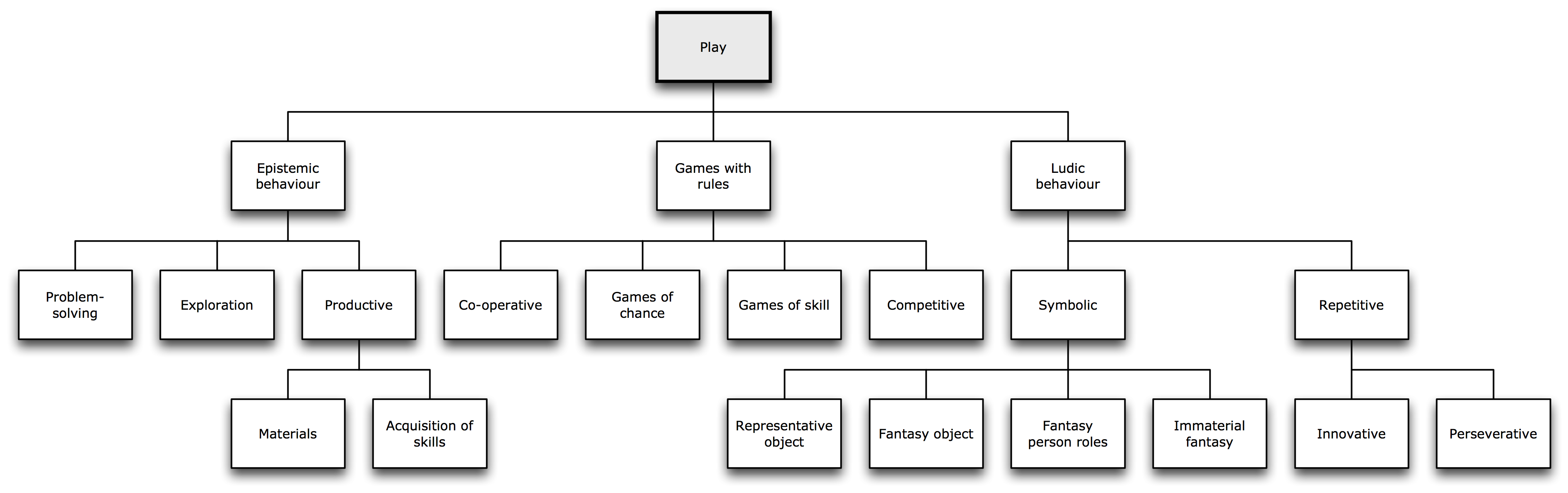
We can look to play for some insights into what happens at exhibits and, for that matter, in many contexts. What we think of broadly as children’s play with objects has two distinct aspects proposed by Corinne Hutt in 1970. In her play taxonomy, also referred to by Rennie and McClafferty (2002), she identifies epistemic behavior, or exploration, and ludic behavior, or self-amusement, along with games with rules.   

What can this do?
In exploration, a child picks up a ball, block, stick, piece of string, sock, stone, (etc.) and begins to investigate it. In eying, touching, lifting, squeezing, shaking, pounding, throwing, dropping, rolling, stepping on, and for the very youngest, mouthing and gumming, the child gathers information about the object’s basic properties. Implicit in the child’s mind during this investigation appears to be: "What can this object do?" Hutt also suggests that investigative, epistemic, behavior may be divided into three kinds of activities. In exploration a child uses her senses to gather information. In problem solving she focuses on doing a puzzle. In productive activity she is intent on making changes to the material and/or acquiring skills.  

What can I do with this object?
Play, or ludic behavior, relies on the child having sufficient information about the object to make it familiar and to be comfortable in shifting to ludic behavior, or amusement. Here the implicit question is, “What can I do with this object?” In this realm, Hutt says, children draw on the knowledge gathered about the object and skills in using it to play symbolically with the object. A block becomes a phone; the stick is light sword; a stone is a magic egg; a sock fits over the hand and is a cat puppet; and a pile of blocks are stacked to be a house with a window for a giraffe. Often pretense is involved.

A new combination, a new round of exploration
 Through play–informed by the initial investigation–a child gathers and consolidates additional information to develop further knowledge and understanding about the object and greater skill in using it. Children often move between exploratory behavior and play. Occasionally, the accidental discovery of a novel feature or introduction of an unfamiliar object prompts a new round of exploration, but this is incidental rather than the goal of the activity.


The need to explore and become familiar with something does not disappear with childhood and is not limited to toys or play. Adults certainly bring more information to each encounter, but the material (and even social) world is not static enough to remain familiar. When a new gadget or piece of equipment enters our life, when we try to open a particularly pernicious type of packaging, or we walk up to the rocket launcher at a science center, we take time to inspect, investigate, and explore before wholeheartedly committing to its use or to making something with it. In fact, Rennie and McClafferty suggest a paraphrase of Hutt’s two questions: “What can this exhibit do?” and “What can I do with this exhibit?”

Museum and Exhibit Context
In developing and designing museum experiences, most of us, most of the time do so as if investigation, play, and planned discovery to accomplish objectives were one and the same. They are not. In fact, the distinctions among them are often material to the goals museums have for learners in exhibits and programs. This disconnect seems to influence not only how learners engage in those activities, but also how long they are likely to remain with an activity and even the messages and understandings they take away.

When a learner encounters objects, tools, or materials at a maker table, a math exhibit, a harmonograph, or a building platform, investigation begins. It is likely to be relatively brief if there is some previous experience and familiarity with what is being explored. With new objects or novel combinations of materials, however, inspection and investigation are both longer and necessary for gathering information.

Museums, however, are not the highly familiar, everyday environments of the kitchen or car. They are, in fact, an intentionally prepared mix of familiar, unfamiliar, and often, rare objects, materials, and mechanicals, presented in engaging and intriguing ways. Since variety, novelty, and something out of the ordinary does characterize museums, it is reasonable to expect that many visitors will require time to explore, become oriented, and take in a museum and its exhibits. Similarly, a certain level of investigation, or epistemic behavior, is likely for children and adults to become familiar or reacquainted with an exhibit since most visitors do not attend museums frequently.

At many exhibits, investigation is likely to focus on what Hutt calls productive behavior that is concerned with changing the material or the user’s skill in using it. Changing the material may involve altering it by tearing, folding, cutting, applying pressure, or dissolving; changing another material by cutting, pounding, piercing, or illuminating it; or making something with it by attaching, assembling, connecting, or sewing it. Combinations of these processes are likely and expand the investigation. Another concern of productive behavior is developing skills in using or working with a material, object, or tool. Through familiarity and extended use, and through multiple tries at one’s own pace, the investigator acquires skills, develops competence, and derives a sense of confidence.

Lessons and Starting Points
Investigation, play, and productive behavior offer useful insights and lessons for planning exhibits. While related to one another, they serve distinct purposes. While similar to many exhibit engagement behaviors, their focus is less on the exhibit's objectives and more on what its elements can do.

Through exploration that often informs–and is informed by–play, children and adults engage with an exhibit. They develop a familiarity with the materials, objects, tools, and the context. These are the very same elements an exhibit intentionally brings together in order to meet its specific objectives. Equally as important, exploration and play provide the learner with skill in using the materials and a degree of preparation that is valuable in pursuing and accomplishing the exhibit’s objectives.

The learner’s tendency to investigate, play, and explore his own objectives offers insights and opportunities into additional ways exhibits might accomplish their objectives:  
  • Recognize the learner as someone inclined to investigate, play, and pursue objectives
  • Channel these activities towards the exhibit's objectives
  • Provide for these activities in exhibit design 


Friday, February 15, 2013

Museum Notes From the Road


Recently, I have been traveling a lot, even more than usual. In just under two weeks, I visited museums in 4 states from coast to coast. Along the way, I spent time in 7 museums in different roles, attended a national project advisors' meeting, and walked New York City's High Line, something I have long wanted to do. I was headed for three more museums and a planning meeting before deciding to make a quick exit ahead of last week’s East coast storm. I sure am glad I did.

Observing the vitality and listening to what’s happening in so many museums–large and small, in towns and cities, across the country–and in quick succession is quite amazing. The variety and intensity alone require many deep breaths, time to thumb through notes and photos, and moments to recall, reflect, and share. Before too much fades away and with a reminder or two about where to explore more, here are some notes from the road.

Partners in Play
Three Seattle area children’s museums have been conducting exploratory research to look at how parents and caregivers see their children’s activities as play and their own role in extending and supporting it. Last fall, Lorrie Beaumont of Evergreene Research and Evaluation, and I interviewed caregivers and trained interviewers at the Children’s Museum of Tacoma, Imagine Children’s Museum, and KidsQuest Children’s Museum to conduct interviews. I wrote about some of my early impressions on an earlier post, Parent Voices, New Insights. Now, using the results of nearly 100 interviews, the three museums are beginning a new round of research. Three action research projects are ramping up and exploring questions that emerged from the exploratory study. Action research is an iterative, reflective process looking for improvements, or action, around everyday, real situations. More often used in school settings, it is well suited for museums and other informal learning environments. It's a great approach for exploring questions related to practice or emerging from research and is an excellent professional development tool. Look for a future post on action research as well as for dissemination of this work by the museums at conferences and on-line.

Museum of History and Industry (MOHAI), Seattle
When I hear someone propose developing a scavenger hunt for a museum, I am drawn to the idea. I like to imagine pairs of children or family groups combing through a gallery, alert for possible clues, furrowing brows about another way to read this clue, and exchanging ideas. I also tuck it away, wondering how well it will actually work in the bustling museum setting and for whom. I was pleasantly surprised on my visit to MOHAI to be paralleling the trail of two 8-ish year old boys enthusiastically scavengering their way through the museum with a set of cards. I noticed their intensity, listened to their conversation, and rejoiced in their sense of accomplishment when they yipped, “Yay! We built a railroad” after pounding in spikes. A few exhibits later, I heard one say to the other, “We have to ask questions.” The other replied, “Yeah! Gotta have questions.” The imperative captured my attention and that of others around us. This is precisely the enthusiasm and immersion we hope for and, in this case, in somewhat older children. While only a sample of 1 (or maybe 2), their enthusiasm reassures me of the potential for children to be actively engaged and excited in searching and discovering.   

Children’s Museum of Boston
It’s been more than 30 years since my fist visit to Boston Children’s Museum and I have been many times since. On this visit, I was impressed by how much the Museum has stayed the same even as it has changed. Approaching on foot from the T’s South Station, I navigated the streets by feel and was delighted to see the big white “Hood” Milk Bottle from across the channel, welcoming and guiding me. Changes in the neighborhood and on the Museum’s plaza made the milk bottle seem different and the same, a dynamic that persisted throughout my visit. A new entry experience flows into a familiar hive of activity around the four-story climber. Legacy exhibits including Construction Zone, Japanese House, PlaySpace connected by a wide corridor of activities for Chinese New Year. Bubbles and Raceways enjoy a new context in Science Playground. One thing that had not changed was the number of highly engaged parents in PlaySpace, including dads, many comfortably occupying the resource room; I noticed they do seem younger than 30 years ago. This mix of enduring and new BCM experiences is fitting for a museum celebrating its 100 birthday.

Math Core
As an advisor for Math Core for Museums, an NSF-funded project of the Science Museum of Minnesota (SMM), I participated in the project meeting at the Museum of Science (Boston). This project has an interesting focus and structure. Its four museums (SMM, Museum of Science, North Carolina Museum of Life and Science, Durham, and Explora, Albuquerque) have been developing a set of interactive exhibits that engage learners, especially middle school students, in experiencing and understanding ratio and proportion physically as well as cognitively. The project has an interest in long-term math environments and repeat visits. Selinda Research Associates is conducting a longitudinal evaluation of the project and at the meeting, Deborah Perry provided an overview of the evaluation that is underway.
Like past advisors’ meetings, this gathering of evaluators, exhibit developers, researchers, and advisors generated  lively discussion, valuable observations, and questions about the project and about museum practice and learning experiences more generally. Why, for instance, has repeat visitation been studied so little? Children’s tendency to build towers and houses with blocks before and often instead of focusing on the intended math activity was noted several times. The thoughtful, succinct, and quotable Paul Tatter observed that, “Learning is not an event,” yet we plan and evaluate learning as if it were. The idea of designing for persistence was thrown out inviting thoughts about what that might look like. Conversations from the advisors’ meeting are continuing.

Children’s Museum of the Arts
This New York children’s museum is not as well known as its New York peers, but deserves to be. It’s a fresh iteration of the Children’s Museum of the Arts I last visited about 20 years ago. Reopening in October 2012 after a relocation and expansion in a new SoHo location, it’s a smart hybrid of a children’s museum and art museum with a thoughtfully playful and seriously arty style infused into both its experiences and design. I am impressed. Still compact at 10,000 square feet, CMA uses its children’s art collection, artist-in-residence programs, artist-led programs, hands-on explorations of art materials and exhibits, and extensive outreach programs to children from a wide range of backgrounds. It’s committed to highly facilitated experiences by artists in its art labs, media lab, clay bar, and video-making and animation station. I especially loved the giant, highly utilitarian, octopus-like sink-and-water station in the center of the art lab that is inviting and visible from the street.

  
New York Historical Society/Jon Wallen
New York Historical Society
This was my first visit to the New-York Historical Society Museum and Library (NYHS) across the street from the American Museum of Natural History and Central Park. The set of interactive touchscreens in the newly designed Robert H. and Clarice Smith New York Gallery of American History were fascinating and as elegant as the gallery itself. Fortunately I had been alerted to the new DiMenna Children’s History Museum in the Jan-Feb 2013 issue of Museum. History exhibits for children are challenging and, until recently, there have been few, if any child-centered, interactive exhibits. As this recent NYHS exhibit, Chicago History Museum’s Sensing Chicago, and Minnesota Historical Society’s Then, Now, Wow! seem to indicate, the moment for children’s history exhibits has arrived. Since I plan to write soon on history exhibits for children that I have seen, I’ll leave that until later.

Loving the High Line
A public park built on an historic freight rail line elevated above the streets on Manhattan’s West Side, the High Line might be prettier and softer when green and warmed by sunshine than in the bleak mid-winter. It could not, however, be any less amazing as a brilliant found opportunity to open up the city and rediscover public space. Meandering through the 1-1/2 mile park high above the street, following old tracks, moving between plantings, and walking along paths punctuated by art is a novel, joyful feeling. Openings between buildings afford amazing views to the Hudson River. On the High Line, the city does not just close in up above and over head. It also spreads out down below and far into the distance.

Wednesday, February 6, 2013

A Disposition to…


In the world of learning, whether in museums or schools, we often hear about skills, knowledge, and proficiencies. We seldom, however, hear much about dispositions. Disposition might be a bit of an old-fashioned word and doesn’t enjoy great use. Perhaps that is because disposition lacks the crisp currency of skill with its sharp edges that lend it to being tested and measured.

Disposition, however, is a useful and underutilized concept, especially in museums with an interest in inviting thinking, engaging learners, and supporting life-long learning.

A disposition is a habit, an inclination, or a tendency to act in particular way.  With a focus on frequent and voluntary patterns of a behavior or activity, dispositions differ significantly from skills and knowledge. Acquiring a specific skill or knowledge on a particular subject does not guarantee it will be used or applied. A disposition makes use of that skill or knowledge more likely. We might say someone has a disposition to be curious if she typically and frequently responds to the setting by exploring, investigating, and asking questions about it. Simply having the skills to ask questions, however, does not assure that she will do so.

Lillian Katz who has been writing and talking about the role of dispositions in children’s learning for 30 years defines disposition as a “pattern of behavior exhibited frequently . . . in the absence of coercion . . . constituting a habit of mind under some conscious and voluntary control . . . intentional and oriented to broad goals.” In Cultivating a Culture of Thinking in Museums, Ron Ritchhart of Harvard University’s Project Zero refers to a dispositional perspective on thinking as not only the ability to think but also the disposition to think. Patterns of thinking not only can be used, but also are used.

Dispositions can be social. Someone may have a disposition to be friendly, helpful, or cooperative. Other dispositions are intellectual such as a disposition to ask questions, to read, to gather information, to observe, to weigh evidence. Not all dispositions are positive. Consider a disposition to be bossy or complain.

Dispositions can be developed and are more likely to be developed when other people, such as parents, grandparents, teachers, siblings, peers, model them. Even so, developing a disposition requires time, time for it to be enculcated, practiced and strengthened. Environmentally sensitive, dispositions are acquired, supported, or weakened by the conditions of the environment, the interactive experiences in settings with significant adults and peers.

Unpacking Dispositions
The qualities characterizing dispositions set them up as a good fit for museums in creating experiences for children and adults. Dispositions can be modeled. Museum educators, floor staff, facilitators can be (and often are) trained to model certain behaviors: asking questions, noticing patterns, or checking assumptions. As museums prepare environments and exhibits with particular objects and activities to invite and encourage learners to use skills and draw on understandings, they can also encourage certain dispositions. Many dispositions relate precisely to the kind of behaviors and actions we want learners to engage in: to notice, to try, to ask questions, to gather information, to be creative. Some dispositions relate strongly to certain areas, like science.

Three related aspects of dispositions make them even more useful in museum settings. First, focusing on dispositions reinforces a learner-centered focus. The learner is the subject, the agent, the person likely to try, to read, or to ask a question. Second, planning that encourages certain positive dispositions builds on strengths and puts abilities into play. Someone is likely to do this; a parent wants to answer a child’s question. Finally, dispositions are associated with action and doing. They lend themselves to active engagement; and this aligns with museum interests. Considering what people are likely to do in an exhibit or at a component based on the conditions created (or that can be created) becomes a worthwhile exercise, reinforcing museums as places to exercise choice and preference. Discussion shifts from learner outcomes and what a child or adult will do or will learn, to what a child or adult can do or is encouraged to do.


Dispositions in Museums
The experiences and environments museums create are powerful mediators of thinking, doing, and learning. Bringing a dispositional perspective to planning these experiences alters the focus from skills and content to learners, and to framing experiences that encourage dispositions relevant to broad project goals. I have been reading, searching the Internet, checking old files, and talking with colleagues to find out how a dispositional approach to providing experiences is being used in museums. I found several references to and examples of dispositions being used in museums.

Dispositions are sometimes mentioned along with skills, knowledge, and attitudes as foundations for science learning in museums as they are In Learning Science in Informal Environments: People, Places, and Pursuits. Ron Ritchhart, mentioned above has been exploring and writing about a dispositional approach to thinking in schools and bringing that approach to museums as places for nurturing students’ awareness of and inclination for thinking. Boston Children’s Museum has brought a dispositional approach to interpretation in Science Playground. Graphic panels invite children to "Notice, wonder, question, play” throughout the exhibit’s three areas. Habits of Mind call out basic dispositions and their relevance to learning about the world.

The Exploratorium deliberately uses and supports the concept on disposition in the Tinkering Studio. Cultivating a “tinkering disposition” is the Tinkering Studio’s approach to engaging visitors in using their hands to investigate phenomena, materials, and tools. In this case, a tinkering disposition is “a proclivity for seeing the word as something that can be acted upon and building confidence in one’s ability to do so”. The Tinkering Studio focuses on space, activity, and facilitation as the conditions that encourage tinkering. A welcoming studio space anticipates and provides for interactions, access to materials and tools, and for tinkerers’ comfort and concentration. Activities are thoughtfully designed to support tinkerability, emphasizing, for instance, hand-made materials, making processes visible, and revealing easy entry points. Facilitators are prepared to be alert, helpful, and unobtrusive in encouraging tinkering.

These examples are varied and interesting but are too few. The people I have talked to about dispositions, while unfamiliar with them, recognized the promise this approach has in museums. If you know of work being done in this area, please share it. If using a dispositional approach to creating museum experiences inspires or interests you, I hope you will get going and get in touch. In any case, please spread the word.