Tuesday, January 1, 2019

Learning With and From Objects: Part 1


San Miguel Toy Museum
San Miguel de Allende, Mexico
Madison Children's Museum
I recently read Object Lessons in Early Learning by Sharon Shaffer, founding director of the Smithsonian Early Enrichment Center (SEEC) in preparation for an interview for an upcoming issue of Hand to Hand, the publication of the Association of Children’s Museums.

Now a consultant for early learning in museums nationally and internationally, Shaffer draws on her experience at SEEC in Object Lessons to provide an overview of the role of object-based learning in museums, from historical, pedagogical, developmental, and interpretive perspectives. The book offers a solid run through of educational philosophies that fit with museums as informal learning settings: those of Dewey, Vygotsky, Bruner, and Piaget. In particular, Shaffer focuses on how those theories help us understand young children’s learning in general and their learning with and through objects in particular. She provides a wide range of examples of object lessons.

Reading Shaffer’s book advanced my thinking about using objects in museums with children. This area of strong and lasting interest for me was sparked when I read Simon Nicholson’s How NOT to Cheat Children, The Theory of Loose Parts in the 1970’s. In fact, part of my inspiration to start Madison Children’s Museum back then was a strong feeling about the value of objects in children’s play, exploration, and learning. I hoped that a children’s museum would provide more children with richer, more varied environments and access to a greater range of objects to use, manipulate, investigate, and transform through exploration and play.

Now, after nearly 40 years of planning, observing, reading, and writing about children using objects and materials in play, classrooms, exhibits, and environments, I am still working on understanding the role objects actually play in children’s explorations in museums, in particular. We have our beliefs and intentions, but what is actually happening?

While I’ve learned more about children using objects in museums through this on-going inquiry, I’ve also learned that the questions are not that simple. Not only is there a great range of objects in museums, but they also serve multiple purposes, in a great variety of museums that are evolving themselves. At the same time, acceptance of children in museums is also changing.

As I read Shaffer’s book, I thought, in particular, about children learning with and from objects in museums, the nature of the objects we select for them, the child’s and adult’s roles in exploring objects, and the settings in which object-based learning occurs. 

The result is a two-part exploration centering on the child’s interests related to learning with and from objects that hopefully both honors and nudges both traditional museums and children’s museums to better serve those interests.

Object-centered
The museum field continues to define itself in terms of objects. The American Alliance of Museums (AAM) Code of Ethics for Museums states that museums make “a unique contribution to the public by collecting, preserving, and interpreting, the things of this world.” Yet, while the field defines itself in terms of objects, discussion about objects—varying definitions of objects, the purpose of objects, and the changing role of objects in museums—continues. Adding zoos to the definition of museums as AAM has done makes sense as far as collections go; but considering animals as objects certainly expands that meaning. Furthermore, as museums approached the turn of the 21st century, objects increasingly have had to compete for museum attention with a visitor-centered approach, community engagement, and the role of experiences.

Museums, even traditional museums, are no longer limited to housing collections of objects. (Think MASS MoCA, user-generated content and objects in museums, etc.). Whether museums need objects to be museums (see Conn and Dillenberg below) and what counts as objects (explored here and hereis part of an on-going, lively discussion.

While only a small number of children’s museums have collections, I do see children’s museums as object based, a view I think is consistent with Steven Conn’s view of museums in Do Museums Need Objects? “as places of ideas—places where knowledge is given shape through the use of objects and exhibitions.”  And I would include the physical environment in this roomy definition of objects.

For me the shifting and expanding status around the museum object is a sign of a continuing, shared value around objects across museums, as well as an opening for exploring children’s learning from and with objects in both traditional museums and children’s museums.

The Same, Only Different
Swimming in objects, children’s museums find the question where are the objects in children’s museums perplexing. These museums see themselves as object centered at their core. The earliest children’s museums were collecting museums with hands-on artifacts to serve children. In the 1960’s the modern children’s museum concept emerged from Mike Spock’s experimenting with removing objects from cases for children’s hands-on exploration.
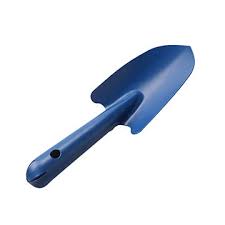
Blue Trowel by Claes Oldenburg  at Kröller
Müller Art Museum in Otterlo Netherlands

Blue garden trowel at the big box store 


In most children’s museums, objects are literally everywhere. Children move, carry, drop, hide, wear, build, and imagine with objects and materials. In fact, the centrality of objects in children’s museums is expressed in many ways, from museum names (Please Touch, Do-Seum, and Hands On) to learning approaches, hands-on, loose parts, real stuff, and materials exploration.

For children’s museums, object centered means abundant, varied objects and materials that children can explore, use, direct, put together, take apart, and incorporate into their play, problem solving, and social interactions. These settings express a great faith in the power of the object to provide children with information, knowledge, understanding, and meaning. In their shape, texture, weight, size, smell, and other properties, objects hold vital information about the world. They are opportunities for asking questions, experimenting, testing hunches, working out new meanings, and building an understanding of themselves and the physical and social environment.

Even spaces for infants and toddlers are full of objects that they can see, sense, explore. They carry balls, scoop sand, fill baskets, push chairs, turn spinners, and clutch books as they scoot, crawl, and toddle. As they repeat an action or activity, they unpack and repack their growing understandings. And they draw conclusions about their agency, how objects respond to different conditions, and what else is possible.

This is consistent with the Association of Children’s Museum’s Standards for Professional Practice definition of objects as primarily serving as tools to motivate learning, addressing the developmental needs of children, and carrying out learning objectives. 

In art, science, history, and natural history museums, object centered most often means objects that are collected, preserved, researched, exhibited, interpreted, and viewed. These objects come down to us from another time, from many cultures, from far away, and from artists and inventors. Children’s first-hand experience seeing original and rare objects sparks curiosity and creates excitement. In some settings a hands-on gallery activity in a discovery room or a family center can extend the child’s exploration beyond the visual experience, expanding knowledge of the object’s materiality, use, and connection to everyday experience.
When plastic or fiberglas objects deliver
an important experience

Hand-sewn fabric fruits and vegetables
(Children's Museum of Southern Minnesota)
When it comes to critically considering objects in children’s museums, we tend to focus on how they fail the criteria of traditional museums by insisting on viewing objects through a traditional lens of authentic, rare, representative, etc. Often, the focus is on the obvious artificiality of plastic food in a grocery store exhibit. The ubiquitous plastic food in children’s museum grocery stores is hard to defend beyond durability and ease of cleanliness. But, how discerning is such a criteria for authenticity when the object is a life-size fiberglass cow that a child can stand near (or under), and can compare the size of a leg, tail, or ear?     

Traditional museums and children’s museums also differ in being able to categorize and analyze their objects. Artwork, natural history specimens, and anthropological collections lend themselves to classification systems. Categorizing and analyzing balls, ball tracks, and Bernoulli blowers; sieves and scoops, bubble wands–not to mention bubbles—is clumsy and full of exceptions, to say the least. A taxonomic approach to organizing and describing objects such as blocks and cardboard boxes that have been recently and variously used as a rocket ship, a submarine, and a giant crawl-in guitar would miss a fundamental richness. I suspect there are work-arounds that the The Strong museum may use in its collection and Toy Hall of Fame or a Reggio-inspired documentation approach that could look at children’s exploration of objects and materials. Maybe we should look into this.

Over the years, the broader museum field has made some accommodations to children’s museums’ and science centers’ looser definition of objects to include props, interactive components, and giant toys. At the same time, a growing agreement about the value of engaging children with objects in museums is occurring and is documented in Shaffer’s book. Nevertheless, both traditional museums and children’s museums could be working harder and more effectively on the promise of children learning with and from objects. In my next post, I want to explore 5 areas  
§  Great Beginnings
§  What Objects Say
§  Freedom to Explore
§  Context Matters
• Access and Availability

Resources
• Steven Conn. (2010) Do Museums Still Need Objects?  Philadelphia: University of Pennsylvania Press.
• Rebecca Schulman Herz, Museum Questions.
• Rebecca Schulman Herz. “Where are the objects? Why is this a museum?” Curator. May, 2017.
• Eugene Dillenburg What, if Anything, Is a Museum?” Exhibitionist. Spring 2011.
• Hilde Hein. "The Matter of Museums" . Journal of Museum Education, Vol. 36, Number 2, Summer 2011.
• Phillip Kennicott. “Is it a museum or not? The question is worth asking.” The Washington Post. October 2018. 
• Scott G. Harris. 2002. Perspectives on Object-centered Learning in Museums. Mahwah, NJ: Lawrence Erlenbaum Associates Publishers.
• Elizabeth Wood and Kiersten F. Latham. (2016) The Object of Experience: Transforming Visitor-Object Encounters in Museums. New York: Routledge.

Saturday, November 24, 2018

Growing Pains


https://audaxdesign.org/life-cycle-of-a-leaf-via-earth_pics/

It happened again recently. Another, unplanned, leadership transition in a young, 3-5 year old, museum. Again, I get over my surprise; everything seemed to be going well. 

Again I think about the bumpy spots all museums encounter. Like any organization, these museums are experiencing, and will experience, rough spots and growing pains. Some bumps are easier than others. The departure of an executive director is a challenge, but not an unusual one. An unplanned departure makes it even harder. Often when it happens, is what makes it hard.

Again I wonder about the museum’s next steps, the probable executive search, and who I might know or know of who would be a good fit for the museum and the position.

Inevitably, I come around to the realization that this museum is navigating a transition from one stage to another in its organizational life-cycle. Just as humans go through life stages (think infancy, early childhood, adolescence, and right on through old-age) so do non-profit organizations, including museums. Planned or unplanned, leadership transitions often occur when a museum is making a shift from one stage to the next. In fact, bumpy spots occur at somewhat predictable points in a museum’s development. In the case of these 3-5 year old museums, they are moving from a start-up stage to a growth stage. Not surprisingly, they are living somewhat in both stages. In this situation, growing pains are likely.

The idea of organizational lifecycles comes from several fields. The work of Susan KennyStevens, a non-profit management consultant based in the Twin Cities has been a helpful tool in my work. In her book Non-profit Life-cycles: Stage-based Wisdom for Non-profit Capacity, Kenny Stevens presents seven lifecycle stages that nonprofit organizations, including museums, typically go through: the Idea stage, Start-up stage, Growth stage, Maturity stage, Decline stage, Turn-around stage and sometimes, the Terminal stage.

Museums of every kind, size, and age experience life-cycle stages. Often these times are rough for staff, board, and sometimes even partners and visitors. A life-cycles approach, however, can be a helpful tool for a board, executive director, and staff. Besides serving as a tool for navigating a transition, this approach can also help depersonalize difficult discussions and decisions at a stressful time for the organization.

Understanding Stages
While inevitable, stages are not deterministic with one stage automatically following another like cruising through state after state on a cross-country road trip. Completing a stage and moving on to the next requires deliberate effort, activity on many fronts, and working together at another scale and complexity. New opportunities come along; there are staff and board transitions; new systems are needed; and some things must be discarded.

The young museums I’m thinking about signaled an intention to leave the Start-up stage when, accompanied by great celebration and popular response, they opened to the public. The Growth stage seemed certain to follow. Moving through stages, however, is not automatic. Opening the museum doors doesn’t necessarily mean completely closing the door to the Start-up stage and stepping over the threshold to the Growth stage.

And while stages may be clear, the boundaries between them are not. Consequently, a museum is likely to be straddling more than one stage and not even realize it.

A stage is not simply a place a museum bides its time or plows ahead to get to the other side. Rather, a stage describes developmental periods when characteristic patterns of behavior emerge, develop, and are resolved. The major tasks that need to be accomplished in every stage cluster in five organizational capacity areas: Programs (including exhibits and programs), Management, Administrative Systems, Financial Resources, and Governance.

Work to Be Done
Managing success in any stage and the transition to the next one relies on having sufficient internal capacity in all five areas. Development–or capacity–in organizations however, is usually uneven and occurs at different rates very much as it does across domains—physical, social, emotional, and cognitive—in humans. Uneven capacity across areas is likely to show up as a rough patch or growing pains.

In museums, and in the Growth Stage in particular, exhibits, products and services generally are more mature than other capacity areas like Administrative Systems or Financial Resources. A museum’s offerings expand in response to public demand. Staff races to keep up; financial tracking systems lag behind. Capacity areas like Administrative Systems or Financial Resources often need time and targeted resources to catch up, for both building new capacity and shedding old ways.

Processes for budget development, program planning, on-boarding staff, and recruiting board members may have been outgrown or were never established. New levels of accountability are needed. What worked for a staff of 7 and a founding board may be inadequate for a staff of 20 and a board of many new recruits. The nature of the work to be done in a stage is not necessarily immediately obvious. For instance, “communication” surfacing as a recurring issue—communication with and among staff, staff leadership, the board—often indicates related capacity issues. Nevertheless, communication internally and externally IS more critical than ever.

– For Everyone
Having the necessary capacity also means having the right people in the right positions: staff, staff leadership, and board. In every stage, staff, board, and staff leadership have specific roles to play, and these roles change across stages. For instance, a board needs to shift from being hands on to being strategic. The executive director needs to have the right characteristics to work with the board and be positioned to lead through a period of growth and development.

Finding the right person to complete a museum leadership team, to fit with the board and fit with staff, can be a challenge any time. Especially when a founding ED has left and a new stage of organizational development is unfolding, a successful search can be challenging. A museum may not get it right the first time. Kenny Stevens points out that, while more has been written about the start-up stage, it is really the growth stage that is the more complex management challenge.

When I return to thinking about what comes next for these museums and I look through the lens of organizational stages, I think about them quite differently. Regardless of its size, age, stage, or focus, every museum faces essentially the same task: building and aligning capacity across all 5 areas. And because every museum is different, there isn’t a set way to move smoothly and gracefully from one stage to another.

An organizational life-cycle approach, however, does help a museum get unstuck and develop a shared idea of how to move forward. It invites a museum to understand which stage it is in, to diagnose its internal capacity across areas, to identify where behaviors are out of sync, and to begin to grow and align its capacity.

The approach doesn’t solve everything. No tool does. Moving from one stage to another, however, is also an opportunity for a museum to become a better version of itself.


Related Museum Notes 
Building Capacity to Have Capacity

Monday, October 29, 2018

Some Misunderstandings of Children in Museums


Photo: Getty Villa

Children are becoming an increasingly important audience for museums. Several changes and trends have been at play. Children’s museums have rapidly grown in both number and attendance since the early 90’s. Understanding families as powerful, flexible, learning groups in museums has also helped open doors for more museums to serve families with children. Advances in neuroscience continue to reveal both young children’s significant capabilities as well as the life-long implications of early experience. For most science centers and museum, children and families have become a high priority audience. Increasingly, history, art, and natural history museums are also interested in attracting families with children to exhibits, programs, and events.

At the same time that museums work to reach and serve children visiting in school, childcare, family, and community groups, we often do so without a deep understanding about who those children are that we want to serve.

It’s true that the word “children” conjures up a wide range of candidates. “Children” spans the first decade of life when remarkable changes occur in every domain of human development that have life-long implications. A colossal developmental arc embraces the years from birth through 12 years—that’s infants to tweens. “Children” also encompasses living and growing up in wide ranging conditions and social and cultural contexts.

Sometimes to simplify things, we group anyone under 12 as “kids,” maybe “little kids” or “big kids.” When we do get specific, we refer to them by grades in school, even though museums are not schools, but informal learning settings. We sometimes think of children as numbers: 60 children arriving on 2 busses for a 9:30 field trip. Sometimes we say “children” when we are actually referring to someone who is a novice with a narrow range of experience in a relevant area. Yet, we also know many children who are not novices and have expertise in dinosaurs, heavy machinery, or players on a favorite sports team.

If museums intend to welcome and serve children, we need to do so from informed, appreciative, and varied perspectives just as we would for any valued audience group, especially non-traditional museum audiences. In conversations with colleagues, reading articles and blogs I often have the sense that museums view children, what they are doing, and why in critical ways that reflect a limited understanding of children. For instance:

Children are egocentric; they think only of themselves and what they want. This usually means that children are selfish with a rigid “me first” attitude. There’s a finality to these statements that ignores the many contrary examples we see of children’s kindness and caring, a mutuality and reciprocity in their interactions. When paying attention, we see toddlers’ eagerness to be helpful. Research supports this; it shows toddlers are helpful to others in accomplishing their goals suggesting they are naturally altruistic.

“Egocentric” also means understanding the world in terms of oneself. This is something we all do—everyone of us—regardless of age. Our experience of the world and what is familiar to us is core to how we understand the world. This is apparent when 4-year old Jake lays out his timeline of world history: “The dinosaurs, Baby Jesus, the knights, and me.” He’s linking what’s important to him and what he knows to where he fits into the world.

Children have short attention spans. It is true that with development, a child’s attention span develops. Ability to focus and manage distractions increases with the development of executive function. Yet, even young children, including toddlers, are able to be focused and persistent. They are often single minded when something is of interest to them. Who has not marveled at how a very young child intently pores over a book, perseveres in getting a lid off a container, or plays for hours with a cardboard box?

Unwittingly we often reinforce children’s short attention spans. We interrupt them while they are deeply engrossed in play or a project. In museums, at home, at the library, on the playground, a parent, caregiver, teacher, or museum volunteer interrupts a child’s focus with, “Let’s go. We’ll do something else.” If, on the other hand, we were attuned to children’s cues, we would notice their concentration, help manage distractions of sound or traffic, follow their lead, and reduce transitions that interrupt their concentration.

Children will make trouble if they are not closely managed. Children are open to the possibilities of an object or space and they use them in novel ways. They view objects, space, and the world itself for what it might do or how it can be used. This often appears to adults as if children are up to mischief. We have only to think of the times we have seen (and been rattled by) children filling their mother’s sun hat with sand to be reminded that children are not limited by an object’s fixed use. Their alertness to the affordances of an object or space is why a large open area is a command to run and a narrow ledge is a step for reaching a distant object.
 
In fact, children are experts in being open to possibilities. They see opportunities in upturned chairs as an obstacle course. In tipping chairs upside down, children are not being destructive and uncooperative. They are using the very skills we hope they cultivate: creative thinking, problem solving, and following hunches. Children (and adults) are always finding uses for things for which they were not intended. This is what creativity, ingenuity, resourcefulness, and innovation are about.

Interested, But Uncertain
We don’t notice the multiple ways that children explore, connect, and learn because this happens in more subtle, variable ways than we expect. For instance, children’s interest in exploring big ideas is not always obvious. When 5-year old Andy asks, “Not counting me, how many people would you say there are in the world?” he is thinking hard about big numbers, his expanding world, and his place in it.

Children’s knowledge may not meet adult expectations, agendas, or curricula. What they do know about how sand spills onto the floor, the best way to spin a helicopter, or what makes a good story, is, however, constructed, visible knowledge, and a promising starting point for extensive explorations. Long before they can talk, children have questions. They know more, much more, than they can express clearly with words. They can express ideas, follow hunches, and form new questions with their senses, their bodies, with materials, and with others.

 I sense that currently we are uncertain about how to fully welcome and engage children in museums. We remark on the amazing capacities that are revealed by neuroscience research, yet we retain views about children’s capacities and their motives that are limiting. Furthermore, we think children have too much of some qualities–activity and imagination. And, on the other, we think they have too little of other qualities–good sense and self-control. We tend to underestimate children’s potential and overlook their capabilities.


Museums can, however, develop an image of the child that shines a bright light on their strengths and capacities and serve them accordingly. We have well-developed strategies and practices for learning about valued audience groups–observation, research, staff expertise, evaluation, and prototyping. We can be an ally in their exploration and learning by being alert to what fascinates them, holds their attention, and sparks their delight in responding to a material, object, or setting. When we see them use materials in unusual ways, we can ask ourselves, “how else can we see and understand this?” We can then imagine fresh invitations for children to experience a space, objects, an activity, or materials that engage and support them in building foundations for learning that inspire them and us.

We owe this not only to children now, but to our other visitors, to our museums, and to the life-long museum-goers we hope children will become.


Related Resources