Friday, October 16, 2015

Exploration & Play ... Play & Exploration

A rework of a previous Museum Notes post, Not Just About Play, the following revisits connections between play and learning. We may know that learning occurs through play, but keeping the nature of this connection in mind in planning experiences is challenging. Play like learning is rarely present in an isolated pure form. Learning and play often blend and blur in the messing around, testing, trying, and fun at exhibit activities of all kinds across virtually all museums. While this might not meet the fine print of the exhibit objectives that have been set, the objectives can’t be met at all without some playful meanders that occur. 


"They're all triplets."
“How do we make a window for the giraffe?” a 4-year old girl asked her 8-year old friend as she held up a small stuffed animal. This was part of an extended building sequence and conversation between 2 girls at Scaling Shapes in Math Moves! at the Museum of Science, Boston. Scaling Shapes is about doubling the size of an object in three dimensions, height, length, and width. The exhibit has a large work surface with a one-inch grid, loose one-inch cubes, and several block structures of assembled cubes. A monitor shows a structure being enlarged by doubling all three dimensions.
 
Their exploration began with one girl asking the other, “Do you want to build a house?” They then swept all the cubes to one side and started building a house for their three stuffed animals, a giraffe, a puppy, and a bear. As they built, they talked about what they were building, and who their animals were. “They’re all triplets,” one said. “They’re watching TV,” added the other. “Where should we put him?” the older girl asked holding up the giraffe. “Let me deal with that!” the younger one replied, grabbing the animal from her. The activity continued, sometimes with more building and problem solving and some times with more conversation and wondering, “How do we make a window for the giraffe?”

Similar activity sequences occur frequently in children’s museums, science centers and museums and probably in every type of museum. Content specialists, advisors, exhibit developers and designers may find this disappointing and feel exhibits are being misused. And for good reason. They have created exhibit experiences to carry particular exhibit messages and concepts and have selected materials, media, and objects to support visitors in making these discoveries. As the activity above suggests, it may not happen, happen right away, or happen in the way the exhibit team has imagined or intended.

That moment of wondering, “How do we make a window for the giraffe?” reveals something about what is happening and might happen at an exhibit. The question involves working with the height and length of the wall; the relationship between the giraffe’s height and the window opening; spanning the window opening; and considering alternative scenarios for the house. This is where the focused exploration exhibit developers hope will occur is most likely to kick in: when exploration has yielded information about objects and what they can or can’t do.

Exploration and Play. Play and Exploration.
Planned for or not, play and exploration are an active, present, and inevitable part of the museum experience for children as well as adults. The problem solving, critical thinking, and planned discovery intended in exhibits require time and opportunity to explore, interact with, develop a familiarity with, and work with an understanding of the materials, objects, tools, topic, and even the social and physical context of the museum.

"What can this do?"
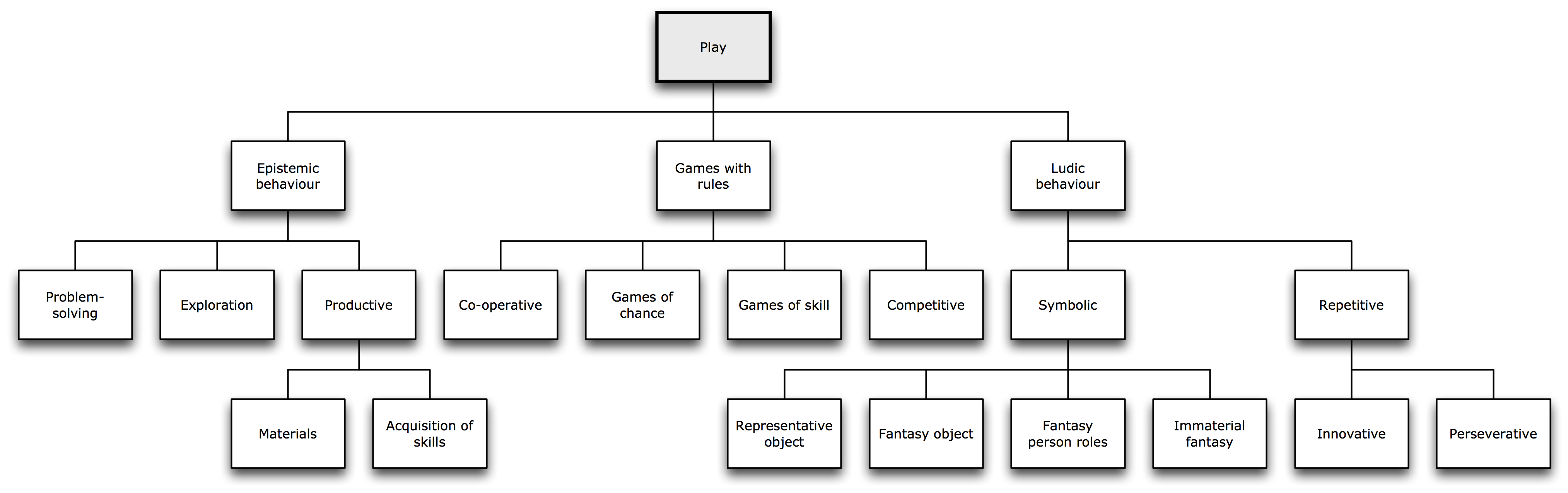
We can look to play for some insights about what often happens at exhibits and, for that matter, in many other settings. What we think of broadly as children’s play with objects and materials has two distinct aspects proposed by Corinne Hutt in 1970. In her play taxonomy, also referred to by Rennie and McClafferty (2002), she identifies epistemic behavior, or exploration, and ludic behavior, or self-amusement, along with games with rules.  

In exploration, a child picks up a ball, block, stick, piece of string, sock, or stone, and begins to investigate it. In eyeing, touching, lifting, squeezing, shaking, pounding, throwing, banging, dropping, rolling, squeezing, stepping on, and for the youngest, mouthing and gumming, the child gathers information about the object’s basic properties. Implicit in the child’s mind during this investigation appears to be: "What can this object do?" Hutt also suggests that exploratory–epistemic–behavior may be further divided into three kinds of activities. In investigation a child uses her senses to gather information. In problem solving she focuses on finding a solution or doing a puzzle. In productive activity she is intent on making changes to the material and–or–acquiring skills.  
"What can I do with this object?"

Play, or ludic behavior, relies on the child having sufficient information about the object to make it familiar and to be comfortable in shifting to amusement, or ludic behavior. Here the implicit question is, “What can I do with this object?” In this realm, Hutt says, children draw on the knowledge gathered about the object and skills acquired in using it to play symbolically with it. A rope becomes a snake; a stick is light sword; a stone is a magic egg; a sock fits over the hand and is a cat puppet; and a pile of blocks are stacked to be a house with a window for a giraffe. A story unfolds. Pretense is often involved.

Through play–informed by the initial exploration–a child gathers and consolidates additional information to develop greater familiarity, knowledge, and understanding about the object, gadget, or material and to acquire greater skill in using it. This is not a predictable, linear process, however. In fact, exploratory behaviors can alternate quickly or blend with play. Occasionally, the accidental discovery of a novel feature discovered through play can generate new data and prompt a new round of exploration. This, however, is incidental rather than a learner’s goal for an activity.

A new feature calls for another round of exploration
The need to explore to develop familiarity with something does not disappear with childhood. Furthermore, it is not limited to toys, loose parts, found objects, or play. While adults bring more information to each encounter, the material (and even social) world is not static enough to remain familiar for very long. When a new gadget or piece of equipment enters our life or we walk up to the rocket launcher at a science center, we are like children. We take time to investigate it. We adjust our grip, test how much effort is needed, look and listen for cues about how this operates, and try different movements before wholeheartedly committing to its use. In fact, Rennie and McClafferty suggest a paraphrase of Hutt’s two questions: “What can this exhibit do?” and “What can I do with this exhibit?”

Museums, Exhibits and Time
In developing and designing museum experiences, most of us, most of the time, do so as if exploration, play, and planned discovery are one and the same for accomplishing our objectives. They are not. In fact, the distinctions among them are both important and often relevant to the objectives museums have for learners in an exhibit or program.

When a learner encounters objects, gadgets, or materials at a maker table, math exhibit, harmonograph, or building platform, exploration usually begins. It is likely to be relatively brief if there is some previous experience and familiarity with what is being explored. With new objects or novel combinations of materials, however, investigation is likely to be both longer and more necessary for gathering information. Perhaps then, the learner can start finding solutions to a problem, make changes to a material, and develop skills.

But other factors are also operating. Museums are not the highly familiar, everyday environments of the kitchen, car, grocery store, or coffee shop. They are, in fact, an intentionally constructed mix of familiar, unfamiliar, and often rare objects, materials, and mechanisms, presented in engaging, intriguing, and often surprising ways. Because variety, novelty, and something out of the ordinary typify museums and their exhibits, it’s reasonable to expect that many visitors will need time to become oriented to, inspect, get to know, and take in a museum and its exhibits. A certain level of exploration, or epistemic behavior, is likely for children and adults to become familiar or reacquainted with an exhibit.

A tendency to play, amuse, or imagine may also arrive unexpectedly. Three small stuffed animals may show up at the Scaling Shapes exhibit in the pockets of 2 girls. The face of a clown may be playfully imagined as the target of the rocket launcher. Adding a silly spin or a playful punch to the floating ball on the Bernoulli Blower may produce new effects, launching another round of testing.
 
At many exhibits, exploration is likely to focus on what Hutt calls productive activity that is concerned with changing the material, mechanism, or gadget or the user’s skill in using them. Changing a material may involve altering it by tearing, folding, cutting, applying pressure, or dissolving; changing another material by cutting, pounding, piercing, or illuminating it; or making something with it by attaching, assembling, connecting, or sewing it. Combinations of these processes are likely to expand, interrupt, or redirect the investigation.

Another aspect of productive activity is developing a skill in using or working with a material, object, or tool, or becoming more precise in using that skill. Through extended use, multiple tries at one’s own pace, and increased familiarity, the explorer acquires skills and develops competence. With time and opportunity, she will engage in behaviors, actions, and sequences that lead to what exhibit planners (teachers, educators, parents) hope she and others will learn, for instance, solving specific problems like doubling the size of an object in three dimensions in the Scaling Shapes activity.  

Lessons and Starting Points
Exploration, play, and productive behavior contain many of the very elements an exhibit intentionally brings together in order to meet its specific objectives, offering useful insights and strategies for planning exhibit experiences for children and adults. While related to one another, they serve distinct purposes for the learner. Through exploration that often informs–and is informed by–play, children and adults develop a familiarity with the materials, objects, tools, topics, and context. As exploration and play alternate, merge, and combine, they nevertheless provide the learner with skill in using the materials and a degree of preparation and confidence that is valuable in pursuing and accomplishing objectives.

Less mindful of an exhibit's objectives, the explorer-player-learner’s tendency to explore and play follows his own objectives. This too offers insights and opportunities into additional ways exhibits might accomplish their objectives by:  
  • Recognizing the learner as someone inclined to explore, play, and pursue her own objectives;
  • Providing for–even welcoming–the mix of exploration (investigation, productive activity and problem solving) and play that is inevitable;
  • Channeling, but not forcing, these activities towards the exhibit's objectives;
  • Providing for these activities in exhibit design, material selection, layout, and images;  
  • Incorporating strategies that prolong engagement to provide the time necessary to both explore and play. 
Related Museum Notes Posts

Monday, October 5, 2015

Curiosity Is at the Top of My List

(Borealis Press)

“I have no special talents. I am only passionately curious.”  – ALBERT EINSTEIN

I’m putting curiosity at the top of my list. What list? A list with critical aspects of learning, 21st century skills, models, standards, and threads for learning. Creativity, critical thinking, imagination, and problem solving often show up on these lists. It’s not that these skills and traits aren’t important, but I’m not sure creativity, for example, would have such a high profile if it weren’t for curiosity.

Considered both a trait and a disposition, curiosity is a natural, active interest in the world that we see everyday in children and adults. It is an attitude of wondering, an urge to find out more, a way of reducing uncertainty, and a means of getting at more complex or inaccessible aspects of the world. Expressed as watching, asking questions, predicting, taking things apart, and pointing, curiosity is a strength during childhood when it transforms a child’s world from new and unknown to familiar and predictable. According to Susan Engel, author of The Hungry Mind: The Origins of Curiosity in Childhood, it is “…the lynch pin of intellectual achievement.” 

Curiosity unfolds when something in our surroundings sparks curiosity. A feeling of surprise or perplexity at some ambiguity captures our interest and sets in motion actions to find out more. We observe, explore through touch, smell, listening; we try to remember something that relates. This action leads to learning simple as well as more complex ideas and concepts.
Huntington Museum and Gardens (Pasadena, CA)
(Photo credit: Vergeront)

Curious From the Start
From birth, babies have an urge to understand what is happening in their immediate surroundings and the effect they can have on it. The world captures a baby’s attention with countless invitations to want to know and know more. Will someone come if I cry? What’s inside the box? How can I reach the ball? They watch people, objects, and events to try and explain what is not immediately apparent, what they can’t determine from interactions alone, or what explains the unexpected. Even before babies can talk or ask questions, they want to know what’s going on and enlist others in helping them find out. They point to indicate interest, curiosity, and invite others to wonder with them. Adults and older children respond with smiles, assistance, answers, or bringing the baby and object closer for better observation.

The nature of children’s curiosity and questions changes with age. Their earliest questions generally have to do with getting new information–What’s that? What does it do? In pointing to or asking about a strange object or the unusual behavior of a pet, a child tries to find out more about what is not immediately apparent. These questions seek clarification of what’s happening, fill out knowledge about a topic, and probe for deeper levels of understanding. They get at inaccessible information, like motives; at the unseeable, like germs; and the unknown, like God. Questions build on questions and answers connect with answers to construct a firmer foundation of knowledge.

At an early age, children are persistent about getting their questions answered. A child might ask a string of questions. Engel notes that children are capable of asking 10 questions in a row to satisfy their curiosity. She cites a study by Tizard and Hughes (1984) in which children 3 and 4- years of age asked an average of 26 questions per hour at home.

Young children are generally curious, but some are more curious than others. All 3-year olds ask more questions than 7-year olds, Engel notes. But all 3-year olds do not ask questions at the same rate and persistence. Individual differences may be apparent in a child’s general attitude of inquisitiveness or as a specific interest. Some children enjoy an intense interest in vehicles, sports teams, dinosaurs, or bugs. Cultural differences and family patterns also affect a child’s curiosity by encouraging or discouraging questions and exploration.

With age, curiosity becomes more social, shifting from a search for physical information to social-cultural knowledge. Interest is in the social layer of life, how people do something and what other people–family, classmates, neighbors–are like. No longer relying solely on adults for answers and information, children can satisfy their curiosity via one another. They explore and think together, pooling knowledge, scaffolding skills, and solving problems together.

Another remarkable change in curiosity occurs with age. Curiosity is alive and well early in life and peaks around 5 years of age when the urge to find out lessens.

Sparking Curiosity
City Museum (St Louis)
(Photo credit: Vergeront)
Children’s curiosity flourishes in intriguing environments with materials that attract steady attention and topics that engage interests. The setting that fascinates the 2 year old–the cupboard, a pile of dirt, the highchair–is unlikely to be equally fascinating to 5 or 10 year olds. But qualities that intrigue the toddler attract the older child and teen–novelty, ambiguity, complexity, surprise, and suspense. High places with extraordinary views, a leafy enclosure for hiding, a terrarium alive with critters, or something exotic engage and invite exploration and inquiry. Variations in patterns, unpredictable phenomena, hidden objects, or the suspense of what’s next mystify children and compel them to find answers. Drawn by complexity and ambiguity, children attend to novelty when something appeals to them.

Wondering, inquiring, and wanting to know more occur not simply because a child is intrinsically curious or the environment is fascinating. A child’s curiosity is strongly related to the adults surrounding her. Children look to them for clues about how to interact with the world, respond to objects and events, and interpret what they witness. When these adults display curiosity, smile and encourage the child, give informative answers, show interest, ask their own questions, and give permission to explore, children notice. Adult facial expressions and responses to children’s curiosity show them they think their ideas, experiments, questions–and they– are important.

These signals further fuel curiosity. When children ask questions and get them answered, they not only have answers, but they also develop a disposition to ask questions and actively seek answers from others. And they are likely to keep asking questions. Children care about the answers they get to their questions.

Curiosity Diminished
Just as curiosity fluctuates by age, it fluctuates from setting to setting. Intriguing environments, objects and materials, and responsive adults continue to spark curiosity after children start school, but they are present less. In the setting where children spend a significant amount of time–school–triggers for curiosity are sparse. The drop in children’s curiosity from the preschool years to kindergarten is sharp.

Paradoxically, the very place we dedicate to children’s learning does not cultivate it. Curiosity may accompany children to school, but it does not flourish there. Other responsibilities and objectives assume higher priority; mastery of a set of skills in the classroom is valued over expressions of curiosity; completing a worksheet about wasps trumps exploring a wasp’s nest.

Just as children notice when adults smile and encourage them to explore, they also notice when adults smile and encourage but do not invite them to explore–as Engel found among many teachers in her studies. Children are expressing curiosity in the classroom about phenomena, materials, activities, other students and the teacher. Teachers, however, deflect questions and curtail exploration in trying to keep everyone on task and accomplish curriculum objectives. In fact, in the classrooms Engel has studied, teachers rather than children ask the questions. Typically, students’ expressions of inquiry are channeled into a discussion of the topic at hand. And when children do pursue their curiosity in the classroom, these episodes are relatively short.

Extending Curiosity’s Range
Because curiosity triggers the best learning, it’s important to figure out how to extend it in age and across settings. Engel notes that at about 3 years children seem to either cultivate curiosity and a habit of finding out, or they don’t. She draws on research to provide examples of how schools can nurture open-ended curiosity. Teachers can be alert to children’s cues of what interests them, invite their questions, and encourage them to follow their ideas and questions. Curriculum, activities, and discussion can incorporate suspense and surprise, provide access to fascinating objects and materials, make room for extended lines of inquiry, and allow children to think together.

Kentucky Science Center (Louisville)
(Photo credit: Vergeront)
In this area, museums, libraries, and out-of-school programs have a prime opportunity, if not an actual responsibility. They burst with information, are unbound by curriculum and tests, and place learners at the center. In fact, museum collections are a great expression of curiosity.

With objects and through design, museums create fascinating environments and experiences that can prompt questions, provoke ideas, and spark explorations. In these settings a wider array of adults–museum educators, docents, play guides, and librarians–can model ways of finding out. This is especially important in influencing older children and children with less of a disposition to be curious who tend to be more susceptible to adult feedback. Extending episodes of curiosity also reinforces museums’ interest in increasing dwell time and prolonging active engagement. Museums’ professional development workshops for teachers can highlight practices that cultivate curiosity, stimulate investigation, model ways to find out, and make connections.

We think we value curiosity. Unintentionally, however, we undervalue it because it is obvious or so very basic and we are distracted by showier qualities such as intelligence and creativity. We use Leonardo da Vinci and physicist Richard Feynman as paragons of creative genius. Feeding their creativity, however, was relentless curiosity. There will not be as much creative thinking or remarkable imagination to celebrate or to change the world if we don’t assure curiosity has a robust and persistent presence throughout children’s and adults’ lives.

Curiosity–the "whys" that are inside of us–matters. A gateway to other skills, dispositions, and accomplishments, curiosity is critical across the lifespan because as we follow our curiosity, we encounter all sorts of valuable moments and connections. The pleasure of finding out and then wanting to find out more goes at the top of my list.

“Fall in love with some activity, and do it! Explore the world. Nearly everything is really interesting if you go into it deeply enough. Work as hard and as much as you want to on the things you like to do the best. Don’t think about what you want to be, but what you want to do.”  – Richard Feynman

Related Resources 
• Engel, Susan. The Hungry Mind: The Origins of Curiosity in Childhood. (2015). Cambridge, MA: Harvard University Press.
• Grazer, Brian and Fishman, C. A Curious Mind. (2015). New York: Simon & Shuster.
• Gower, Reid. (Uploaded 2011) The Feynman Series – Curiosity. 
Hollett, R. (6.2014). The Importance of Curiosity: Lessons from Richard Feynman 
• Perry, Deborah L. (2013). What Makes Learning Fun? Principles for the Design of Intrinsically Motivating Museum Exhibits. Lanham, MD: Alta Mira Press.

Thursday, September 24, 2015

Museum Schools ...and Museum Preschools


RMSC Preschool (Photo credit: RMSC)
The Center for the Future of Museums followed up on its popular session on the future of education at the annual meeting in Atlanta with a pair of blog posts on museum schools. In Trending Now: Museum Schools Laney Tillner, graduate student at Middle Tennessee State University, wrote about the rise in museum schools and their variety drawing on her thesis research and experience at the John Early Museum Magnet Middle Prep in Nashville (TN).

There are more than 30 museum preschools at history, art, science and children’s museums, zoos and nature centers across the US which contribute to the bigger picture of museum schools and the current and future learning landscape. Museum preschools:
are both well established and growing;
• have a relatively easy alignment between informal learning and formal learning methods;
• fit into the larger educational ecosystem of their communities; and
• are part of the early learning field that is increasingly viewed as critical to closing the achievement gap

In museum preschools, children spend their days in an extraordinarily rich and remarkable learning environment: the museum. Located at the museum itself children enjoy easy, usually daily, access to hands-on exhibits, immersive environments, dioramas, collections, program carts, gardens, nature areas, and sometimes a discovery room or a planetarium. Naturally curious and with a propensity for learning all the time, young children explore interactive models and objects from collections. They look at art, do observational drawings in exhibits, and measure dinosaurs using standard and non-standard units of measurement. They visit multiple museums in SEEC (Smithsonian Early Enrichment Program), use outdoor nature areas, and work with artists. Museum educators and docents are content specialists and facilitate guided inquiry with objects.
Opal School (Photo credit: Opal School)

In the US, museum preschools are both well established and expanding. The Museum School at Fort Worth Museum of Nature and History (TX) has been operating for more than 60 years; the John Michael Kohler Arts Center Preschool has operated for almost 50 years; and the RMSC Preschool at the Rochester Museum and Science Center has operated for 40 years. Well-integrated into the museums, these preschools help deliver missions to grow science learners, nature explorers, and art lovers; they are often a response to community priorities around literacy and school readiness. Frequently they support a museum’s strategy for learning across the lifespan. Along with other preschools, pre-K and childcare progarsm, they are part of the early childhood infrastructure in their communities. At the same time, museum preschools are growing. Perhaps 10 more preschools have opened in the last 5 years and no doubt, more are being planned.

While there is no standard model for a museum preschool, most share several characteristics. They enroll children two-to-five years of age and sometimes children from six weeks through eight years. They are distinct from most preschool classes, workshops, and programs many museums offer to young children accompanied by adults. Rather children attend these half-day and full day programs by themselves following a regular schedule.

Museum preschools share much with their non-museum counterparts. They serve as a preschool option by both accommodating family childcare needs as well as by providing enriching play and learning experiences that focus on the child’s social, emotional, physical, cognitive and language development. Some preschool classrooms are age-based and others are mixed age. Some follow a preschool tradition of part-day sessions (2 or 2–1/2 hours) and part-week schedules (Monday-Wednesday-Friday or Tuesday-Thursday). Others are full day, full-week, and year round. Museum preschools typically have licensed and certified teachers, successfully meet local and state licensure, and often carry the added distinction of being accredited by the National Association for the Education of Young Children (NAEYC).
Lincoln Nursery School at deCordova Museum and Sculpture Park (Photo Credit LNS)


Museum preschools follow, borrow, and are inspired by current and popular early learning philosophies, principles, and practices. They may select from and combine Montessori philosophy, Reggio-inspired practice, the High Scope Curriculum, or the project approach. Some also incorporate their museum’s learning interests such as inquiry or family learning. As in preschool programs of all kinds, teachers and assistants plan activities and projects around themes and topics that children explore in small groups, through stories, building and making, in dramatic play, and free play, and on field trips to the museum and library.

Reflecting current best practices in early learning, the curriculum ranges from play-based to emergent to academic. Yet, even though some museum preschools are more structured and more academic than others, museum preschools enjoy a relatively easy mix of informal and formal learning approaches and environments. The social, object-based exploration, and contextualized learning that characterizes informal learning environments and experiences is well suited to how young children learn. It is typical of learning environments and classrooms planned with children in mind. If early childhood education programs are not generally under the radar of accountability pressures of testing and standards, they are frequently deliberate ways of sidestepping those pressures making more room for informal and potentially innovative learning approaches.

Museum preschools also fit into the larger educational ecosystem of their communities. They are STEM, STEAM and even SHTEAM focused; language and literacy based; and often interdisciplinary. Some like the Hundred Acre School at the Heritage Museum and Gardens (Sandwich, MA) are in partnership with the local school district. Opal School of the Portland Children’s Museum is both a beginning school for children ages 3–6 and a public charter school of the Portland Public Schools for grades K–5. My Nature Preschool at Tamarack Nature Center (White Bear Lake, MN) is a partnership of the county park system, the local school district, and a local preschool. Many preschools are providing valuable field learning experiences for preservice teachers at area colleges and universities.
There is strong evidence that high-quality early childhood programs help develop children’s language, critical thinking, and social skills and are part of the solution to our nation’s opportunity gap. The object rich, language rich, social environments of museum preschools can and do serve as models for high-quality early childhood education. Many of them are serving children from wide-ranging backgrounds and providing scholarship support.

Stepping Stones Museum for Children’s and its partners Literacy How, Norwalk Community College, and Norwalk Housing Authority have developed a language- and literacy-based preschool to help close the achievement gap in Connecticut. Now in its fourth year, the Early Language and Literacy Initiative (ELLI) Lab School and Pre-Kindergarten Model Classrooms is a comprehensive program serving children 3 – 5 years and their families. It applies research to successful programmatic and classroom practices and integrates it into the professional training of early childhood educators across Southwestern Connecticut.

Like museum schools, museum preschools offer new opportunities for learning in museums, sometimes contributing and sometimes changing their local learning landscapes. The broad range of institutions that offer preschools, the recent growth spurt, and even the long-standing tradition of museum preschools, provide a strong platform for growth and change. Expanded partnerships, research, innovative learning strategies, and a fresh look at the relationship between informal and formal learning are just some of the possible contributions museum preschools seem to be ready to make. 

Museum Preschools  
Children’s Museums
Discovery Kids Preschool at Discovery Center of the Southern Tier (Binghamton, NY) 
Early Childhood Institute at Miami Children’s Museum (Miami, FL)
Early Explorations Preschool at Great Explorations (St Petersburg, FL)  
ELLI (Early Language and Literacy Initiative) Lab School and ELLI Pre-Kindergarten Model Classrooms at Stepping Stones Museum for Children (Norwalk, CT) 
Eureka! Nursery at Eureka! National Children’s Museum (Halifax, UK)
Hands On Preschool at Hands On Children’s Museum (Olympia, WA)
Museum Explorers’ Preschool at the Children’s Museum of Skagit County (Burlington, WA) 
Museum Preschool at Young At Art ( Davies, FL)
Opal School of the Portland Children’s Museum (Portland, OR)
Preschool Alternative at The Family Museum (Bettendorf, IA)
Preschool Powered by Play at the Children’s Museum of Tacoma (Tacoma, WA)
The Children’s Museum Preschool at The Children’s Museum (Indianapolis, IN)
The New Children’s Museum Preschool at The New Children’s Museum (West Hartford, CT)
The Preschool at A.C. Gilbert Discovery Village (Salem, OR)
The Thinkery at The San Louis Obispo Children’s Museum (San Louis Obispo, CA)
Woodbury School at The Strong, National Museum of Play  (Rochester, NY)

History and Nature
Museum School at Fort Worth Museum of Nature and History (Fort Worth, TX)
Smithsonian Early Enrichment Center (SEEC) at The Smithsonian  (Washington, D.C.)    
Tallahassee Museum Preschool at the Tallahassee Museum (Tallahassee, FL)
The Hundred Acre School at the Heritage Museum and Gardens (Sandwich, MA)

 Science Centers and Museums
RMSC Preschool at Rochester Museum and Science Center (Rochester, NY)
SCI Preschool at Science Center of Iowa (Des Moines, IA) 

Art Museums
ArtStart at the Parkersburg Art Center (Parkersburg, WV) 
Art, Nature, and Me at Stamford Museum and Nature Center (Stamford, CT)
John Michael Kohler Arts Center Preschool at the Kohler Art Center (Sheboygan, WI)
Lincoln Nursery School at deCordova Sculpture Park and Museum (Lincoln, MA)

Nature Centers
My Nature School at Tamarack Nature Center (White Bear Lake, MN)
Nature Preschools at Massachusetts Audubon (Arcadia, MA; Boston Nature Center, MA & Drumm Farm, MA)

Zoos
Preschool at the Buffalo Zoo (Buffalo, NY)
St. Louis Zoo Preschool at The St. Louise Zoo (St. Louis, MO)
Toledo School Preschool at the Toledo Zoo (Toledo, OH)

Related Museum Notes Posts 
Connecting Contexts for Early Learning 
Children in Museums
The Dance: Informal and Formal Learning


This post borrowed from a 2011 article, Science at Play Museum Preschools, in Hand To Hand

Saturday, September 12, 2015

What Do We Do with This Learning Framework?


ArtZeum - Telfair Museums

Recently I worked with the learning innovation team at a museum to develop their first learning framework. With a newly minted strategic plan, midway in celebrating their centennial anniversary, and on the threshold of their 2nd century, the museum and its learning team were well positioned to look back and forward and consolidate their most important learning interests. Over the course of 3 workshops I observed growing clarity about the core ideas, increasing congruence among them, and occasional references and connections between framework elements. Discussion around key ideas became more extensive in ways I imagined it would be as the group applied a framework.

In the final workshop, a participant who had been very engaged in discussions and provided thoughtful feedback asked about the ways to use the framework. I was pleased the question of use arose. It conveyed a view of the framework as a working tool in the learning life of the museum.

The question made me pause. Highlighting use of the framework had been a priority all along. Workshop-by-workshop, with pre-work and off-line assignments, I was laying the foundation for using the framework in planning and evaluating programs, events, and exhibitions. In introducing each framework element, I had described what it was and what it contributed to the framework. To be certain I’d cover the essentials, I followed my written notes closely. I chose examples of how a part might be applied; for instance how learner impacts help in developing exhibition goals. Along the way, I’d asked them about how they thought a part of the framework might be used.

Pivoting from Creation to Implementation
The question also alerted me that a pivotal point in the creation of any framework or plan had arrived. There is a moment when the focus shifts from developing and building to providing for use and application. Elaborating and detailing yield to developing familiarity; possibility yields to reality; and intention yields to action.

Explanations, definitions, examples, exercises, discussions, and repetition along the way are essential. They help in previewing the process and framework parts, generating content, and assuring parts engage firmly. The building process brings the group along. Initially, developing the substance of a framework is the main task. Ultimately, ownership and usability must take the lead.

Navigating the transition from developing a robust plan or framework to using it everyday means shifting perspective from co-creation to ownership. Focus moves to the users, context, and practices. What are the everyday ways this group can work with the framework? How do they work together as a team? What do they need to interface with the rest of the museum? What is attractive and to whom in using the framework? Where will they encounter the biggest challenges?
 
Becoming Routine 
How does a framework become used routinely among team members, accessed regularly, and part of the collective mindset? The cumulative effects of actual everyday, repeated and on-going use exercise, test and strengthen a plan or framework. Often it isn’t possible for a facilitator or consultant to stay involved during the early phase of implementation or be on-the-spot for coaching. Constructing the implementation piece with a group can, however, bridge development and daily use. A team’s or department’s internal knowledge and deep familiarity with the everyday context connect implementation steps with existing practices, routines, schedules (and idiosyncrasies) for easier use.

Ease of use is critical because a framework or plan is a use-dependent tool. The more it’s used, the better it is understood and the more it is able to support connections and generate new insights. Contributions from teams about making a framework a well and regularly used tool and guide typically cluster into four areas: developing familiarity with the framework, building internal capacity, integration with the museum’s work, and growing the framework. These four areas provide a structure for selecting and organizing activities that are relevant, span short and long-term interests, and accommodate multiple approaches.

• Broaden awareness of the framework includes practices and activities that familiarize staff, volunteers and the entire organization with the framework, its purpose, content, and applications; that introduce it to partners and funders; and that celebrate framework accomplishments and successes. 
• Develop internal capacity includes practices and activities that incorporate the framework into professional development plans; orient staff and volunteers to the framework, its purpose and use; share and explore related books, studies and articles; and build expertise in key areas.
• Integrate the framework into museum processes includes practices and activities that incorporate the framework into team, department, and organizational schedules, procedures, and practices such as position descriptions, experience planning and evaluation, and budgeting; and that make the framework the foundation of the museum’s interpretive plan.
• Grow the framework includes practices and activities that explore and test the framework; develop supporting tools and fill gaps revealed by use; and that adapt and update the framework with lessons from its application and based on changes in the museum and community.

Two areas I have found are helpful to add to these four are getting started and leadership. 
• Getting Started focuses on taking the very first steps to assure an easier, stronger start on the framework or plan. Working with activities in all four implementation areas, identifying those that can and should be worked on first, and sequencing these activities across the first year sets priorities and makes way for later activities. 
• Leadership and advocacy. Support and leadership related to the plan or framework must be visible and active and come from the head of the team, department, and museum. Leadership is also informal, taking the form of advocacy for the plan or framework, referring to it and bringing it into discussions. Enthusiasts, the curious, and early adopters are natural candidates for advocacy. 

By the way, I would certainly invite that workshop participant who asked about using the framework to be just such an advocate.

Related Museum Notes

Tuesday, September 1, 2015

Consolidating the Gains: After the Museum Doors Open


Minnesota Children's Museum 1995. (Photo credit: Jeffrey P. Grosscup)
The ribbon has been cut and the doors to the new museum swing wide open welcoming friends, members, supporters, neighbors, and the curious.  

Opening day festivities are well attended. The new spaces are awe-inspiring; the exhibitions sparkle. Fundraising is virtually complete and the punch list has been pared to a manageable length. Systems have been tested and tweaked. Media campaigns have drawn the hoped-for attention. Donor and member events have been great successes. The rounds and rounds of prototyping caught the bugs early. The community discussions that inspired the vision for the big museum project still feel inspiring. Years of planning now seem like a blur.

Twenty years after opening day at the “new” Minnesota Children’s Museum (http://www.mcm.org) on September 16, 1995 these impressions are still with me along with the many lessons I was fortunate to learn about planning and opening a museum. Yet, as memorable as the opening was, the following year and the lessons learned navigating it were even more enduring.


The Big Lesson 
Those lessons cluster around a single message. No matter how resounding a success everyone thinks and says the opening and new museum are and how amazingly well the first months go, the critical task is to retain and consolidate the gains made through the expansion and over the first months of operations.

This challenge also comes to mind now as I read and hear about recent openings at the Do-Zeum, San Antonio’s Museum for Kids; Austin’s Thinkery; The Broad Museum in Los Angeles; the Mid-America Science Museum (Hot Springs, AR); the Children’s Museum of Sonoma County; the new wing at the Columbus Museum of Art; and the Children’s Museum of Southern Minnesota.

Whether doubling the physical footprint, building a wing for exhibitions, converting space for events, adding a large-screen theater or opening an extensive outdoor area, a large capital project has changed the museum. The transition from planning to opening to running a new institution is one of both planned and unexpected challenges that can make consolidating the gains more challenging than might seem.   

Every new such venture is originally fueled by enormous passion. Working with a shared vision of a building, a fresh visitor experience, new amenities, and stronger exhibit experience makes coordination and alignment of the museum’s efforts relatively easy. Once that milestone has passed, however, the view ahead is fuzzier. The territory in which a museum now finds itself is new. Familiar signposts, patterns and benchmarks from the past are either irrelevant or in serious need of updating. The temptation is great to feel the museum has arrived and that efforts getting there have the momentum to surge forward. The first months or even year after opening, known as the benefit period, won’t last forever and can disappear unexpectedly.

Along with the sense of enormous pride and accomplishment among staff, volunteers, and trustees on opening is relief and deep exhaustion. And yet, during any long-term project, a museum has cultivated partnerships, shared its aspirations broadly, actively invited the public into its life, and deliberately stepped into the limelight. The action is just beginning.

 
Retaining the Gains
Just what are the gains that need to be consolidated? During the course of planning, a museum has assessed the need to expand or renovate, made a case for support, cultivated community good will, projected attendance, raised funds, planned exhibits, developed new programs, brought on additional staff, set up new systems, and trained staff. From a new physical footprint to a new community footprint, it has quantified intended gains in areas across the museum and that the museum itself will have on the community. It has set new attendance targets and identified new audiences to reach. It has projected growth in expenses as well as income; set development goals; structured admission and membership; added new earned income activities; and calculated economic impact. New exhibits with new themes, topics, and learner impacts fill galleries and require on-going maintenance and repairs.

Consolidating gains typically means capturing the lessons learned; stabilizing financially and operationally; determining where to work harder to improve on what works; shoring up areas that lag behind; making the most of available momentum; and recognizing new opportunities. The museum shifts from promises and projections to targets and tracking. In this period of time, the museum has an opportunity to operate and serve from a higher platform. To do so, it needs to meet some consolidation challenges.

Consolidation Challenges 
Consolidation Challenge. Develop new baselines for benchmarking performance in key areas. In a new, larger, or renovated building, old benchmarks don’t work. Because square footage, attendance, and admission fees change, ratios for tracking key financial indicators and performance change. To know how the museum is doing and how it can do better, new data is needed, as is the time for collecting data, observing seasonality shifts and multiple cycles, and comparing actuals with projections.

Consolidation Challenge. Retain and support staff, especially key staff. With the expansion, the museum has added staff with new expertise while existing staff carry important organizational knowledge. Through training, the museum has invested in staff across the museum. The focus now is to retain and grow this expanded capacity during a period of transition. After a major project, people leave for various reasons. Temporary staff and contractors leave as work is completed. Permanent staff may be ready to move on, find a new challenge or change of pace. The same goes for trustees. Be kind.

Consolidation Challenge. Engage the audience and community at a higher level and in targeted ways. Many, if not most, projects begin with community input to assess the need for expansion, generate programmatic ideas, and prototype exhibits and programs. During the long process that follows, however, there’s little feedback from audiences. Upon opening, a flood of audience feedback, good and bad, pours forth. At this point, a museum needs to make the most of this feedback; be responsive and connect with visitors; and reinvigorate its community engagement strategies.

Consolidation Challenge. Focus on new opportunities to grow impact. Greater museum visibility, a sense of optimism, and increased capacity combine to catalyze new and larger opportunities for greater impact. A museum may enjoy a new position on the learning and cultural landscape, have a new seat at the table, or be able to set a new table around its priority interests. With an eye on delivering significant long-term impact, a museum should build on the strongest partnerships, work in areas of emerging expertise, and develop larger initiatives that align with community priorities.

Consolidation Challenge. Become the new museum. Expansion has changed the museum. It is a new institution with a new identity created through multiple changes starting with its building, possibly a new location or name, and on-line presence. A new logo, brand, and perhaps name have been unveiled, differentiating the museum from its former self and other venues. Now is the time to fully inhabit the promise of the museum through guest and learner experiences, text panels, the tone and spirit of interactions with staff and volunteers, and everyday moments.

Consolidation Challenge. Plan for a new future. The big museum project has been all about a new future for the museum, a future that has arrived and is already quickly receding. It’s time to rethink the museum’s future and get out in front of what’s coming next. Through strategic planning, a museum can reinvigorate its vision, look ahead, and build on the gains to generate new ways to better serve the community.


Related Museum Notes 
Growing Site By Site
Vision, Process and Position for the Big Museum Project
Starting on a Higher Rung