Monday, September 17, 2012

The Trouble With SWOTs


In my family, we say, it’s not really a party unless the M&M’s are in a bowl. For some people, strategic planning is not really strategic planning unless there are SWOTs. Two frequent questions when a strategic planning process is being considered or is underway are, “Do you do SWOTs”? “When are we going to do a SWOT analysis?”

Although casually flung about, people often don’t know what SWOT stands for and what the analysis (or matrix) is intended to accomplish. A SWOT analysis evaluates the Strengths, Weaknesses, Opportunities, and Threats affecting an organization.
• Strengths are characteristics of an organization (or project) that give it an advantage over other organizations.
• Weaknesses are characteristics (or limitations) that place an organization at a disadvantage relative to other organization.
• Opportunities are external chances to improve an organization's performance.
• Threats are elements in the environment that could cause trouble for an organization.
Strengths and Weaknesses are internal to, and areas in which an organization has control. Opportunities and Threats are external areas in which an organization is able to exercise little control. Strengths and Opportunities are helpful factors while Weaknesses and Threats are harmful. A SWOT analysis is a way for an organization to capitalize on strengths and opportunities, be alert to weaknesses and threats, and avoid them or soften their impact by leveraging its strengths and recognized opportunities.

I appreciate the symmetry of a SWOT analysis, consideration of internal and external factors, and an equal focus on helpful and harmful factors. But unless a SWOT analysis is conducted with rigor and unless Strengths, Weaknesses, Opportunities, and Threats are selected carefully, the tool is weak

An understandable tendency is for a group to generate as many positives, either Strengths or Opportunities, as possible. Equally understandable is the scant appetite most groups have for naming the negatives associated with efforts and enterprises to which they give their time, money, and passion. Wanting to ignore looming threats that could quash hopes or demand more of volunteers is a reasonable impulse, but not a helpful response.

A SWOT analysis was requested as part of a strategic planning retreat for a museum board not long ago. To focus the analysis, I developed a strategic backdrop that synthesized readily available information about the museum’s audience, community and stakeholders, facility, leadership, exhibits and programs. In the retreat the board was going to sort through the critical strategic and operational issues into strengths, weaknesses, opportunities, and threats facing the museum.

“A great staff” was proposed as the first strength. It was followed by a long list of activities the museum had worked on and was proud of: weekly programs, a partnership with the library, a workday to clean-up exhibits, adding a new corporate sponsor, the community. Nothing was said about the board president who was a bit of a bully or the fact that the facility was obviously inadequate in several key respects.

Perhaps my facilitation allowed the strengths and opportunities to be overly extensive, the weaknesses and threats to be skimpy, and at least one issue to be proposed for all four quadrants. I know from other retreats and talking with other planners who use SWOTs, however, this is not unusual.

That’s the trouble with SWOTs. They end up as four lists with somewhat different emphases but no real sense of priority. When a board lacks the practice, shared understanding, or political will, a SWOT becomes a list that leads to flabby goals and a casual commitment to executing the plan. Anne Ackerson recently wrote about precisely this on her blog, Leading By Design.

That’s why I thought my strategic planning buddy, Andrea Fox Jensen was particularly brilliant the other day. She said, we need to ask, ‘Where are you hitting a home run that you really need to?’ and 'Where are you not hitting a home run that you really need to?’ Asking about completed home runs frames a question to get precise, honest answers about how the museum has done in key areas. This question goes directly to achievement and shifts away from intention. Good intentions and even the best of intentions are not results. There are no sort of or almost home runs. Answers to this pair of questions helps distinguish what areas to change and what not to change.

Imagine such an approach as an alternative to a SWOT analysis during a strategic planning retreat with the following questions.
• Where are you hitting a home run with your stakeholders? (Prompt: aligning with community priorities, strong relationships, a sought after and trusted partner) Where are you not hitting a home run with stakeholders that you should be?
• Where are you hitting a home run in serving your audiences? (Prompt: on-going understanding of your audiences, great visitor service, accessible services) Where are you not hitting a home run in serving the audiences that you should be? 
• Where are you hitting a home run in creating extraordinary experiences that are valued and effective? (Prompt: developed with visitor input, engaging to priority audience groups, show evidence of impact) Where are you not hitting a home run in creating extraordinary, effective experiences?
• Where are you hitting a home run with a diversified funding base? (Prompt: its change over the last 5 years; how you compare to similar museums; areas of growth) Where are you not hitting a home run with diversifying revenue that you should be?
• Where are you hitting a home run as a valued community resource? (Prompt: a great reputation, distinct capacity or asset, create value through research, teacher professional development, etc.) Where are you not hitting a home run with as a valued community resource?

The focus of these questions is by no means limited to the areas above. For one museum communication, collections, and facility might be critical areas to explore in meaningful ways. For other museums, governance and internal capacity might be critical. Focusing on areas that matter and in ways that seriously need to be understood is what is important. So play ball!

Monday, September 10, 2012

Growing Site By Site By Site

Minnesota Children's Museum today
 
Should we focus on opening our museum in a permanent site with the space and amenities we really want or should we open sooner in a smaller site and assume we’ll move later?

This is one of the most frequently asked questions from groups starting a museum. Mostly I hear it from children’s museums, but it is no different for virtually any new museum. One would think that being asked this question repeatedly over 30 years that I, and other museum planners, would have a good answer. Nope. There are no simple answers to this question. In fact, no single answer could fit every, or even many, museums’ circumstances.

The question itself reveals the complexity and various trade-offs involved in making a decision with far-reaching implications. Realities of capacity and readiness must play a role in whether a museum is able take on a large, permanent home or is better suited to grow site by site. Often opportunity and even serendipity have a deciding, if invisible, hand in what site shows up, where, when, and with what strings. Inevitably, the relativity of time distorts the meaning of permanent. Three years is forever in the life of a 5-year old organization but merely a pause in a 30-year organizational journey.

First Site
Whether a museum operates with no walls, borrowed walls, or permanent walls, in the end each answers the question of it first site its own way. In my experience starting in an unbelievably small space, moving onto a somewhat bigger second space, and then landing in a good-sized third or fourth space is not unusual. Madison Children’s Museum where I was involved during its mobile years and its first two spaces has grown through multiple moves as has Minnesota Children’s Museum where I worked in its second and third sites. Growing site-by-site characterizes how a number of established museums have grown.

Austin Children's Museum (TX) operated as a museum without walls from 1983 to 1987 when it moved into a 5,000 square foot (s.f.) space. Ten years later it opened in a 20,000 s.f. space in downtown Austin. In May 2012, the Museum broke ground for a 40,000 s.f. building in a mixed-use development northeast of downtown.
Bay Area Discovery Museum (Sausalito, CA) opened in a 2,500 s.f. pilot site at a shopping center in Marin County north of San Francisco, in 1987. In 1991 the Museum relocated to a 7-1/2 acre campus at Fort Baker (under the Golden Gate Bridge) and occupied 21,000 s.f. In 1993 and 1999, additions increased the space to 31,000 s.f. and then 31,500 s.f.  New construction on an entry building with classrooms and performance space, improvements on interior spaces, and development of exterior play areas took place between 2003 and 2005 increasing indoor s.f. to 52,000 plus 1.84 acres of outdoor exhibits.  
Chicago Children’s Museum opened in the hallways of Chicago Public Library in 1982 and moved to a 7,000 s.f. space in Lincoln Park in 1986. A move to a 21,000 s.f. space in North Pier followed in 1989. The Museum opened in its current home of 57,000 s.f. at Navy Pier in1995. Plans are underway for an expansion.
Explore & More Children’s Museum in East Aurora (NY) opened in 1994 with 500 s.f. of exhibit space in a school and added 500 s.f. more in 1997. In 2000 the Museum relocated to a 6,500 s.f. space in an office-park building in a residential neighborhood. Currently planning is underway for new construction of 25,000 -30,000 s.f. of space in a multi-use development at the western terminus of the Erie Canal in downtown Buffalo.
Madison Children's Museum's first walls
Madison Children’s Museum (WI) shifted from traveling exhibits in public venues to a 500 s.f. basement space in the Wisconsin Academy of Science, Arts and Letters in 1980 and was open on weekends and school holidays until 1985 when it moved into a 5,000 s.f. space in the garden level of an old factory building at the edge of downtown. In 1991 the museum opened 8,000 s.f. of space in a renovated bank building on State Street. Twenty years later, it moved 58,000 s.f. in a renovated a 1929 Montgomery Ward Building right off the Capitol Square.
Minnesota Children’s Museum opened in 1981 in a 6,000 s.f. space in the Itasca Warehouse along the Minneapolis River front. In 1985, it relocated to an 18,000 s.f. historic railroad building midway between Minneapolis and St. Paul. In 1995 the Museum moved into a newly built 65,000 s.f. building in downtown St. Paul. Recently, the Museum announced a 14,000 s.f. addition to its current building and reconfiguration of interior spaces.

Madison Children's Museum 2012
The earliest spaces these museums called home were modest. Some were so small or incidental–like the hallways Chicago Children’s Museum occupied–they were not even measured. Some early spaces received minimal preparation and others were renovated. Getting from a first space to a “permanent” home can take 10 years or 30 years. As these timelines illustrate, even when a museum is in its “permanent” home, its physical footprint is likely to change by growing and reconfiguring space. Facility and site changes are a reality; they reflect museums’ responses to changing contexts and to serving visitors whose interests and priorities change.

Bigger Steps
Site by site growth is not the only model for growing a museum. There are fewer, but increasingly more, museums that open “full-size” in a permanent home. Betty Brinn Children’s Museum (Milwaukee, WI) opened in a new 25,000 s.f. space in 1995 without incubating in a previous site. Creative Discovery Museum (Chattanooga, TN) opened in a new 42,5000 s.f. building in 1995. Stepping Stones Museum for Children (Norwalk, CT) opened in a new 19,000 s.f. building in 2000 and opened a 22,000 s.f. addition in 2010.

In 30 years, the arts, culture, and education landscape where museums position themselves has changed across the country. Children’s museums have become more familiar in towns and cities and are relatively established in the lives of American children and childhoods. Making the case for a children’s museum or science center doesn’t have to start with an introduction to an unfamiliar museum concept.

With the growth of museums, the start-up and expansion process has consolidated and become somewhat formalized. A group starting a museum will often find and identify their own “benchmarks,” museums in communities of similar size or with a similar vision; they will know their histories and growth. Sharing and developing resources for starting museums have also occurred on several fronts. The Association of Children’s Museums published Collective Vision in 1997. It sponsors an annual emerging museum conference and launched Collective Vision On-line Tool Kit in 2011. The Mid-Atlantic Association of Museums has offered an annual Building Museums symposium. In 2012, Minnesota Historical Society published Building Museums: A Handbook for Small and Midsize Organizations by Robert Herskovitz, Timothy Glines, and David Grabitske.

Navigating Site Questions
The site-growth question is not only common, but is also bound up with other long-term strategic choices a museum faces at an early stage in its development when it has few procedures and precedents for guidance. Site questions will always interact with larger questions of a museum’s vision, process, and position. Site and facility are more tangible ways for a board to approach larger, more abstract issues of mission or what the museum is and will become. The very concreteness of site’s size, its address, and expense can mean greater comfort in finding a site than exploring intangibles like experience, quality, or learning value.

Finding a first site–or perhaps any site–also requires distinguishing among size-related considerations like location, quality, or vision. For some museums, questions of site and facility are actually a proxy for other issues like fundraising goals (modest or ambitious?); personal or professional relationships in the real estate, construction, or development sectors; or values related to diversity and access. Finally a sense of urgency to find a site can be so insistent for founders and board members that it dominates the other business of starting a museum, overshadows other possible ways the museum could pursue growth, and at times actually derails a museum project.

Learning from Experience, Proceeding with Confidence
There is no formula for finding the right site at the right time in a relatively simple process. A few guidelines do emerge, however, from scanning the experiences–successful and otherwise–of other museums that have wrestled with finding a site.
Vision: Maintain a roomy vision for the museum, even if it will take a long time to physically grow into that big vision. Keep the vision.
Discuss. Engage in lots of lively discussion about site and size. Bring new questions and new information to the discussions. Be honest and respectful in discussing the museum’s capacity to successfully raise funds, create an outstanding experience, and effectively operate a site.
Evaluate. Develop a really solid set of site selection criteria to help frame what is required of a site and to compare sites. Revisit the criteria periodically because circumstances change. This does not mean changing the criteria every month. It does mean bringing new information, perspectives, and questions to the criteria to test, refine, and strengthen them and the candidates. This builds a strong, shared sense of what they mean–and don’t mean–for longer-term and newer board members. When the real site decision comes up, things can move very fast. 
Compare. Build a strong list of promising sites well informed by an understanding of the real estate market, neighborhoods, zoning issues, and the health of other culturals. Visit the sites. Always–always– look at multiple sites and compare and contrast.
Realism. Be realistic about the museum’s challenges and capacity. Be aware of committing to a larger facility than the museum will be able to support financially and will have the capacity to operate well. At the same time, avoid frequent moves. Relocating is demanding. It takes a lot out of a museum staff; it can be challenging to bring visitors along to a new location.
Setbacks. It’s not unusual to find an “ideal” site that then falls through. In hindsight, the site turns out not to be as good as it seemed at the time: the area didn’t take off or a site of a better size came along.
Caution. Even the best-managed site processes can become enmeshed in controversial issues that initially seem minor. Be alert to the early signs of a pubic fuss arising about a site, especially if the museum is associated with it. Contact museums that have had to navigate similar situations and learn from their experiences.
Opportunity. Keep an eye out for opportunity. Listen for the knock.

Monday, September 3, 2012

Playing with ….. Mud


I have long loved mud. It is a messy and joyous medium full of great possibilities. As a child I molded “fruit” from the mud excavated from around the foundation of our newly built house. I built nests out of mud and dried grass and sat in the woods to watch which mud-grass nest design birds would choose. Hearing e.e. cummings’ phrase, “…when the world is the mud-luscious…” for the first time in college, the ooze and joy of mud play and the deep, dark pungent mud smell from childhood engulfed me.

The scooping and sculpting, digging and dunking, concocting and cooking, mixing, making, and sitting in mud has long been part of childhood. Just as I remember sculpting with mud, a friend recalls a spring mud ritual in New Hampshire. When the snow was almost melted and the dirt-covered playground softened, eager boys hurried outside and scooped out snow to play marbles in the mud. Christine Maestri wrote in the Star Tribune some years back about her year old niece choosing mud to explore over an entire whole farm. Passing the barns, animals, garden, toys, grass, the toddler walked directly into the mud puddle and sat down where she stirred and squished the mud in her fingers and played with it for nearly half an hour. 

Childhood without mud play is sanitized in too many respects. This is more than adult nostalgia, a romanticized vision of childhood, and my personal fondness for mud. Given mud’s great learning value as fascinating content and inspiration for varied experiences, mud play has a limited presence in most children’s lives. Clay and sand are great, but mud is better. It is local, plentiful, versatile, and somewhat forbidden.


And Then There Was Mud
Mud is a world-making medium. The world was covered with primordial ooze, mud, at its very origins. Mud in its many forms, hot and eruptive has contoured the world; cool, slimy or thick, it has been a habitat for critters.

Just as mud was at the beginning of the world, it is also a universal medium for children to explore, discover, and use to shape their world. It is elemental, putting children in touch with the earth. The pressures of a small hand or the push and poke of even a tiny finger can sculpt mud and shape a world. Mud is not only local, it is also intensely seasonal.

Anything a-la-mud
Mud lends itself to cooking, painting, sculpting, building, and full body slathering. Children can create mudloaf, mud pies, mud lattes, and anything-a-la-mud in muffin tins, pie pans, ice cube trays, cake molds or cookie sheets. Do not forget the scrapers, pancake turners and spatulas; the stirrers, spoons, sticks, and brushes for mixing, mushing, spreading and stirring. In short, set up an entire mud kitchen. And the birthday candles. Leaves, seeds, and sticks make any mud creation better. Equip a mud patch with hand shovels and trowels for digging; buckets and tubs for filling; hoses, watering cans, and cups for adding water and making sure the mud is “just so.”

Mud play is inevitably child-directed. Few adults want to get in there and take over a mud activity. We do not need to teach children to investigate mud or how to do so. Investigations with mud start in many ways. Not surprisingly, children’ investigations of mud begin with touch, a finger, a toe, a hand, a foot, whatever the moment (and supervising adult) will allow. Deeper immersion will follow.

When I have watched children play with or in mud, they are either extremely intent and serious or are playful and exuberant. If intent, a child is alone in thought, observing closely and with great concentration as if measuring with her mind how much she must press this mud patty before the mud fills in. Or a child might watch how the mud drips form at the lip of the cup. A child might concentrate on a muddy finger and drag it across a stone, a bare arm, or a piece of paper and notice how mud paints.

If joyous and spirited, children crow, cajole, and compete with one another about their mud related accomplishments. They might be stringing together mud-inspired rhymes in a sing-songy voice, serving mud lattes to imaginary friends, or applying face paint to scare others. Their imaginations transform mud to oobleck, to lava, to chocolate. Children join forces to sculpt mud worlds with castle outposts, great walls, towers and moats.

 This is just the kind of lively participation in the world–physical, natural, social, sculptural, aesthetic–we so want children to enjoy. We seldom, if ever, see the same excited questions, deep absorption, extended discovery, and elaborate play narratives emerge from an exhibit on sedimentary, igneous, and metamorphic rocks with fixed specimens, labels and photos.

Learning from Mud
Attractive to all ages, the mud table at Discovery Hollow
Considering mud is so prevalent and versatile, so joyously accessible, there are surprisingly few opportunities for children to explore mud in museums, classroom, and camps. Occasionally a children’s museum or nature center will boldly embrace mud. Tamarack Nature Center added an enormous mud table in Discovery Hollow. Yet, one museum asked me to take “mud pies” out of the final draft of the exhibit master plan. Visions of muddy-fingered children disturbed board members.

Mud is quintessentially interdisciplinary. Is mud science, solids suspended in liquid? Is it art, a plastic medium with expressive qualities? Is it humanities, a universal building material providing shelter the world around? Yes. No. Mud is mud.

While exploring mud is often unstructured and open-ended, it is also an entry point for children to explore and learn about big and sometimes complex ideas and often with a degree of authenticity that is valued.

Making bricks at the Santa Fe Children's Museum
Children are able to make adobe bricks at the Santa Fe Children's Museum. Outside, under the trees, children mix the soil (typically a sandy clay loam) and water, find the right proportion to get a stiff mix; fill and compact the wooden forms; and then remove the brick from the form and let the bricks dry in the sun. In the play and work of brick making are centuries of building knowledge, a feel for the native soil, the heft of wet and dry bricks. This can be repeated in other locales with wattle and daub methods using an underlying structure with twigs and sticks, mixing cut grass or straw into the mud, and ‘plastering’ it onto the structure beneath.
The clay house at Minnesota Landscape Arboretum
As part of the summer 2012 exhibit, Dirt-O-rama: Intriguing Tales of the Underground at Minnesota Landscape Arboretum, children worked with artists to create a clay house in front of the Arboretum Learning Center. Starting with an underlying straw bale structure, a coat of clay from the local brickworks was plastered over the spiral structure. Nearby, the Mud Kitchen was open for play on weekends.

Backyard bubbling mud at Pittsburgh Children's Museum
In addition to the indoor clay studio and the outdoor sandbox at Pittsburgh Children’s Museum are vats of beautiful, bubbling mud in the Backyard. Children can dip their hands and arms into the roiling ooze that suggests the Earth’s origins, feeling its temperature and consistency and sensing how it coats and clings to the skin. In Animated Earth by artist Steven Eisenhauer, children can add air to the mud vats. Turning the handles adds air pressure to change the surface, the size of the bubbles, and the music of the mud.

In an ode to the medium of clay, Denver Art Museum’s 2011 exhibit, Marvelous Mud: Clay Around the World explored clay’s range and versatility as a mark of human interaction with the earth. The show features a great sweep of ceramic arts through human history and around the world, with antiquities and contemporary arts from the museum’s collection. Artists, asked to create specific works for the museum, stretched the possibilities of mud and ideas about clay. In the Mud Studio, children and adults explored clay as an inviting and forgiving sculptural medium that invites experimentation, permits mistakes, and allows reworking. 

Mud play doesn’t have to be outside or full body, although that is a terrific way to enjoy mud. Mud can be scooped onto a cookie sheet, fill up the sensory table, top off a plastic swimming pool, or be discovered in a mud puddle. It can turn an outdoor kitchen area into a mud kitchen. But I have to say that watching children at the Arboretum play in the mud, that the one having the most fun and on whom all eyes were directed was the boy sitting in, covered with, and lolling about the mud patch.  Oh, there is an International Mud Day, June 29th. But I think any day can and should be a mud day.


Sunday, August 26, 2012

Anywhere and Everywhere… Books

Books, front, center and stacked


Years ago I wrote about Anywhere and Everywhere Play in children's museums in an issue of Hand To Hand about creating opportunities for and inviting play to happen in varied and unexpected places. Since then, the anywhere and everywhere phrase and its rhythm have thrummed through my mind, picking up and finishing with possibilities of what, like play, could be anywhere and everywhere. For instance, books.

Like yarnbombing and guerilla gardening, like Peace Poles and bluebird houses, on-the-spot book stops, mobile libraries, reading places, and neighborly book exchanges are popping up anywhere and everywhere in big cities and small towns, in the US and around the world. Inspired by literary, civic, and political spirits, this is a populist echo of Andrew Carnegie's construction of public and university libraries in small towns and big cities across America a century ago. The mobility and versatility of these book spots mean they can, and do, show up anywhere and everywhere as well as go places. They deliver the delight, generosity, and civic joy of people getting into the act to share a love of books, reading, and stories. Passing on transforms readers and booklovers into citizen librarians.

Little Free Libraries
Identifying label with contact information
Little Free Libraries has great ambitions. With a mission to promote literacy and the love of reading and to build a sense of community, its goal is to surpass the 2,500 libraries around the world contributed by Andrew Carnegie. The Little Free Libraries’ world map lists–with GPS coordinates–libraries in 11 countries (including 7 Canadian Provinces) and in 43 of the united States.

The micro-libraries are wooden boxes approximately 23”w x 24”h x 15-7/8”d mounted on posts and filled with books. Built by amateurs and expert carpenters, they are humble and elaborate, creative, practical, and personal. They are constructed of found materials such as cranberry boxes and barn wood and are sometimes muraled and adorned with distinct hardware. Winter hardy, their gable, gambrel, and shed roofs and front doors with latches keep out the elements. Sometimes they are lit and occasionally are accompanied by a stool or bench. I even found one with energy bars.

Books, art, and a place to sit
These are free books, but not simply free books. They are books to borrow, share, pass on, return, and restock that fulfill the meaning of a circulating library. Hardbacks, paperbacks, poetry, fiction, non-fiction, and children’s books, books come from family bookshelves, book drives, and sometimes, as a memorial, from a loved one’s book collection.

Little Free Libraries (LFL) are suited for places people relax and might want a book but forgot one: in parks, playgrounds, plazas, public squares, beaches, and campsites. They are a true gift in places where people wait, in dentists and doctors’ offices, Laundromats, and bus stops. They reinforce the message of places people go to enjoy themselves, connect with others, and learn something, at museums, art centers, and nature centers.  Little Free Libraries have the potential to bring libraries to rural towns and remote places.

This one also offered energy bars
Last week was a good week for finding Little Free Libraries. I came upon 3 in Minneapolis and 3 in small Wisconsin towns. In Minneapolis, one was in front of a house on a leafy street. Settergren’s Hardware has a Little Free Library; it’s located just 2 blocks from the Linden Hills Library in one direction and 2 blocks from Wild Rumpus children’s bookstore in the other. Another LFL is in front of Uptown's Soo Visual Arts Center. In Wisconsin, I found one in a big corner lot in Spring Green and 2 in Mineral Point, one in front of a gallery and the other across the street in front of a hotel.

Referred to as little churches of the mind, water coolers, and bird houses, neighbors gather around the book boxes in front yards, children stop and peek inside, runners pass them along trails, and students find them in the school garden. Little Free Libraries offer a pop-up surprise, a very personal invitation to read, and a generous act from a book-loving stranger.

Book Friends
Expressing the spirit of anywhere and everywhere…books and giving new meaning to pop-up books are two versions of libraries cropping up in urban settings.

Out on a Limb for Books. When the Evanston Library Board (IL) voted in early 2011 not to continue funding the South Branch Library, Friends of the Evanston Public Library were not content to do without a branch library. In less than a month, they funded an experimental space, donated books, and opened The Mighty Twig. Smaller than a branch library, the Mighty Twig circulates books on an honor system and takes donated books to community centers, coffee shops, and schools throughout Evanston.

Portable Reading Room. In 2009, an under-visited Street Lab storefront library created by Sam and Leslie Davol in Boston’s Chinatown was moved two blocks away to the Greenaway because that’s where the people were. That move inspired the Davols to think about how to create a portable outdoor library. They commissioned local architects and Massachusetts Institute of Technology students to create a mobile modular outdoor reading room. The result is a modular library system called the Urban Neighborhood Institution (shortened to Uni) that was financed with donations from Kickstarter crowd-funding website.

The Uni at Boston Children's Museum
The goal of the Uni is to share books, showcase the act of learning, and improve public spaces. 
Modular cubes hold books, objects, and activities on topics related to a specific location, like the Louis Armstrong book cube at the Queens (NY) location. Uni-librarians mix and match the cubes, but some cubes are curated by organizations, educators, and individuals with a passion and knowledge on a particular subject. The Uni has been installed at multiple locations in New York City including the Queens Museum of Art and Queens Library. In June, 2012, it popped up at the Boston Children’s Museum’s waterfront plaza. The Uni is headed for installation in Afghanistan.
A book stop at Bookworm Gardens


More on Micro-libraries
• Corner Library in New Haven, CT: www.emceecm.com/libraries.html
 

Thursday, August 16, 2012

Conceptual Frameworks: Thinking Out Loud


Three stickie notes with thought fragments scratched on them have been flipping across my desk over the last few weeks. They are the product of professional reading and preparation for a workshop, Bringing an Organizational Perspective to Evaluation that I presented at the Visitor Studies Conference in Raleigh. One stickie says: Conceptual framework: Ecologies of Parent Engagement (Barton, Drake, Perez, et al. 2004) Another says: Positive Youth Development (PYD). The third says: conceptual framework OR theoretical framework?


Conceptual frameworks haven’t been very much on my radar. I find references to a “conceptual framework” in evaluation studies where they are unpacked as context for situating a study’s results. While familiar and useful in the world of research and evaluation, conceptual frameworks have not yet migrated very far into other areas of museum practice.

Recently the three stickie notes have assembled a Ouiga board kind of message to suggest that conceptual frameworks might be used in other ways to advance a museum’s visitor, learning and experience interests. If we can use a conceptual framework to look at a study’s results, why not use it in planning the experiences that a study might, or hopefully, will eventually look at critically? 

Can museums, I wonder, use conceptual frameworks as something like a theory of action about how to change, improve, or strengthen themselves, the audiences they serve, and their community?

What IS a Conceptual Framework?
While not completely unfamiliar with conceptual frameworks, I am 
not nimble working with them. My fuzzy feel for what conceptual frameworks are isn’t adequate for defining them, so I have checked a few sources. It was easy to find that conceptual frameworks are of interest to research in academia, business, and social sciences. It was also easy to gather that current usage of the term is considered vague and imprecise. And while every source I found cites Miles and Huberman (1984) for a definition of conceptual frameworks, discussions about distinctions among variables, factors, and concepts are lively. Conceptual frameworks are variously described as:
• A set of assumptions that can help outline possible courses of action or a preferred approach to an idea or thought.
• An organized way of thinking about how and why a set of activities takes place and how we understand them.
A less developed form of a theory that links abstract concepts to empirical data.

The last description best fits with the ways I think museums could use conceptual frameworks: informed guidance in planning experiences to advance their mission and accomplish major goals. The link between theory and research is fundamental. An attractive but abstract concept like positive youth development becomes useful when backed up by evidence of, for example, increased positive developmental outcomes like confidence or caring or a reduction in specific negative behaviors. Viewed as a less developed form of a theory, a conceptual framework accommodates the lively, unpredictable, real-world conditions of museums serving thousands of people with varied expectations, exploring exhibits, looking at objects, and interacting with one another. 

This description also yokes theory, research, and practice together as valued and complementary ways to advance understanding in museum work everyday. As a theory with supporting research, a conceptual framework can focus work, frame choices, and inform the supporting practices about how to create the conditions–the spaces, activities, materials, labels, and facilitation–to help produce desired experiences for the children and adults who visit.

At its most basic, a conceptual framework is a useful tool if there is:
• a theory with research backing it up;
• relevance to a museum’s mission, strategic, and learning interests; and
• meaningful input from internal and externals stakeholders at appropriate points.

Museums are constantly unrolling the map of territory they are interested in–a theory. A conceptual framework, or several selected ones, provides a way of looking at or interpreting that territory. Museums then ask, what do we know about that territory? and go about finding out–research. In looking at what they have learned and how to use that new knowledge, museums modify their approaches–practices. In successive steps, they revisit and revise conceptual frameworks tailoring them to their purposes.

Working With a Conceptual Framework
I have a hunch that many museums or museum practitioners are already working with conceptual frameworks in creating visitor experiences without really thinking very much about it. This is better than having no navigational coordinates. It is not, however, as helpful without the benefits of selecting, or acknowledging, a conceptual framework, and then applying it deliberately to see what it looks like in a particular museum.

A conceptual framework or a set of conceptual frameworks provides a museum with a touchstone, a common and a constant reference point for work by many people over time. When a group of people working together selects and uses a conceptual framework, they need to be explicit about what questions to address, how to go about addressing them, and explaining how effectively they actually are. A shared framework facilitates prioritizing, identifying which features of an experience to focus on, which factors in particular count, and what to abandon. From one project to the next, a conceptual framework provides a shared interpretive perspective for looking at and understanding what is happening and how it can be changed as a museum tries to engage parents, increase conversation, or extend dwell-time at an exhibit.

Sometimes the assumptions underlying a conceptual framework or its situational focus may readily align with a museum. Just as likely, a framework won’t be easily transferable from one context to another. Perhaps it has been developed for school settings or libraries and is being considered for a museum. It can still be applicable, but its limitations should be noted and worked with. These gaps are probably where a museum will focus its efforts in tailoring the conceptual framework to more capably assist the museum in accomplishing its aims.

Some Conceptual Frameworks
A couple of conceptual frameworks for museums have been right before my eyes. There are others that are probably a launch point for a conceptual framework, and still more I haven't met yet. 

As the beginning list below suggests, conceptual frameworks are varied; they come from diverse contexts, can be tailored to a specific museum, applied to a project or may define an entire museum’s strategic stance. Some models and strategies like Habits of Mind or Visual Thinking Strategies that are familiar in museums have similarities to, but don’t appear to actually be, conceptual frameworks. 

What do you think about the list below and about bringing conceptual frameworks into the larger playing field of museum practice?

• Family Learning: Ellenbogen, Kirsten, Jessica Luke, and Lynn Dierking. (2004). “Family Learning Research in Museums: An Emerging Disciplinary Matrix?” Science Education. July 2004.
• Positive Youth Development (PYD). There are many sources two of which are:
Lerner, Richard M et al. “Positive Development of Youth, Participation in Community Youth Development Programs, and Community Contributions of Fifth-Grade Adolescents: Findings From the First Wave of the 4-H Study of Positive Youth Development”. Journal of Early Adolescence. Vol. 25 No. 1 Feb. 2005 17-71.
Catalano, Richard. M. Lisa Berglund, Jean A. M. Ryan, Heather Lonczak and J. David Hawkins. 2004. Positive Youth Development in the US: Research Findings on Evaluations of Positive Youth Development. ANALS, AAPSS, 591. January 2004.
• Ecologies of Parent Engagement in Urban Education. Barton, A. C., Drake, C., J. G. Perez, K. St. Louis, & M. George. 2004. Educational Researcher, 33(4), 3-12.
Every Child Ready to Read by the Public Library Association of the American Library Association used in Storyland: A Trip Through Childhood Favorites created by Minnesota Children’s Museum.
• A conceptual framework for the Exploratorium’s Teacher Institute is discussed in, “The Place and Role of the Exploratorium’s Teacher Institute in Strengthening the Teaching of Science” (2006) by Judy Hirabayashi and Laura Stokes.

Thanks very much to Cheryl Kessler at Blue Scarf Consulting for talking out loud about conceptual frameworks with me.

Wednesday, August 8, 2012

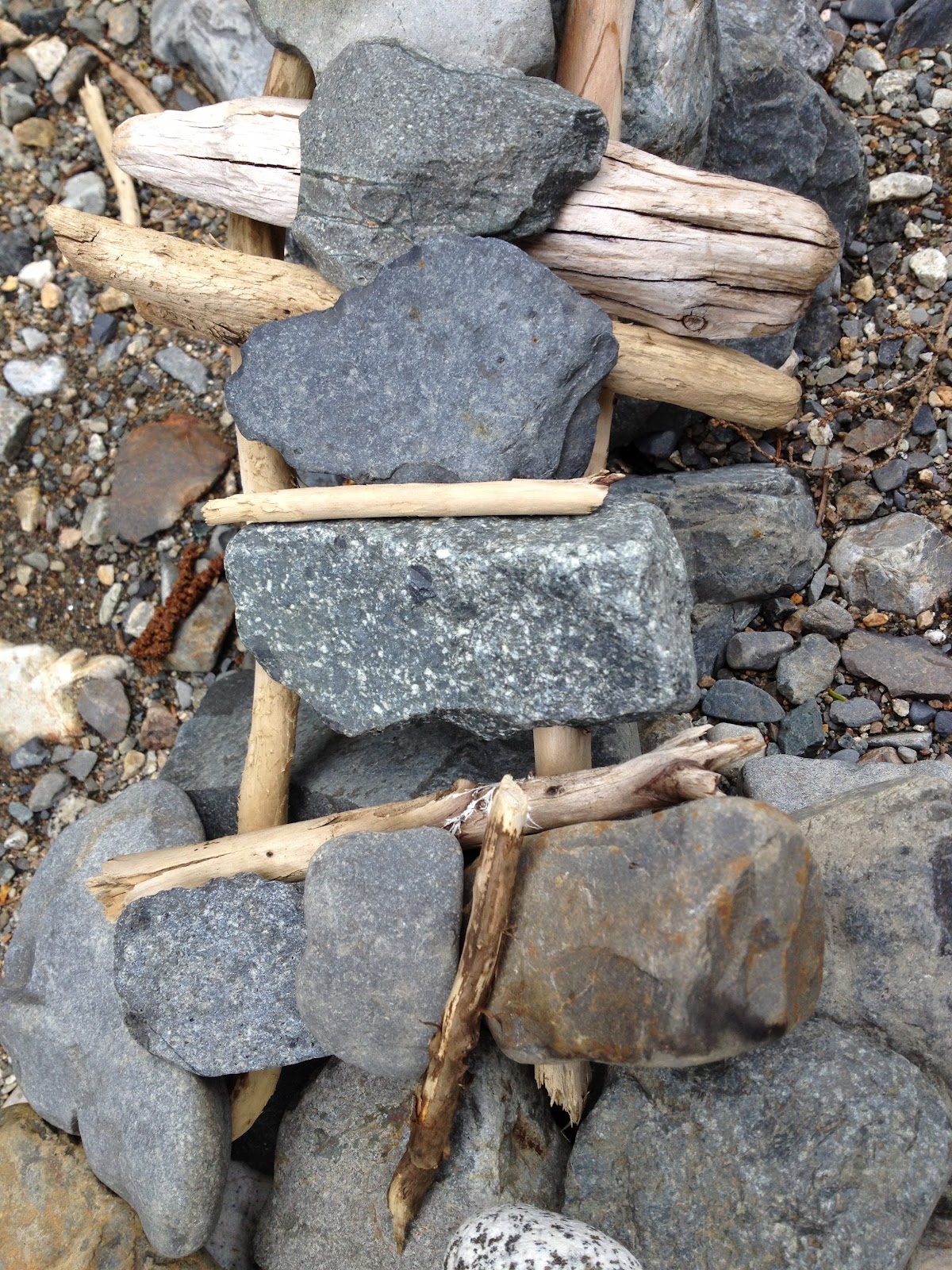
Dialogue with Materials


Have you had any good conversations with materials lately? Perhaps with clay, copper mesh, some smooth stones? Or have you watched a child gaze at and concentrate on lengths of wire, then bend, twist, twirl, coil, kink, pull, straighten, loop, dangle, hook, and reconnect the wire?

Old, new, or natural, materials make up our world: the ceramic mug, the coffee in it, the wooden table where it sits, the rug under the table, the wooden floorboards below, the Ashlar block foundation, the concrete sidewalks outside, the old elms overhead, and their shade. This is a material world.

Materials carry information about the world, how it works, and how it is likely to work. We develop a familiarity with the materials that are at hand. We come to know them through our senses; what feels sharp, soft, rigid, bumpy, slippery, or rough; how light shimmers; how this object slides; how old paint cracks. Knowing begins here, with the senses. Drawn deeper into the material through our senses, we go beyond what we knew before. Our knowledge of our world is more precise.

We may have no other end in mind than to explore what this material can do and what we can do with it. We observe, notice, and wonder. We explore the obvious aspects of a material. We compare what happens by adding a little pressure or a lot. We bend it a little or stretch it so much it cracks or tears. We learn from rather than about materials.

Materials invite spoken and unspoken questions. What will happen if…? So we manipulate the material and predict what will happen next. We wait and watch. We persist in trying to make it happen again. Later, we return to the material to find out if it has changed with time. Another question pushes forward and a once-casual dialogue with a material becomes research. 

Using a material we not only learn its properties–this wire is springy–but we also experience what dealing with that property actually means, how to work with it or subdue it to accomplish our intention. We find things out for ourselves and enjoy the feeling of having learned something ourselves.

When we stay with a material, we find new possibilities. This familiarity offers new information, suggests ways to represent an idea, or hints at a fanciful purpose. Our dialogues with materials change our understanding and imaginations and reveal beauty, complexity, ideas, and promise. 


How can we create more rich opportunities for adults and children to engage freely and explore many kinds of materials in museums, schools, and at home?


Resources
Beautiful Stuff. (1999). Cathy Weisman Topal and Lella Gandini. Davis Publications, Inc.: Worcester, MA

In Dialogue by Jennifer Azzariti: indialoguedc.com/category/materials/