Tuesday, January 10, 2012

Light Table Explorations


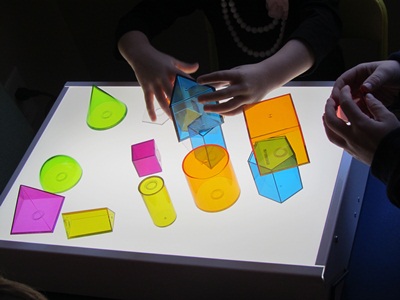
It may be the short days and long dark nights of winter, especially in the northern tier of states that make me think about light tables. I am always attracted to them, but now, especially, I love the pool of light spilling out from it  and illuminating the faces and hands of children and adults.

A light table typically has a translucent top illuminated from below and is often used for making tracings, examining color transparencies, back-lighting–except when it’s not. These tables are used in architect’s offices, design studios,  for home crafts, in museums and preschools. When they are in exhibits, art studios or preschools, they might be covered with sand or salt, doilies, blocks, or x-rays.

Light tables have found their way to museums and preschools from several sources. One is the pioneering work of Victor D’Amico, the first director of education (1937 - 1969) of the Museum of Modern Art (MoMA). His philosophy of creative teaching placed children at the center and connected creativity to innovation for preparing children to live in a democratic society. One of the motivational objects D’Amico designed for MoMA’s studio classes first called the Young People’s Gallery was a table-top light box where children could mix colors to create new ones using colored Plexiglas shapes.

More recently, light tables have found a place in museums inspired by the innovative pedagogy practiced in the preschools and infant-toddler centers of the city of Reggio Emilia (Italy). In these centers, there is great respect for the child as a capable learner and recognition of the environment as teacher and source of beauty. Teachers observe, listen, and record learning about children’s thinking. Light is considered a material, a language, and a way for children to create new languages and possibilities.

Dialogues With Light
Light is something you can touch and yet, not really touch. This and the power of illumination invite small hands, roomy imaginations, artists’ sensibilities, and scientists’ observations to engage in playful and serious explorations. It’s not unusual to see children and adults encountering light tables in immediate sensory, physical, and emotional ways.

A light infused building platform
Investigations may start with mixing colors, stacking and overlapping colored Plexi paddles, tissue paper, or colored cellophane paper to see what happens and to make new colors. From a basket a child may select everything green and arrange a landscape. This landscape may dissolve into patterns of shells and buttons or a collage made with plastic caps, sea glass, or pom-poms.

Papel Picado  patterns in En Mi Familia

 
Sorting and arranging objects and materials on the light table, one child might notice that light shines through some objects a lot, others a little, and some not at all. Another child is interested in the patterns of light and dark from paper doilies, perforated designs of papel picado, holes punched in paper, and mesh. Why does light pass through the acrylic prism one way and pass through differently if the prism is turned around? Light invites spoken and unspoken questions ? What does this object look like when filled with light? Where are the shadows when light comes form below?

Illuminating bones at Explora
Placing a book and small figures at the light table or paper puppets or paper dolls, children tell and retell stories to themselves, friends, and parents. They explore the form and feel of letter and number shapes swirling yarn or bending wire or glow sticks; they make squiggles in the sand, or trace shapes with a pen on transparencies. The vocabulary of light, its properties, and effects emerges and grows from these explorations: bright, glisten, glow, glimmer, shimmer, soft, shine, sparkly, shadowy, luminous.
  
Clearing the way for light, small hands plow sand
The light table makes it easier to see what can otherwise be difficult to see. A face glows as someone leans across the light with a new question, shares a crumpled candy wrapper, or points to the pool of light on the ceiling. Light tables illuminate x-rays and reveal the insides of snakes; the light shows the delicate details of a flower petal, feathers or a butterfly wing, enlarged under a magnifier.

There isn’t any subject matter area that the naturally interdisciplinary light table and its vast array of companion materials can’t cover in open-ended ways. To these rich possibilities, children and adults bring their interests, their many ways of exploring and knowing, and what is beautiful to them about the light.

Bringing Good Things to Light
I am impressed with the capacity of light tables–in their many variations in school, exhibit, and studio settings–to engage both children and adults. Light tables seem to have physical, social, and cognitive dimensions that work together as if as a single dimension. In a semi-darkened area, light connects people and establishes a sense of place, often in an evocative and beautiful way. Within this place, it is possible to explore the physical and expressive qualities of light.   

I am also drawn to how easy it is to be competent and creative at light tables at every age. Intent and absorbed as they explore light tables, infants and toddlers will pull themselves up on and crawl over light tables; with each movement they notice how light interacts with and changes different materials and objects, including their hands. Light tables also capture the attention and interest of adults as children’s companions, engaging their questions and ideas. But they are not just for children or for adults who are with children. Perhaps you remember the u-tube video of Kseniya Simonova, a Ukrainian artist who combined music and her sand painting skills to depict Germany's invasion and occupation of Ukraine during WWII.  

Changing the set-up or setting of a light table–even just slightly–generates intriguing new possibilities. Place mirrors along the side, at the end, or overhead to reflect children’s activity to the child as well as to the adult. Shift from a flat to angled surface or from white to colored lights. Place a tub with bubble solution on top of the light table; spread the table with sand; put the light table inside a small tent; or add an overhead projector to project colors, shapes on the wall. Any of these variations launch new explorations.

Museum of Science, London     Light wall in Reggio Emilia


Follow The Light
• The same mylar light box step-by-step: http://makeprojects.com/Project/Mylar-Light-Box/153/1
• Science Museum of London’s light table: www.sciencemuseum.org.uk/objects/interactives/launchpad/light_table.aspx


Tuesday, January 3, 2012

In Praise of Small Gems

View into the galleries: The Museum of Russian Art

I had several ideas in mind for the first Museum Notes blog of 2012; writing about a holiday visit to The Museum of Russian Art in Minneapolis hadn't been one of them.

The Twin Cities is a museum-rich community with many choices for a holiday museum visit. Originally, my husband and I had thought we might visit the recently expanded Weisman Art Center or the Minneapolis Institute of Arts. As we went out the door, I suggested visiting TMORA; I had been to before, but my husband had not. We hadn’t known about the current exhibits. We simply headed for the museum and found this relatively new, small, and out of the way museum to be a small gem.

The Museum of Russian Art (TMORA) was founded in 2001 by American art dealer Raymond E. Johnson and his wife Susan with works from their private collection of Russian art. First opened in a Twin Cities suburb in 2002, the museum re-opened at its current location in south Minneapolis in 2005 in a renovated and long-empty church.

In spite of its location in a residential neighborhood and facing a sound barrier along the interstate, the museum is quiet and intimate; it feels like a refuge worlds away. Renovated by Julie Snow Architects, Inc., the building was remodeled just enough to re-purpose the space, highlight details, and maintain a sense of calm. A clear glass rail on the mezzanine and careful attention to lighting open, connect, and soften the space. Restoration succeeded in revitalizing the building for showing Russian art from the 20th century as well as artifacts from the 3rd century B.C.

The two current exhibits are The Art of Oleg Vassiliev: Discovering 20th Century Russian Masters and Antiquities from the Ukraine: Golden Treasures and Lost Civilizations. One of the most prominent members of the non-conformist art movement that flourished in the Soviet Union, Vassiliev now lives in the Twin Cities. For 30 years he managed to stay under the Soviet radar and earn a living by being a children’s book illustrator at a Soviet publishing house. The exhibit features a selection of 75 of his works on paper, book illustrations, and paintings that span 50 years.
Antiquities from the Ukraine follows a chronology of archeological artifacts from the Neolithic age to the Byzantine era unearthed in the Ukraine. Artifacts created and left by the peoples who lived in, traded with, traveled through, invaded, and occupied the region include 7,000 year-old Trypilian pottery, Cimmerian bronze swords from 1,100 B.C., and 3rd century B.C. gold jewelry ornaments from Scythian burial mounds. 
Convivial and Well-composed
The museum was pleasantly packed; the cashier mentioned this with obvious delight as we entered. The three gallery spaces–ground, mezzanine, and lower levels–were small enough for us to be able to stand close to art and artifacts and pass by others without jostling and bumping. The spaces were not just pleasantly packed; people were also engaged and connecting. Connections were seasonal, personal, and sometimes inspired by the artifacts. I noticed a few people pausing and greeting others for the briefest chat and new-year greetings. Occasionally someone spontaneously commented on the astounding size of clay jars from the 4th century B.C., inviting comments and opening up a conversation.
Besides a good size crowd, the visitor mix was varied in a way I don’t often find in the Twin Cities. Europeans, families with children, 20 and 30-somethings, and multi-cultural and cross-generational groups filled the galleries. I heard Russian, Polish, Turkish, and German spoken; three young sisters repeated in German in hushed tones to their mother, “Guck mal, Mutti!” (Oh, look, Mommy) as each pointed to a fantastic gold necklace, buckle, earrings, or crown.
As a museum planner, I couldn’t help but wonder how this small, relatively new museum drew such a large crowd. I overheard a TMORA staff person and intern talking about how the museum had done no marketing over the holidays. A small museum’s voice could hardly compete with holiday roar of  Target and Wal-mart. So, perhaps Vassiliev has a local following. Or perhaps people simply know how to find their way to a museum for beauty, respite and shared experiences, especially around the holidays.
We hadn’t come to TMORA with a particular interest in Russian art or Ukrainian antiquities. Nevertheless, we were drawn in, and fully. I noticed and was somewhat surprised at how I found myself caring about these artifacts and where they had come from; hoping my Ukrainian neighbor could see the exhibit; enchanted by Vasssilev’s children’s book illustrations. Viewing Vasssilev’s House with the Mezzanine prints inspired by Anton Chekov’s story, “House with the Mezzanine,” I decided I want to read that with my book group.
Reflecting on my previous visit, the nature of my engagement with these two exhibits, and my observation of others, I think TMORA has successfully shaped an experience congruent with its mission: “We believe that learning about other cultures enriches our lives. We believe that a small museum can make a difference by fostering the human connections that bind us together in an increasingly global society.” One way the museum extends the experiences is through The Izba, the museum shop, a rich social, visual setting with music, coffee and lovely, high quality including amber jewelry, lacquer art, porcelain, glass, icons, and matryoshka dolls. 
I left with the agreeable feeling of having been to a special event planned for me. Over the last few days I have been able to conjure up these sensations, find new questions, and recall the delight of exploring TMORA.
A Toast To Small Museums
Let me start 2012 with a toast to small museums and to small gems, in particular. My appreciation for small, and just smaller, museums grows with each visit to TMORA, The Rubin Museum of Art (New York), the Wing Luke Museum (Seattle), and The Textile Museum (Washington, DC) as well as from working with the Bakken Museum in Minneapolis.
These are museums that are doing well at being themselves on purpose, including having a sharp sense of purpose. TMORA makes an expressed commitment to being small in its mission statement. Being intentional in declaring a purpose is a great navigational tool for the decisions and choices every museum must make. It gives clear direction; fosters coherence among exhibits, programs, and scholarly work; and pushes for deeper and new perspectives in declared territory. Being small may even discourage going off-mission very far or for very long. Challenges of funding and operating small museums are no less than for larger museums and are often greater. While resources may be extended by resourcefulness and nimbleness, there are limits to what ingenuity can produce. A smaller size helps create the conditions for personalizing experiences and making connections with the audience; Nina Simon at the Museum of Art and History (Santa Cruz) has been exploring and sharing this on Museum2.0.
I am gradually recognizing that the draw of smaller museums for me is how the dimensions of experience–aesthetic, social, physical, and intellectual–merge and unfold across a small space and maintain coherence during a visit. Contained within those smaller spaces, the feel of the experience presses in and makes its imprint. This is what I look forward to finding in museums in the coming year.