Showing posts with label Science Museum of Minnesota. Show all posts

Saturday, July 9, 2011

Wonder Years: The Story of Early Childhood Development


Wonder Years: The Story of Early Childhood Development, an exhibition from the Science Museum of Minnesota (SMM) should be in a mall. I mean that in a good way and as a sincere compliment.

The exhibition presents the science of young children’s development and insights into their everyday learning from the world around them and places both in a larger social and civic context. A clear long-term community interest is expressed in an ambitious goal: “Ensure that all children benefit from the growing body of knowledge about the science of early childhood development and get the best start in life.”

While the exhibition works in the Museum’s 4th floor Human Body gallery, a mall setting would bring this message to a broader audience and further build on the Museum’s mission: Turn on the science: realizing the potential of policymakers, educators, and individuals to achieve full civic and economic participation in the world.

 My interest in the strong children-strong communities connection I’ve written about previously drew me to explore Wonder Years three times from March to late June. The first time I participated in an SMM tour for Minnesota Association of Museums and heard from Project Leader, Laurie Fink, about the exhibition. I spent an afternoon on my own exploring Wonder Years and a third time, I ducked in to it with a friend prior to visiting Tutankhamun.

SMM and its partners have managed the challenge of creating an engaging visitor experience with a serious public message. Alignment of a solid conceptual approach with its intended audience, a varied experiential mix, and a robust community platform is deliberate and strong.

The exhibition and related programs and events is a partnership among SMM, the Center for Early Education and Development (CEED) at the University of Minnesota, and Public Agenda, a non-partisan engagement organization. Funding is from the National Science Foundation.


Reaching a Broad Audience
A Wonder Years flyer identifies the intended audience as teens and adults, parents and non-parents, anyone with a child,  was a child, or lives in a community with young children. In short, the audience is intended to be everyone. On each of my visits I saw a variety of visitors and visiting groups. There were 3-generation families, parent-child pairs, families with young children and with children of very different ages, groups of teens, groups of young adults, and young couples.

Some of these and future visitors may also be policy makers and community leaders. Very likely, many adults in the exhibition have a major role in the lives of young children–their own children, grandchildren, nieces or nephews; young neighbors, students, or youth volunteers. These relationships provide strong personal connections to exhibition content. As a neighbor, volunteer, mentor, caregiver, voter, and taxpayer, virtually every adult has a citizen’s interest in children’s current well-being and potential. Children’s experiences today shape their capacity as adults to work and take part in the community; this is the source of a community’s future vitality and resilience.

The flyer also makes clear that Wonder Years intends to reach and engage members of the community more broadly through public programs as noted below. These will undoubtedly draw in members from other parts of the community. Yet, broad and varied as visitors to SMM are and as inclusive as related programs are, a mall would undoubtedly provide a broader audience.


A Solid Conceptual Approach
The exhibition brings together recent research on early brain development, insights into how young children learn from the world about them, and a perspective on early childhood development as a common interest. 

A positive view of young children as strong, competent, and born to learn comes through clearly. Focusing on children's remarkable accomplishments before they even enter school and highlighting the great promise of the first years of life, the exhibition does establish early childhood as the Wonder Years. Overall it avoids clichés about young children and presenting them as cute. Large images of children on photo banners show them playing, engaging in everyday exploration, talking, touching, and laughing, hugging and being held. These images express and reinforce messages about the importance of positive relationships, active engagement with the world, and early language experiences. Occasionally the gleeful laughter of a laughing baby video can be heard and it is delightful.

Four key messages organize exhibition content and guide lay-out. The interests and perspectives of researchers, experts, parents, young children, and citizens intersect with areas and activities and reinforce the messages.
•             How scientists learn about children’s development looks at pioneers of child development research, how scientists study young children, and some questions that interest researchers.
•             What is happening in early development explores the role of early experience in shaping the brain and brain architecture; early language experience and the brain; and early social, emotional, physical, and cognitive development milestones.
•             How young children learn from the world around them highlights some of the amazing feats of early learning, the role of vision in language development, and the importance of play.
•             The impact each of us has on the healthy development of our youngest citizens brings together the impact of strong and positive relationships, the importance of everyday moments, and the contribution of many hands to the experiences children need for the best start in life. 

An important principle in early development comes across consistently throughout the exhibition but it is not made explicit. Interaction is critical and constant: interaction among developmental domains (physical, social, emotional, etc.), between children and the environment; and  interactions with parents, other caregivers, and others involved in children's lives.


Experience As Message
Wonder Years takes on and meets challenges many exhibitions face in translating information rich topics into active experiences without compromising content. It covers recent research, technical information on brain development, and hard to visualize processes of language acquisition and development. Resisting the temptations of extensive text, Wonder Years forges a fresh mix of familiar formats and creative strategies to present content experientially.

Videos, biological specimens, microscopes, quizzes, puzzles, and games familiar in many exhibitions are used well here. There are opportunities to hear what experts say, set-ups for conversation, and an invitation to record opinions on issues. Content is accessible and presented in both English and Spanish in text and videos. The writing style is generally clear and engaging and sometimes crisp, like “Experience is the brain’s electrician.”

How pruning makes the brain more efficient
At components like Connections Shape the Brain, text, images, and a relevant instrument or model work smoothly together. Illustrating how pruning makes the brain more efficient, flashing lights show the path a message might take as it travels through the brain of a toddler, a child, and a teen. A mother comparing the three ages told her 5-ish year old son, “That’s’ why we do things over and over again. So we can do them faster.”

What the exhibition does exceedingly well is to power exhibition messages with visitor activity, sometimes getting inside the experience of a researcher, a parent, even a baby. This parallels the critical importance of experience for early brain development; “Experience shapes the brain,” one text panel notes. Similarly, engaging in conversations, tasks, role-play, and perspective taking affords a first-hand experience.

"We are going to do an experiment."
 Children’s activity sometimes becomes the exhibit. I saw parents test their child’s “theory of mind” or being able to understand that others have their own thoughts and feelings. Saying, “We’re going to do an experiment with you, Kayla.” a mother settled in at the table and guided her 2-year old daughter through the test. 
The child's activity becomes the exhibit.
In the exhibition’s pretend kitchen, children climbed on the stool at the sink, turned on faucets, and washed dishes. Well-positioned text panels cued parents on opportunities for language, interaction, and how these support a child’s development for precisely those child behaviors they might see. Nearby, children as well as adults looked through a set of three goggles that allowed them to see like a baby sees at birth, at 1 month, and at 3 months.


Seeing as newborns and infants see.
The exhibition design is not as strong as the content. Occasionally it detracts from the experience and messages. Multiple exits and entries interrupt the flow serving as paths between the building's elevators and stairs. White text on pale blue panels renders text almost unreadable. One video is mysteriously placed at about 8 feet above the floor. Finally, design styles, particularly color palettes, differ between areas and feel as if they came from separate designers or even projects.
 

Community Platform
Wonder Years is framed as a project with an exhibition. Its strong and complementary partners are key to this configuration. They combine expert content, experienced public engagement, and a recognized public venue.

A slate of community programs has significant, although less obvious, presence than the exhibition–certainly for museum visitors. Nevertheless, they are planned to actively engage members of the community in considering what the science of early development means to us as individuals, to our communities, and to our youngest citizens.
  • Citizen Conferences were held in the Twin Cities and in Greater Minnesota in May 2011. For parents, early childhood advocates, state and local policymakers, and interested community members and citizens, the focus on these half-day working sessions was to explore society’s responsibility to children birth to 5 years.
  • Issue Conventions are intended to encourage smaller groups of organizations and community groups to explore how the exhibition and programs can further their efforts at educating others and expanding networks.
  • Public Forums in Fall 2011 will bring experts and community members together for public presentations and conversations on the scientific findings and their implications for families and communities.

The partnership mix also suggests how seriously SMM is taking its goal for all children to benefit from the growing body of knowledge about the science of early childhood development and to get the best start in life.


Wonder Years is an engaging and responsible look at a critical social issue: the early development of children, their future capacity, and the ultimate strength of our communities. I think this makes Wonder Years a great exhibit to see at the mall. I hope you get to see it there. 

Resources
•            Gopnik, Alison; A. Meltzoff and P. A. Kuhl. (1999). The Scientist in the Crib: What Early Learning Tells Us About the Mind. William Morrow & Co: New York.
•            Hart, B. and T. R. Risely (1995). Meaningful Differences in the Everyday Experience of Young American Children. Paul H. Brookes Publishing Co: Baltimore, MD.
•             Schonkoff, Jack P. and D. A. Phillips (Ed.) (2000). From Neurons to Neighborhoods: The Science of Early Childhood Development. National Academy Press: Washington, DC.

Monday, March 28, 2011

The Well-used Advisor


Last week I spent 1-1/2 days as an advisor at a partner and advisor meeting for Math Core at the Science Museum of Minnesota (SMM). A collaborative project funded by the National Science Foundation, Math Core for Museums is intended to provide rich, engaging, long-term experiences and environments for children and youth 6 through 12 years old and their parents. Approaching the end of its second year, the 4 partners, SMM, Museum of Science (Boston, MA), ¡Explora! (Albuquerque, NM), and Museum of Life + Science (Durham, NC) have developed working prototypes about ratio and proportion to stimulate mathematical imaginations and builds mathematical abilities and:
•                encourage children to acquire deep understanding of math concepts;
•                make the practice of math skills surprisingly enjoyable; and
•                help children identify success with math as personally relevant and rewarding.]

A long-term exhibition will open at each partner museum bringing several innovations:
•                open-ended and planned discovery experiences that engage children and their caregivers with ratio and proportion repeatedly over many museum visits;
•                exhibition design approaches that involve visitors in verbalizing their mathematical reasoning, going beyond simple empirical observations to reach more general conclusions; and
•                the use of kinesthetic experience and design arts as a major area of application and insight into the nature and use of ratio, proportion and similarity.
 
Advisors Wanted
As we think of them in museums, advisors bring expertise, experiences, and perspectives that are otherwise difficult to access. Even if a museum had all the expertise it needed in-house, being self-contained would not produce the same healthy vibrancy that engaging colleagues as advisors does. With backgrounds in other museums, in non-museum settings, and in the community, advisors contribute a fresh dose of the outside world. Advisors may have specialties that complement or extend available internal specialties. Often their participation serves as a valuable capacity building opportunity for staff. Whether bringing a critical perspective to long-term museum strategy, providing more extensive experience on a project than is currently available in the museum, or contributing an expertise such as science or literacy, advisors are important among a museum’s stakeholder groups as I’ve written about before.

Over the years I have had the good fortune to be a well-used advisor on several  projects. Looking towards the other end of the advisor spectrum, I have also been invited to be an advisor and provide a letter of support; perhaps I heard when the project was funded but then heard not a word about the project. When I have been a well-used advisor, I have been put to work productively on a project’s behalf. This last week’s project was definitely such an invigorating and rewarding opportunity. Over the course of two terrific days, I thought about what was coming together to produce a highly successful meeting that significantly advanced the project and justified the considerable expense involved. While this is a large project that is well-funded, the underlying thinking that applied here can also work for smaller projects and in smaller museums.

My observations and perspective are as an advisor and are also informed by comments from other advisors and partners. They cluster in a few areas.

Making the Most of Advisors
Three consideration make the most of advisors and partners coming together in one place over a period of time to be highly productive.
Relevant and deep expertise about a topic or topics. A wide range of expertise is required for any complex project.  I certainly think collaboratively creating an interactive exhibition about mathematics for children and youth (at 4 locations) qualifies as complex. As people introduced themselves and shared observations, it was clear that the assembled expertise reflected the full dimension of the project, fuller than I had first realized. It was varied, deep, and relevant. Various types of expertise were present, for instance: in accessibility, mathematics, embodied cognition, new media, visitor research, math education, and prototyping. In some cases, the expertise of a partner or advisor was quite specialized and just what the project needed in a particular area.
A mix of perspectives. Perspectives, while informed by expertise are also shaped by experience and background bringing different lenses and filters to a topic or project. Perspectives criss-cross and intersect in interesting ways to open up a question, tackle an issue, or find a solution. Some similar but distinct viewpoints were apparent among internal and external and museum researchers as well as mathematics researchers; mathematics and science educators; educators from formal and informal learning settings; museum and non-museum informal settings.  Viewpoints on how messy exhibit activities could be varied among partner institutions . 
Gathering input on moving ahead
Lively discussion. Thoughtfully selecting advisors and partners for expertise and perspective would be utterly lost without a comparable commitment to engage, connect, and mix people and perspectives in various ways. This does not mean encouraging polite conversations and high levels of agreement. To the contrary, it means creating a shared sense of purpose, valuing different voices, guiding with questions, and providing time for open conversation and reflection. In fact, it’s likely that somewhere in the course of the meeting there will be messy moments, a productive tension, and (if I might be a touch dramatic) the triumph of a collaborative spirit.

A Productive Gathering
An unimaginable amount of thought, planning and pre-planning goes into any meeting, let alone a meeting that brings dozens of people together from a dozen states, is highly accountable to the outcomes of a significant project, and is respectful of people’s time. I thought several of the features of the meeting really contributed to its value.

Great gatherings start with thoughtful advisor and partner selection. Besides selecting for expertise and perspective, advisors have to be interested in the project and value the opportunity to contribute. This means a willingness to make time on their calendar, to participate actively and turn-off phones, and to believe fully that what others have to contribute is as, or more interesting, than what they have to say. After you have the group of partners and advisors you want, the following come into play.

•                Advanced preparation. People are busy. Get dates on the calendar early with clear information start and end times and travel arrangements; give a progress report on the project; set and share meeting goals. Send the agenda and any reports.
•                Project goals and commitments at the forefront. Nothing serves keeping on track as well as re-visiting project goals at each step of the process. While goals are bound to morph somewhat, they are the best accountability tool and centering device I know of. When a meeting brings together people who have not been working everyday on this project, opening with goals brings everyone together and focuses their expertise on the same set of important ideas.  There were several points in the meeting where returning to the goals moved us forward. 
•                Create an environment in which everyone can participate. Somewhere between extending a friendly invitation and setting a firm expectation, make it clear that the full range of experiences, perspectives, and expertise are welcome, valued, and needed. This practice is established early in a project’s history. At the first partner and advisor meeting, advisors were all asked to make a presentation about a similar project they’d been involved in and its lessons for Math Core.
How does this work? A question for learners and prototypers
•                Experience what the visitor will experience. It’s easy to assume we know more about the experience we are planning for visitors than we actually do. Even if there aren’t resources to do extensive formative evaluation, for instance, there are ways to get into the act. In an advisors meeting, time experiencing what the project will offer is essential. Twice we were able to spend time in the Museum with well-developed exhibit prototypes, once for ourselves along with school groups and once observing family groups.
•                Ample time for sharing. This meeting was well-paced with time for the whole group together, sharing results of a research study, a preliminary evaluation report and the preliminary accessibility report, along with large group discussions and reflections. There was also time and place for side conversations which was built into a “non-conference” exercise that built on side-bar conversations.

Playing it Forward
I think the meeting met its goals (and then some). Partners and advisors left feeling they had accomplished a lot and were eager to get going on the next steps. For me, great, interesting ideas and insights from partners and advisors boiled up from a quick 22 hours that I will be noodling on, working with, and writing about probably for years to come. Five seem particularly engaging.
• The value of learning, or of an experience, is how meaningfully it comes to live in a future behavior or experience. Thanks to Paul Tatter, ¡Explora!
• Children aren’t afraid of problem solving but we have to give them the materials and problems to solve to make it easy for them to see the underlying math (or other concepts) involved. Thanks to Dr. Hyman Bass, University of Michigan.
• Gestures–pointing, moving arms, making shapes in the air–as evidence of what kind of an experience a person is having. Thanks to Ricardo Nemirovsky and Molly Kelton from San Diego State University.
• Parents take their role as their child’s teachers very seriously. Their only role model, however, is the classroom teacher. How can we model, or coach, parents in informal teaching?
• Create experiences for learners to make it easy for them to move from messing around, to fluency, to improvisation.

My Thanks
Partners and planners
The presence of so many people made this gathering wonderfully engaging as did the hard work of many more I probably never saw. When I drew up a little table plan to help me remember the names of people, I counted 36 people around the tables. I can’t thank everyone but I must thank J. Newlin who gave great care to planning this, and to the project itself. J. encouraged just the kind of conversation and exchange that made it productive and an example for using advisors wells. 

Monday, February 21, 2011

Exploring Geometry Playground

Exploring the Gyroid


Geometry Playground is unusual in at least two respects. First, it focuses on math, a topic that is underrepresented in museum exhibits. Second, it’s a traveling exhibition committed to integrating a highly experiential approach. Produced by the Exploratorium and funded by the National Science Foundation, Geometry Playground was at the Science Museum of Minnesota in January 2011 when I saw it just before it traveled on. 

As an advisor on the project I was inclined to like it. I had been fascinated as I  watched exhibition ideas and components evolve over several years. Yet, I was impressed by how well project goals about geometry; social interaction; learning through immersion; and playground design came together coherently and strongly. In the playground spirit, Geometry Playground (GP) is physical, playful, and social. And it does it with geometry.

Stack of Stars
Mind and body work together all the time to provide us with information about the world. In GP, minds and bodies work together to explore familiar and novel geometric shapes at multiple scales. Children climb on, squeeze through, and peek into the tunnels of the 12-foot tall Gyroid structure. They clamber up and over and perch on the Stack of Stars climbing structure. This experiential, immersive exploration provides children with direct, first-hand experience of shapes, features, proportions, and scale. Moreover, it does so while maintaining in-tact physical and spatial relationships basic to understanding geometry. As a result, the super-sized Stack of Stars and Gyroid structure are not just a fun call to children and tweens to scramble and stretch across a novel structure. Spatial skills as well as social and motor skills are being exercised when a child shouts to others, “Come on! I know a short-cut to the top.”

Developing a whole-body appreciation of the stars (stellated rhombic dodecahedrons) comes from climbing on them and squeezing through openings between them. At the edge of the structure’s platform are also sets of smaller stars producing a side-by-side comparison of scale and new perspective on both units. As hand-held manipulables, the stars can be lifted, rotated, and fit together in Space Filling Blocks giving a concrete sense of how the star’s features fit together. Alternative ways to explore space-filling shapes extend beyond scale. Diagrams show how these not-so-familiar stars are formed from another shape by manipulating features. Nearby, turning the wheel at the Stellator shows a dodecahedron transform into a stellated dodecahedron. In addition, along the climber’s platform, photos of everyday space-filling shapes place them and geometry in the context of daily life.

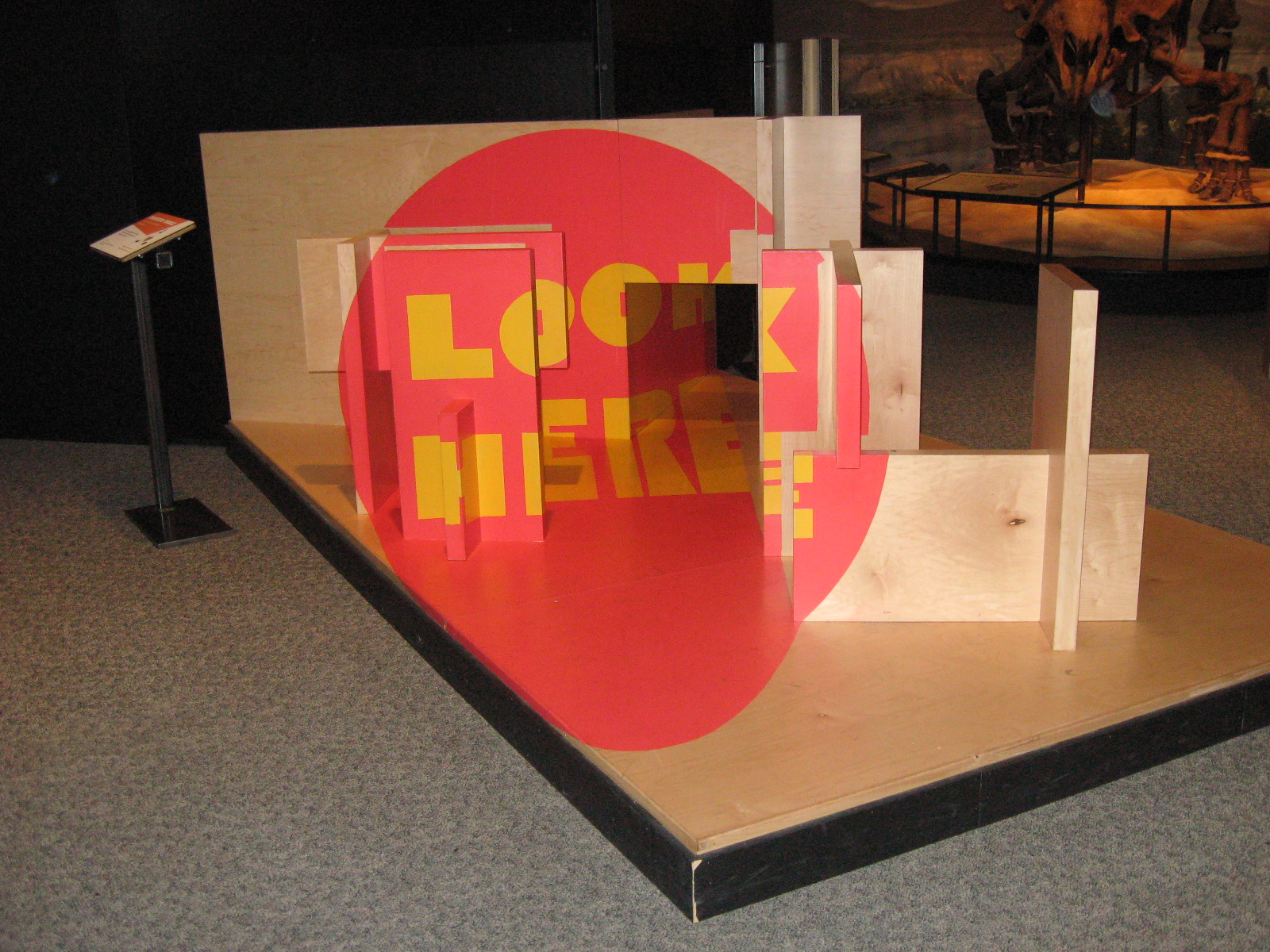
In keeping with an experiential approach to geometry, exhibit messages are integrated into surfaces and structures and are encountered by moving in and through space. Text on the floor in front of the giant Distorted Mirror reassembles miraculously into instructions. Text on the face of the Projected Puzzle becomes readable when the puzzle pieces align. Challenges for exploring the Gyroid follow the smooth curving surfaces of the tunnels precisely where children will–and must–look as  they reach and climb. 


Playful Exploration
Projected Puzzle proclaims, "Look Here."
A playful, minds-on exploration of shape, perspective, distance, and distortion complements the lively navigation of the innovative climbing structures. Lining up with the pieces of the Projected Puzzle prompts several tilts of the head to read, “Look Here” and finally gets a smile. The distorted mirror changes our relationships with familiar objects and makes them look surprising or funny. Variations on the geometry of looking into a distorted mirror produce perplexing results.  A conical mirror flips images inside out. A foot-tall cylindrical mirror transforms a radial pattern into a grid so drawing letters on the grid produces scrunched and scrawly letters to (stifle a) laugh at. Then there is the tall cylindrical mirror that wondrously squishes an elongated chair and the people on it to normal proportions. 

Distorted Chair reassembled in the mirror
 
Geometry as Social Space
Living large ...inside a globe
Several classes of students 11 or 12 years old seemed to enjoy themselves and each other as they scampered up, across and over the Stack of Stars; they talked, called out, and chatted with one another. Tweens perched on the Gyroid and wormed through its tunnels. In both cases, the structures were social space, a kind of space often absent from their settings. The novelty of this structure made hanging out on a playground cool or, perhaps, irrelevant. Here they moved, they talked, and they teased on a pile of geometry. At the hexagonal Distorted Drawing table members of a class shared tips and laughed at slip-ups. Classmates squeezed into and chatted inside a familiar object–a globe–experienced in a not-so familiar way, at a giant scale and from the inside. 

"You just find these four corners."
Workstations with seating located along the railing of the Stack of Stars platform invited exchanges among visitors, including me. Eleven year-old Mohamed paused to fit a space-filling block in a tray. Not immediately successful, he seemed ready to take off. Pointing to the block he held in his hand, I asked him about the four pyramids on one side. Just enough of a clue, it turns out. He fit the block into the tray with only a try or two. Fitting in the next few blocks went faster. I heard Mohamed say to himself, “It gets easier and easier.” When Abdullah, a classmate, stopped by, Mohamed gave him a tip: “You just find these four corners and the block fits. Like this.” The two boys worked together fitting in several more blocks so there was no wasted space. When Mohamed’s teacher passed by she asked, “Mohamed, would that be a tessellation?” Mohamed paused and answered, “It’s a tessellation. Yes! There are no gaps. Yes! I filled it up!”


… and Beautiful
Geometry Garden
Those not called to explore the exhibition’s geometry with exuberant physicality, might be attracted by its beauty. One area, Geometry Garden, is a cabinet of geometric curiosities–everyday objects, natural, sculptural, topological models, spirals. They call attention to geometry’s presence everywhere, in many forms, and often beautiful. The cases create almost a room-like space with a quiet, contained feel for lingering and appreciating the thoughtfully selected, artfully displayed and wonderfully lit objects.  Highlighting the beauty of the geometry comes through in many, smaller, more subtle ways in all parts of the exhibition as well. The space-filling blocks literally glow as they rest in back-lit trays. The lighting also illuminates the blocks’ faces, accentuating the surfaces and features.  The imposing scale of the Gyroid and Stack of Stars and selection of materials make them more like sculptures. The smooth, polished surfaces of the wooden Rotating Squares (ovals and triangles) work as striking sculptural pieces as well as artful seating, and an irresistible crawl-though tunnels.


Geometry Playground lives up to its name as a playground for geometry. 

 During my visit, toddlers through tweens in school groups and family groups filled Geometry Playground. Children were all over and inside the climbing structures. Class and family groups clustered together to build a Sculpture That Moves, design at the Tile Designer, Geometron, and draw at Distorted Drawing. Pairs of students and adults worked at the stellated rhombic dodecahedrons. Small groups of adults as well as students and teachers strolled among the lighted cases of Geometry Garden.

The lay-out at SMM seems to suggest that finding enough space for a floor-plan that builds on geometry is a real challenge. At 5,500 square feet with 12-foot tall structures, Geometry Playground is a big exhibition. It requires both significant volume as well as a huge area; it won’t fit into just any space. The solution at SMM was to locate parts of the exhibition on two separate floors. The exhibition’s flow was interrupted and many visitors likely spent time on only one floor.

The exhibition is the major part of a bigger project that included two visitor research studies, the addition of some geometry structures on playground in San Francisco. The exhibition will travel to The Ruben H. Fleet Science Center (San Diego, CA) for summer 2011 to summer 2012.

For more information visit Geometry Playground