MUSEUM NOTES
Jeanne Vergeront
Vergeront Museum Planning
Are you sometimes caught off balance by a child’s thinking? Do you pause, check your assumptions, and appreciate children’s insights, for instance, when 4-year-old Jake comes up with a timeline of world history as: “the dinosaurs, Baby Jesus, the knights, and me”? Does that just seem cute? Or do you recognize there is something more complex behind these and other insights?
This matters. How we see children shapes how we engage with them, shape opportunities for them, step back or forward as they find their place in the world. Regrettably, when we consider children’s capabilities, we often highlight what they can’t do. Babies can’t feed themselves, toddlers don’t share, preschoolers can’t read or ride two-wheelers. We confuse children’s being novices with their being deficient. Using adult yardsticks to assess their capabilities, children not surprisingly don’t measure up.
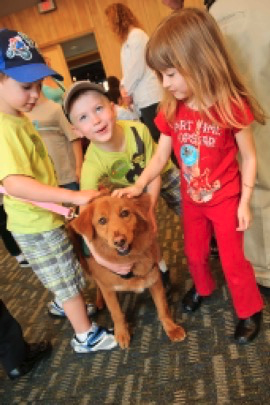
 3. Children are impressive at helping and finding helpers. While we often say children are self-centered, they, in fact, both help others accomplish their goals and enlist helpers in accomplishing their own goals. Children tend to know when to turn to others for help. Early on, they count on adults to act on their wishes and goals: to be fed, comforted, or reach something up high. Babies are reading us and our feelings. As they watch adults help, children learn to help others, including dolls and animals.
 5. Children are naturals at… having wonderful ideas. Often launched with the exultation, Hey, I got an idea! children talk to, play with, and connect with each other through ideas—how to build something, propose a story idea, solve a problem, make up a game, or make something work in a new way. Children are not just consumers of other’s ideas and creativity. Everyday they generate possibilities from what fascinates them, what they wonder about, their knowledge of the world, and their imaginations. There’s joy in the movement of ideas, ideas that build on other suggestions. Children delight in their ideas adding, I know what we can do and Let’s try this.
 7. Children are great at … making metaphors. We’re accustomed to thinking of metaphors in art, literature (she has a heart-of gold), and scientific advancements. Metaphor is, in fact, a way of understanding and experiencing one kind of thing in terms of another. Basic to human communication, metaphor is something we use consciously and often unconsciously.
When, however, we slow down, look closely at children with genuine interest; when we are open and appreciate the remarkable ways they make sense of the world, we see competence, capabilities, possibilities, a spark.
The more we pay thoughtful attention to children, the more we discover their extraordinary strengths and capabilities. We notice that children have some great capabilities we hadn’t recognized.
What are children great at? You might be surprised.
open and appreciate the remarkable ways they make sense of the world, we see competence, capabilities, possibilities, a spark.
The more we pay thoughtful attention to children, the more we discover their extraordinary strengths and capabilities. We notice that children have some great capabilities we hadn’t recognized.
What are children great at? You might be surprised.
1. Children are great at… making connections. They make connections between previous experiences and knowledge and new knowledge and new experiences. Young children connect actions and consequences; understand that symbols stand for words and numbers; find similarities between very different objects; and understand that expressions reflect feelings. This work starts early. When 2-year-old Gwen eats something she likes, she says, “I eat it all gone, none left for Mommy.” Later looking out a window watching a squirrel eat grass she says, “Squirrel eat grass, none left for Gwen's feet.”
Parents, educators, and adult friends play important roles in creating the conditions that encourage children to make many, varied, and fresh connections. When adults step back and allow children to explore spaces; select unscripted materials; invite them to notice details and incorporate them into their play; when adults respond positively to children’s curiosity, ask open-ended questions and talk about shared experiences, they are nourishing children’s inclination to make and build on connections.
2. Children are naturals at… developing theories. We don’t have to be scientists and run randomized control groups or develop theories. In fact, we constantly construct, test, and revise our theories about the world. Children do too. Driven to explain the world, they develop theories about how the world works. As young as 4 years, children develop a “theory of mind.” They gather information from interactions and observations about what others think and feel that are different from their own wants and beliefs. They analyze evidence based on what they experience, drawing conclusions and revising their theories. And they test their theories by asking questions, making new connections, and making predictions.
The process of developing temporary explanations about all sorts of things is a precursor to critical thinking. Why did it happen this way? What will happen if…? Children notice patterns of evidence; they understand about contingencies and how different actions and objects have causal effects.
Developing theories benefits from having time to understand nonobvious causal relationships. And that’s what happens when children play, explore material-and object-rich spaces, and learn with and from other children.

When children see someone in trouble, they want to do something to help. They like helping. Children step in to help because they have an idea, a skill, or strength they enjoy using. They like being part of the group, playing with others, and accomplishing something bigger with others.
Adults can show empathy, and act on behalf of others. Rather than socializing children to focus on their own work (Keep your eyes on your own paper), adults can invite children to think together and share ideas, offer multiple avenues for input. Mixed age and ability groups offer opportunities to help and be helped. It’s important to let children be helpful even if it means a bit more of a mess.
4. Children are accomplished at… pretending their way to more complex understandings. They are curious; they ask questions, think about possibilities, and imagine different ways the world might work. They do this through their theories, understanding something about an object or subject matter, and through pretense—in play. In imagination-based thought during pretend play, also known as counterfactual thinking, children imagine alternatives to the current picture of the world and reason about what might happen if?
Children are adept at generating possible worlds in every day moments, about the house, in play, drawing on their growing knowledge of objects and events. Possibilities emerge as children imagine various ways things might go and bring new worlds into existence. They might pretend there is no gravity. They know that the world doesn’t act that way, but what if it did? How would we walk? fly? eat? These unreal scenarios draw on what children know about gravity, weight, movement and develop their ability to reason counterfactually.
Adults can support children’s play with possible new worlds by encouraging imagination-based play, inviting children to think about alternatives and, predict what might happen.
 5. Children are naturals at… having wonderful ideas. Often launched with the exultation, Hey, I got an idea! children talk to, play with, and connect with each other through ideas—how to build something, propose a story idea, solve a problem, make up a game, or make something work in a new way. Children are not just consumers of other’s ideas and creativity. Everyday they generate possibilities from what fascinates them, what they wonder about, their knowledge of the world, and their imaginations. There’s joy in the movement of ideas, ideas that build on other suggestions. Children delight in their ideas adding, I know what we can do and Let’s try this.
 Having wonderful ideas contributes to children’s intellectual and social development. Wonderful ideas help grow more wonderful ideas giving children a sense of the power of their minds, their imaginations, and their relationships.
When adults step back, observe and listen to children’s ideas; provide space and time for children to make, test, and modify connections between ideas; and let children take their ideas where they need to go, children feel empowered in having and sharing ideas.
6. Children are experts at… being informants on what they like, notice, value, and what is meaningful to them. In areas where they have first-hand experience, expertise, and familiarity, children have abundant and valuable information. They are eager to share their adventures, stories, and accomplishments; feelings emotions, ideas, and possibilities that excite them. They tell us who they are and are becoming, giving us a glimpse of what matters to them that is not otherwise available to us.
When we don’t involve children as participants and co-constructors with us in making decisions on their behalf—in research, design of places for play and learning, creating activities, and selecting materials and objects— we miss insights we need if we are to empower them and serve them well.
When we do partner with children, however, they talk, draw, act out, and use materials, to share their views and express their thinking. They narrate adventures, mention details adults overlook, and make novel connections. We find clues to how they view and make their place in the world.
Several approaches—here, here, and here—inspire us with examples of engaging children in meaningful ways on topics that affect them, and places to live, learn, and play.

Children are thinking metaphorically when they perceive a visual similarity between two very different objects that are not usually yoked together. Knowledge of the one object amplifies knowledge of the other. Play is full of metaphor, both verbal and visual. In play, the light may have a voice, a feather may evoke a sword, a bald head might be a “barefooted head”.
There is something more complex behind these charming images. Children are using their knowledge of the world and their creativity to exploit the possibilities of an object’s features, opening up rather than confining its perimeters. Object- and experience-rich settings, opportunities to manipulate objects, freedom to explore their features and sensory qualities, varied ways to express ideas and solve problems, and questions such as what does it remind you of? invite metaphor and metaphorical processes.
8. Children are natural … democratic citizens. Curious, engaged, born researchers, wanting to belong, and attuned to the interests of others, young children possess the habits and dispositions related to democracy. They feel a sense of us which is evident when the child introduces an idea with, Let’s… When other children add, I’ll be the dog or I’ll drive the spaceship, they are playing with a shared mindset. Through listening, talking, and considering other points of view, they think and act for themselves. They create their own activities, make up their rules, solve their own problems, share narratives, and collaborate on projects—together. They create a world.

Children’s interest in the common good is expressed on behalf of a group of children in a class, on the block, or an informal group at a museum or library. Space that children can claim for themselves—on the front stoop, the sidewalk, in a fort, or under a tree—is space shared with other children, thought about collectively, and an opportunity for learning to live together.
Rather than teach—instruct—children in democracy, adults can model inclusive approaches and provide environments that value differences; invite varied points of view; use language children can use such as I think, in my opinion. Offering children opportunities to see the community and be seen by the community and engaging them in research and planning brings insights into our understandings that are not otherwise available.
9. Children are born creators of a culture of childhood. More than an age cohort, the culture of childhood is children’s shared experiences of growing up and finding their place in the world. It is a continuous dialogue: children form the culture of childhood which, in turn, forms them, shaping their social identity, creating a sense of community, and opening possibilities. Encompassing the hallmarks of culture—language, objects, materials, expression, meaning, and symbols—it is a continuing force of connection, community, and hopeful futures. Play in many forms is the native language of the culture of childhood. Children find and solve problems together; figure out, communicate and negotiate rules; and they fill roles that adults take when they were present.
Adults can recognize and encourage the culture of childhood and make it visible. This may involve expanding the cultural space of childhood by engaging children, families, educators, and community members in co-constructing outdoor spaces, museum spaces, nature areas, play environments, and other informal learning settings where children can come together, experiment, and creatively explore using multiple modes of expression, materials, and media. And make their mark on the world.
Before Our Very Eyes
These and other capabilities fundamentally challenge our assumptions about what children can do early in life. When we are optimistic about children’s competencies at a young age, we discover extraordinary strengths and capabilities and are less preoccupied weaknesses and limitations. We don’t need to wait for these capabilities to emerge later in childhood. They are, in fact, present early in children’s lives, bringing joy, and enriching childhood. When we encourage and support these capabilities in children in rich, varied, and welcoming settings, children see themselves as thinkers and doers, makers and creators, friends, and helpers.
Museum Notes
Also