Monday, August 29, 2011

Bookworm Gardens


Bookworm Gardens is not the storybook garden you might imagine with oversize teacups, fairytale castles, and a theme-park feel. Instead Bookworm Gardens is stories remembered and imagined from childhood found, in woods, fields, and sunny glades, and made fresh and vivid with plantings.  

Located on eight acres of land made available by Sheboygan County in eastern Wisconsin, Bookworm Gardens is the dream of founder Sandy Livermore. It has grown through the commitment and generosity of volunteers, artists, community organizations, and businesses.  

Peter Rabbit's hiding place, the tool shed in Mr McGregor's garden
Dozens of gardens on roughly two acres have currently been designed around stories and books. Seventy-five stories were selected through a collaborative process with teachers, librarians, reading specialists, parents, and children. Some stories are familiar and well-known; others are less so. Some are fiction; others are non-fiction, and from and about many cultures. 

Children’s books, stories, and a few fairy tales certainly represent the majority, but the stories are for a wide range of ages, including adult. In addition to expected stories like The Tale of Peter Rabbit (Beatrix Potter) and Make Way for Ducklings (Robert McKloskey) for younger children, there are chapter books like Sarah Plain and Tall (Patricia McLachlan) and The Wind in the Willows (Kenneth Grahame). A Sand County Almanac (Aldo Leopold) is more familiar to adults.

Stories are told in big and small ways, but never in the same way. They sometimes spread out like The Magic School Bus (Joanna Cole) and are planted incidentally as tree sculpture of re-used materials inspired by The Tin Forest (Helen Ward). The Gardens are punctuated by several major elements, a Hansel and Gretel House, an amphitheater and, soon, an outdoor kitchen. Landscape architect Herb Schaal from EDAW (Fort Collins, CO) provided the design that brought together the stories, the landscape, gardens, and activities.

Open this spring for its first full season, Bookworm Gardens looks as if it’s been there longer. The landscape has worked with the stories to inspire the gardens. Attention has been paid to working with many of the existing plants. For instance, instead of clearing the land, they removed invasive species and dead wood, cleared selectively, and kept many of the the Red Pines. Following the land’s contours and features, the ravines and slope have been incorporated into the landscape design and stories. The small post-and-beam barn, a project by students at the local community college, uses weathered boards that make it look like it’s seen many hard Wisconsin winters.

Of the many things Bookworm Gardens has done well, one is to seamlessly bring together a love of stories, the power of place and setting, and the possibilities of gardens. 


The Power of Place
The Magic School Bus lands at Bookworm Gardens
Stories are told–or perhaps told better– at Bookworm Gardens because they are told through outdoor settings that are multi-sensory and fully dimensional, complete with weather and smells. Even the most brilliant illustrations and even pop-up books can’t provide sunshine, wind, a drop of rain, or a splash in the pond.

A carefully edited landscape gives a strong sense of place to all the stories with a changing feel from on story setting to another. The Magic School Bus, with wings extended, back doors flung open, and plants spilling out, looks very much as if Ms. Frizzle has been at the wheel and driven off the road. Positioning the bus heading down a small slope adds excitement. 

Stopping by the Little House in the Big Woods.
Follow a soft pine needle pathway to a small clearing under the Red Pines. It’s Laura Ingalls Wilder’s Little House in the Big Woods. At any moment, it seems, Pa could come around from the back of the covered wagon, Ma could come out of the small cabin to cook over the open fire and Laura and Mary might return from gathering wood. Anyone can put on an apron, sweep out the cabin, or play with corn-husk dolls and join Laura and her family in their story. 

As unexpectedly as Jack and Annie come upon the tree house in Frog Creek, visiting bookworms come upon The Magic Treehouse (Mary Pope Osborne). Cantilevered over the ravine, hovering above the tree branches, the tree house gives a great sense of being up high along with an expansive view into the deep woods. As in the book, this treehouse is on pathways to adventures. In the quiet of the woods beyond sits a Japanese teahouse and garden. Step inside to fold paper cranes as in Sadako and the Thousand Paper Cranes (Eleanor Coerr) or count along with One Leaf Rides The Wind (Celeste Davidson Mannis). Over in the meadow, join Marco and imagine the fish to be caught from the bridge in McElligot’s Pool (Dr. Seuss). And keep an out for the family of ducks waddling right out of Make Way For Ducklings (Robert McCloskey), baby ducklings with wings out in a row behind mother duck to the stream’s edge.


Discoveries Everywhere
Like a really good book, the story gardens scattered across the landscape captivate readers, walker, gardeners, and bookworms. Opportunities for discovery are everywhere along meandering pathways, views that open, and thoughtful attention to materials and detail.

Rewards for noticing and looking closely are many and wonderful. They are to be commented on, puzzled over, and remembered. A slice has been taken out of the pizza garden from  Curious George and the Pizza (Margaret and H.A. Rey). Charlotte’s message from Charlotte’s Web (E.B. White) is written in the spider web in the barn and is a creation of a local metal artist.

Look up. Cloudy With a Chance of Meatballs (Judi Barrett) has inspired hanging fishing bobbers, hotdogs, and hamburgers from overhead tree branches. Look down. Foot-high toadstools carved from fallen oak trees by a local friend of the garden pop-up here-and-there. For many they are fairy gardens located near tiny shelves of colored pebbles, nuts, pine cones, and bark. For others their specific profiles identify the type of mushrooms. No, look low. There's Stuart Little (E.B. White), his house and car, and miniature plants, tucked among the terrace near the ampitheater.


Where Winnie the Pooh lives under the name of Sanders
Some smaller story gardens might be missed which would be too bad. The charming detail of Winnie The Pooh living under the name of Sanders is playfully presented in the tree house. Mr. Sanders’ cottage looks just like it does in the line drawing in Winnie The Pooh (A.A. Milne) except that the lines have been filled in and the cottage is child-size. Elsewhere, plants may nearly hide the story; by the end of the summer, the corn plants cover the cereal bowl and spoon of From Corn to Cereal (Roberta Basel).

Artists have brought a hand to creating sculptures, murals, embellishments. Beautifully crafted doors open the book bins in the stone pillars throughout the gardens, literally opening up more stories. And while not exactly a garden, a discovery is to be made in the girls’ restroom where a long-necked giraffe peeks over from one stall to next. 

So well sited are the stories, you can go from story garden to story garden and discover a dozen stories before lunch.


Layers of Stories, Gardens, and Play
Stories in the gardens
Bookworm Gardens is a naturally inter-generational place. Grandparents stroll, sit, and bring a practiced green thumb to the garden. Children hop into a story and act it out or pick up the magnifying glass and look at flowers. Parents too move across a range of roles and activities: as player, walker, or reader, facilitating engagement for the youngest, or chatting with other parents and grandparents. Even youth are involved as readers in the garden.


Harry the Dirty Dog gets scrubbed
Not only is there a sense of playfulness throughout the gardens, but there are many kinds of play as well. Children can tie the giant’s shoelaces in Jack and the Beanstalk. They wash and scrub Harry The Dirty Dog (Gene Zion), which is a great, great favorite as is giving Harry a haircut. Children step through set of giant colorful picture frames as they follow Katie into a story into a painting in Katie and the Sunflowers (James Mahew). Role-play is everywhere: playing Laura in Little House, helping Pooh track Woozles, checking the garden shed for Peter Rabbit, or sitting on an egg to help as Horton Hatches the Egg (Dr. Seuss).

Plantings add interest, content, and activities for children and adults. Children fill watering cans and water plants or, sometimes, a topiary llama or bear. In the grass they find the spiny green burrs of the rare American Chestnuts planted years ago on the property. Learning about what plants support caterpillars and attract butterflies in the Waiting for Wings (Lois Ehlert) butterfly garden is interesting to all ages. The garden around Is Your Mama A Llama? (Deborah Guarino) has a humorous collection of plants with animal names.

Places to sit, rest, remember, and retell the stories are plentiful, playful, and garden and story inspired. There are garden benches, a sod sofa, and rocking chairs. The Three Bears family of chairs might be too big or too small, but are often just right for lap time, reading time, and friend time.


Many Happy Endings
Bookworm Gardens is a wonderful story with many happy endings. It continues to grow. About 60 of the 75 story gardens have been planted and more are planned. The dinosaur for Dinosaur Bones (Bob Barner) had just arrived but was not yet planted when I visited. Next to the Hansel and Gretel House, land is being cleared and readied for The Secret Garden (Frances Hodgson Burnett). Closing for the winter in November, Bookworm Gardens will open next spring for a new season.

A soon to be planted story garden: Dinosaur Bones

Monday, August 22, 2011

Relationships As a Museum Value


Some familiar ways relationships play out at museums–here at OMSI
It may seem I’m stating the obvious in saying relationships are at the heart of museums and why they matter.

We often refer to the powerful relationship between people and objects that distinguish museums from other settings. We talk about relationships with funders. Museums have significant educational and community partnerships. Various types of social media help museums stay in touch with their visitors.

On the other hand, relationships may not really be at the heart of museums so much as a part of serving visitors, members, volunteers, and vendors. Few museums include relationships among their guiding principles or organizational values along with, for instance, respect, inclusiveness, cooperation, or quality. Were relationships an explicit value, a museum would be engaged in thoughtful and on-going cultivation, nourishing and sustaining relationships with internal and external stakeholders and with the community. Valuing strong relationships would guide decisions and individual and organizational behavior at every level. There would be a degree of accountability around recognized and valued relationships and the supporting practices for pursuing them.

Recognizing Relationships
My own relationships with museums–working with many museums and with some museums over many years–have increased my appreciation of the value and potential of relationships. Observing in museums, developing strategic and education plans, and hearing staff and board talk about their museum’s strengths, strong relationships are at the core of a museum’s mission, sustainability, and recognized community value. Relationships operate at every scale from strategic to daily operations and span every museum function. They are expressed in countless ways.

•            Several years ago, I walked through Discovery Center Museum (Rockford, IL) with Executive Director Sarah Wolfe; she greeted–and was greeted by–a dozen parents and children by name, remembering camp projects and asking about family members.
•            I have watched as Stepping Stones Children’s Museum (Norwalk, CT) has evolved from having many programmatic partners, to having long-term committed partnerships, to conducting an audit on the impact of these partnerships on engaging low-income residents.
•            Strong and established relationships with foundations were a critical source of guidance and support for three museums I worked with as each went through extended leadership transitions.
•            Rochester Museum and Science Center (NY) enjoys third generation enrollees in its preschool.
•            For 20 years, a group of children’s museums has been collaborating to develop interactive exhibits to travel to member museums. YMEC (Youth Museum Exhibit Collaborative) shares a model similar to the SMEC (Science Museum Exhibit Collaborative) and TEAMS  (Traveling Exhibits at Museums of Science) Collaborative.
•            Madison Children’s Museum (WI) built on existing relationships with local artists, architects, designers, and fabricators to create artwork or exhibit elements for its new 56,000 square foot museum.
•            Cultivating Relationships is a program strategy for The Bakken Museum (Minneapolis, MN) that recognizes that “relationships are at the heart of learning and at the core of The Bakken’s strategic interest in serving the community.”
•            One museum has been thoughtful and deliberate in cultivating wonderful friends, building awareness, community connections, goodwill, and advocacy around the convergence of public policy and museum priorities.

These examples may sound like anecdotes, and, in a way, they are. But for several of the museums mentioned here, I chose only one of several examples of significant relationships for that museum. For  museums where relationships are a priority, managing them well is also a priority. Within those museums there is a shared understanding about cultivating and supporting relationships that is not unlike a systematic and strategic approach to stakeholders.

An Expanded View of Relationships
Less apparent, but essential to museums’ value, are ways in which relationships–social, physical, and experiential–are deeply embedded in learning. Learning involves others, people with whom we are in relationship. Our earliest learning relies on personal bonds with caregivers and within the family. Of course, the social context of learning with family and friends continues throughout the life cycle and across every type of learning setting, formal and informal, including museums, zoos, and nature centers.

Julian explores relationships at ¡Explora!
Understanding and meaning depends on the flow of talking, pointing, interrupting, sharing ideas, and negotiating with family members, peers, museum staff, and volunteer. We are also constructing, testing, reconstructing, and elaborating on ideas that connect our previous experiences with experiences afforded by exhibits and programs. This might be at an interactive exhibit component, an activity on toddler Tuesdays, standing before a painting, or stepping back in time in an historic home. In fact, museums invest a great deal of creativity, problem solving, evaluation, staff training, and fabrication in shaping the kind of social encounters in exhibits and programs to encourage remembering, shared hunches, elaborating on ideas among families, community groups, and other social groups.

I’ve also learned a lot about relationships from the Municipal Schools in Reggio Emilia (Italy) where relationships are at the very core of a remarkable and hardworking educational experience over the last 60 years. The concept of relationships is captured incisively and expansively by Loris Malaguzzi, the guiding light of Reggio practice: 

“Relationship is the primary connecting dimension of our system, however, understood not merely as a warm, protective envelope, but rather as a dynamic conjunction of forces and elements interacting towards a common purpose.” 

 Relationships interact: people, objects, parts. (Argyle Design, Inc.)

In the Reggio approach, children are considered in relation with the family, other children, the community, and the wider society. Relationships–exchanges among children, cooperation at all levels of the school, and sustained exploration in projects–enrich learning. Not only are relationships important among children, parents, and teachers in these schools, but connections between the schools, the wider community, and the city are also critical. The school and the child are integrated into the broader civic and cultural context, contributing actively to the life of the city, to its vibrancy and resilience. This takes many forms, from children being out in the community, to studying the city, to being viewed as active citizens in the city, citizens of today who will also live in the future.


Relationship Value
A more expansive view of relationships has real potential for museums. Relationships have an easy fit with the multi-faceted and complex nature of museums, capable of straddling both mission and margin, tangible and intangible benefits. They lend themselves to the multiple, dynamic connections and interactions a museum has daily, weekly, monthly and throughout the year with a wide range of stakeholders having varied perspectives and interests.
Relationships at play at Heureka
An organizational value of relationships supports the quality, variety, and relevance of learning and customer experiences expected of a museum and necessary to its recognition as a respected community resource. Through successive interactions and exchanges among people and groups of people, a museum’s relationships evolve, just like the dynamic external context in which it operates and the community where it lives. A museum’s interactions and relationships offer a prime opportunity to learn from and about visitors and members of the community. This is a boon to museums that might otherwise ease towards complacency or rest in comfortable in isolation.

Relationships can also be a way for a museum to be nimble in its work, serving internal and external audiences and accomplishing its strategic and financial goals. A focus on sustained relationships encourages a longer-term perspective, an investment of time and attention that considers a museum’s interests and resources and those of its stakeholders, supporters, and partners. A shared organizational understanding of the potential of relationships, supported by compatible practices, systems and structures are necessary elements for staff and trustees to live this, or any, organizational value.

Committing to relationships as an organizational value places a museum in a rich ecology of interconnections and exchanges with visitors, learners, and supporters; with other organizations and museums; and in a shared life with its community. 

Saturday, August 13, 2011

Postcard From The Edge of Summer


I’m off on vacation. It will probably be something of a busman’s holiday–a visit to a museum, a garden, a county historical society, and a stack of articles to enjoy. It usually is. But there’s always something unexpected and memorable to take away.

Two years ago, driving along the Trans-Canada Highway in the Rockies we came upon cars backed-up for miles and at a complete stop. We stopped too far from the accident ahead. Eager to stretch our legs and breathe the piney air, we stepped out of the car onto the shoulder of the road. Looking into the woods an unexpected message greeted us.


I have enjoyed noodling on the who and why at this very place for two years; I have neither answers nor clues, but savor the delight of imagining.

Monday, August 8, 2011

The Conference and The Conversation


Just like everyone loves a great party, everyone loves a great conference.

In a way, it’s high season for planning great museum conferences. The Visitor Studies conference recently concluded. Early Bird registration is here for the October ASTC conference. In mid September, the Association of Children’s Museum’s program committee meets to plan InterActivity 2012. And here in the Twin Cities, committees are in planning mode to host AAM’s annual conference April 29 - May 2.

I enjoy and, in fact, rely on a really good conference and have written about the 2011 InterActivity in Houston and the VSA Conference. I catch up with colleagues, hear about exciting work and new (or continuing) challenges, and push my thinking. Much as we all look to the conference itself to inspire our work, I have been thinking that the year surrounding the conference is overlooked.

This idea started taking shape in a thought-provoking session at the end of the VSA conference. Joe Heimlich, Jessica Luke, and Kris Morrissey challenged the group to think about strengthening the critical practice of the conference. A spirited discussion pushed the boundaries of the topic. Comments ranged across structuring the conference as a journey, experimenting with session formats, and finding more time for critical reflection.

The thinking was quick and lively. The intensity, though, had the end of-the-conference feel. This is when personal connections have been renewed and fueled; the energy of shared experiences runs high; and a momentum built over three days has taken hold. Intentions about continuing the conversations back in our museums, universities, schools, and practice are good and true. Yet, they fade as we each grab a suitcase, step onto the elevator, catch the shuttle, and speed to the airport.

Regrettably, the sense of urgency to know more about and build on each others' work disappears. Remembering to share articles, references, and links is interrupted. The remarkable opportunity of bringing people together from Portland, Houston, and Boston all in one place has evaporated.

I’m no different in this respect. That last session at the VSA conference, however, has pushed my thinking about what sustaining the conference throughout the year might be like.

What if a conference were a node or a moment in a rich flowing conversation among many colleagues over the course of a year, and moved from one year on to the next?

Both extending the conference and strengthening the conversation are necessary. Conferences should be no less rich, while the surrounding conversations should be more inclusive and robust. This would enhance what conferences are intended to: grow professionals, open the field to new ideas, advance professional practice, strengthen our institutions, and deepen our community value.

Conversations do take place throughout the year among colleagues, across projects, and between partners. Listservs are active; blogs are growing in number and followers. My sense is that overall they are relatively small, brief, and unlikely to build momentum. A broader reach and shared energy would allow the conference to energize the conversation and let it do more of its work.

An unimaginable amount of planning occurs far in advance of a conference in our association offices, on committees, and in museums. A really good conference is everyone’s responsibility. So too is a sustained and satisfying conversation that wraps around it and draws us in.


Extending the Conference
Extending the conference is not a matter of making it longer, but of giving it a bigger tail.

•            Build up to the conference in varied ways. People arrive at conferences fresh from pre-conference workshops and events. Project meetings can occur then. This brings energy. What other conference appetizers and desserts are possible?

•            Plan the conference as a journey that continues beyond the final sessions. This builds on Emlyn Koster’s suggestion at VSA to think about next year’s conference as having a beginning, middle, and end. And I would add, a new beginning.

•            Wind the conference down in a way that moves the conversation forward and invites participation. It’s true that by the last day of a conference, numbers dwindle. A day with a decidedly forward trajectory might stem attrition.

•            Actively engage attendees in next year’s work at the conference end. Right after the conference theme is introduced and summary or critical reflection sessions are happening, sessions are fresh, connections are strong, and resolutions are firm. Make time for people to find each other and start talking about next year’s sessions.


Strengthening the Conversation
The conversation is really many conversations, with voices and channels added to build connections, spread ideas, and nourish the sense of community among museums.

•            Launch the conversation from the conference. Agree on a book to read as a group about next year’s topic. Frame a question or topic to explore on the listserv and in readings over the coming year.

•            Generate ways for more people to be involved in different aspects of the conference conversation all year long. I know of program committees, host committees, and reviewers for session proposals. What are other roles?

•            Use online formats to channel energy and exchange on a conference theme or shared question. Joanna Fisher has started a Museums, Community and Social Responsibility conversation on LinkedIn. 

•            Add your voice and bring someone to the conversation. We are all part of other conversations. I read museum journals and often have silent conversations with the authors; these sometimes become part of conference sessions, blogs, an email to a colleague, or a search for more articles on a topic.


More Questions
Change happens from the top down and the bottom up. These are initial thoughts from the bottom about an attenuated conversation around museum conferences. Admittedly, some may not be new ideas at all and others may be unrealistic. But perhaps this will invite you and others into the conversation to share and explore these and more questions. And frame your own.

•            What encourages on-going conversations in other settings? Does your museum do this fairly well? Do you attend a conference that is attempting to do this? In the VSA session, Mary Ellen Munley mentioned Open Space Technology and World Café. I just googled, “café conversations” and found two sites that look interesting: Conversation Café and Public Conversations Project www.publicconversations.org.

•            What are on-line equivalents to conference session formats that might work? 

I'm looking forward to the conversation and the conference.

Sunday, July 31, 2011

Thinking Like a Museum Evaluator


Poster Session conversations at the VSA Conference
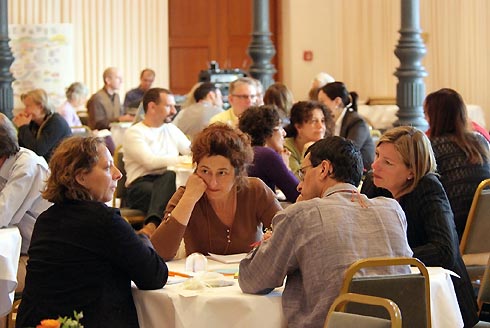
In my next life I want to be a museum evaluator and researcher. I guess that will have to be after I am a museum planner, a librarian, an urban planner, and an arborist. I was reminded about how much I enjoy the evaluator perspective at the recent Visitor Studies Association conference in Chicago, July 24-27.

One thing I tuned into over the two-and-a-half day conference was how presenters, evaluators, and researchers answered questions. When a question was posed, I often noticed there was a short but perceptible pause, followed by a well-crafted reply. In the cartoon part of my brain, I pictured a thought bubble above her head with a list or steps in a logic model she checked before answering. I also thought I saw another thought bubble hovering over the head of someone whose answer noted specialized terms.

This is the second year I have attended the VSA conference. Both years I have been drawn to and invigorated by the thoughtful and disciplined thinking and interest in critical reflection in so many sessions and among so many people. Again and again, I saw a willingness, even a zest, to explore questions. I often had a sense of an evaluator’s independence, objectivity, and neutral stance related to information that was gathered, presented, and interpreted.

Thinking About Practice, Finding Patterns
Listening to projects, studies, methods, and results, I thought about the related thinking and practices that support this work. These practices not only made the sessions better, but are relevant for me in my work and in work across museum. Four sets of practices have stayed with me. 
Questions Everywhere. There’s no doubt about it. Evaluators and researchers love questions. Sessions opened with questions as titles and ended with questions as well. “Based on this, how can we create programs that…?” was a question I heard more than once. It wasn’t just the sheer quantity of questions that was impressive. They were well-crafted questions. Some framed major conversations, others took into account the complexity of situations: “How do we evaluate fairly when pupils have different social, economic, and family circumstances…?” Even standing at the elevator, in the poster session, or at lunch, evaluators and researchers were asking questions.

Checking and Challenging Assumptions. Checking assumptions is sometimes procedural like asking if everyone has had a chance to speak. Other times it seriously challenges the fundamentals like asking how (in)adequate attendance is as a measure of success. Checking assumptions can also flip a switch and reroute thinking, as when Joe Heimlich said that measures are met when we’re successful; we’re not successful because we meet our measures. There were many friendly provocations such as asking whether we are preserving success measures to preserve ourselves. Besides a willingness to challenge assumptions, I admired an appetite for experimenting in what presenters shared and encouraged others to try. In the middle of a session, one of the presenters reminded participants, “We’re trying to do new things.” 

Finding Language. I appreciate precise language for clarity, variety, and getting at meaningful distinctions. Multiple references to the role of language in visitor studies were made. In the first session I heard “languaging visitors,” or giving them the tools to talk about and share art. The value of visitors’ language to get at what’s intangible, like intrinsic benefits, also came up. For that matter evaluator and researcher language and “articulating intended results” received attention. There were many acknowledgements of context-specific terms: Big I and little “i” identity, inquiry-based strategies, and the Exploratorium’s own definition of “immersives.”
Playing It Forward. Frequently, the follow-up to presenting a project or a study was a slide or the question, “What can we do better?” If this question wasn’t posed, then a focus on Next Steps or areas of future study was. Often specific ways in which programs, exhibits, or marketing materials could be changed were highlighted. I greatly appreciated the push for improvement this represents­–a strong interest in action, change, and closer alignment of intention and achievement. Someone in the final session asked, “How do we, as a field, increase the rigor of our work in ways that are supportive of our colleagues but hard on the research and evaluation?”

Now, there’s a great question that challenges assumptions, makes meaningful distinctions, and plays the conference forward.

An Evaluator’s Perspective
New perspectives arriving
These practices interested me and I wanted to learn more about how evaluators see these and their own practices. During the conference I asked five people about what they see as a distinct perspective of an evaluator. We talked in line for the bus, at the elevators, and before sessions started. Speaking primarily about the perspective they bring to evaluation, they mentioned the following.
•                  I’m constantly wondering how the visitor experience will be. I look at prototyping as the value of the visitor’s report and behavior. (Elizabeth, in-house exhibit planner with evaluator responsibilities)
•                  Testing assumptions about what the visitor, or learner, takes away or understands from the experience. I try and bring multiple stakeholders and their perspectives to the task of interpreting what people are taking away. (Camilla, independent evaluator)
•                  I’m constantly asking questions and wanting to know the reason for things. Everything you figure out leads to a new question. (Lorrie, independent evaluator)
•                  I’m hungry for context. I ask myself if I have and understand the context I need (background, perspective, familiarity, etc.) to bring the right tools to this person or team to do what they need to accomplish. (Nina, in-house evaluator)
•                  Objectivity. An evaluator has a neutral relationship with information; she needs to show the information and let program people bring their perspective and needs to interpreting it. (Andréa, in-house evaluator)

Over the course of my five conversations, I shifted my question from asking about an evaluator’s thinking to an evaluator’s perspective. I debated about whether and when to tell them I was going to put their response in this blog and decided to do so. I did notice I had a mix of internal and external evaluators and researchers, but also realized by sample included only women. I wished I had more time for conversations and a new round of questions.

The conference was valuable as was my little study. I have a lot to play forward and a lot of work ahead before I’m thinking like an evaluator.

Monday, July 25, 2011

Learning Assets - Part 2


Lookout Cove: 2.5 acres of outdoor exploration at Bay Area Discovery Museum

In exploring museums' learning assets recently, I mentioned about 15 different substantial resources through which museums deliver experience and learning value to their visitors and communities. The list continues to grow through conversations and reading. But neither the precise list nor the number of items is really important. Instead it illustrates that museums have many learning assets. As you can see, most of them are quite familiar.
•           Exhibits, programs, collections, library, school or preschool, maker space, film and multi-media, historic structure, gardens, science park, the building, research center, outreach or mobile museum, recycle center, nature center, planetarium, aquarium, teacher resource center, theater, and hall of fame.

Every museum has learning assets. But not every museum knows what its learning assets are and why they are valuable. Museums do consider exhibits (or programs, teacher resource center, or aquarium) as financial assets and perhaps as strategic assets. But these assets are also critical resources for accomplishing broad strategic and learning goals. Making explicit how they contribute to a museum’s being a recognized convener for children’s well-being, supporting 21st century learners or workforce development, or activating civic engagement around urgent social or environmental issues–is necessary to activating their value

The Benefits of Learning Assets
Beyond a general sense that identifying learning assets might be helpful, what does clarity about learning assets accomplish?

Earlier this year, I wrote about a hard-working question I often use as a tool: what can this attractive option accomplish, that needs to be accomplished, that another attractive option cannot? That’s a good test for evaluating learning assets as well. There are two perspectives on this question to consider. First what does this help the museum accomplish for itself organizationally and second, what does it accomplish for the audience?

Internally, defining a set of learning assets:
•          Creates a shared strategic and organizational context for all learning assets. Each asset has a distinct and significant contribution to make to the organization’s strategic and learning interests. Aligning assets on one strategic platform assures they all focus on advancing those interests.  
•           Establishes a framework for accountability. Responsibility for delivering learning value follows the asset by: calibrating organizational impacts to each asset and its capacities and opportunities; organizing staff for work; and allocating and managing resources.
•           Strengthens interdependence and interaction among learning assets. Clarifying that there are, in fact, learning assets and what they are makes each more valuable. Defining the contribution of each asset positions all of them for interaction by pointing out ways they can work with, support, and enhance one another.  

A museum’s valued and complementary learning resources help:
•           Serve the full audience and age range. Every learning asset does not have to serve the full audience or age range. Certain assets can serve targeted audience and age segments well. Together all of the assets can serve the audience fully.
•           Serve the audience with choice. Multiple assets increase the number and range of activities to assist learners in customizing their visit to interests, time, visitor group, and relationship with the museum.
•           Assist learners in extending and deepening their learning and play experiences. Managing learning assets to afford specific opportunities makes it easier for learners to build on an experience, follow-up on an activity in greater depth, explore interesting content through a new format, or experience a different perspective.

Working Assets
Defining a museum’s learning assets is a good start, but knowing their qualities and contributions is important to putting assets to work. I find four reference points helpful to consider: context, comparability, complementarity, and capacity.

1830's Log Home at Madison Children's Museum
•    Context explores an asset relative to the museum’s strategic and learning interests and to other assets. Consider the garden in relation to exhibits. What does it accomplish that an indoor exhibit does not? How important is the garden in providing first-hand experiences with naturally occurring seasonal cycles and changes important to the museum’s mission?
•     Comparability refers to the relative size of the assets. There can be wide variability among assets. In one museum a theater might be a program space for weekly performances; in another it might have a full schedule of live theater and demonstrations that explore current issues through science with students and the general public. Size is not only physical space or audience numbers. An asset may have staff assigned to it, a strong identity among constituents, or a recognized expertise for the museum.
•      Complementarity is the usefully different aspect of each necessary and valued resource through which a museum delivers learning value. Push on distinctions to probe what’s distinct and how it serves the other assets; a museum school is an on-going learning community with a continuity among students and teachers that programs do not have. Research on inquiry learning conducted in the museum's research center can be delivered through the teacher institute or programs; research on collections can inform exhibit planning.
Science Park at New York Hall of Science
•     Capacity is the asset’s ability to make an impact on or for learners or the community. Impacts­–or positive changes the museum believes are possible–are not easy to define. Still it’s helpful to keep a broad view of learning, be clear about the nature of the impact, and relate it to the organization’s long-term, intended impacts. How will the teacher institute reduce the achievement (or readiness) gap among students?

There are more ways to work a museum’s assets. Recently I heard from a science museum and library that I worked with 2 years to develop a learning framework that described 4 learning assets: exhibits; programs; collections and library; and the house and grounds. We also developed an exhibit master plan. The museum is now completing a program plan that describes the audience, vision, strategies, results areas, and impacts for programs. A collections plan is in the queue for 2012 and will be followed by an updated building and grounds plan. In addition to developing a plan for each asset that looks at and explores these assets at close range, the museum is using the 4 assets for budgeting and funding requests.

Your Museum’s Learning Assets
Size up your museum’s learning assets. Look around the museum to get a sense of where and how the learning assets are coming through on your website, in the organizational structure, the budget, and vocabulary. Think about the following.
•           How does your museum look at and talk about its exhibits, programs, outreach, film and   multi-media program, or resource center?
•            What are your museum’s leaning assets?
•           How do you define exhibits at your museum as a learning asset? or programs as a learning asset?
•           How does this help internally to strengthen these areas and encourage collaboration?

•           How has it benefitted your audience? your community?

Related Museum Notes Posts

Monday, July 18, 2011

A Museum’s Learning Assets - Part 1


Museums deliver learning value through exhibits and how many other ways? (California Academy of Sciences)

Exhibits and programs are the primary way museums and science centers deliver learning experiences and learning value.

And so are collections. So is film and multimedia programming. And also a school, a garden, or an historic building. What about a library? A teacher institute? Outreach or an aquarium?

Identifying the different ways museums are educationally valuable may start off easily enough. But the list quickly expands; more possibilities are found and more distinctions are made. If you’ve encountered this, you know it’s not easy. You should also know, it’s not uncommon.

Several years ago I developed a learning framework and exhibit plan with a museum that was experiencing multiple challenges. It re-opened at a new site just after 9-11 and it was undergoing multiple leadership transitions. Our planning process was a natural playing field for the tensions among exhibits, programs, and a museum/charter school the museum operated. In the course of planning, we needed to describe the primary ways in which the museum would implement its broad educational goals to serve its visitors, students, and community. It was tense with an impending sense of winners and losers; was the school really part of the museum? were programs being recognized for what they brought to the museum experience?

Four Small Words 
We avoided a seemingly inevitable hierarchy in what now seems like an obvious solution. We designated all three areas as valued and complementary assets through which the museum delivers learning value. In the end the plan’s legacy was not its pedagogical framework or exhibit concepts but the recognition that the museum needed all three of its learning assets. And they needed one another.
A family art program (Children's Discovery Museum of San Jose)
Identifying a museum’s learning assets also proved to be useful in developing a learning plan for 2-1/2 recently merged museums. Not only did each museum bring its valued assets to the new entity, but the new museum needed a single–and shared–set of learning assets to move forward. This approach has worked for a very established science center and museum with a planetarium and nature center as well as exhibits and programs; for a start-up children’s museum; and for an expanding science center.

Given their versatility and tested diplomatic capacity, learning assets have become a standard part of the strategic and learning planning I do with museums.

Learning Resources as Assets 
Learning assets serve as overarching objectives for accomplishing a museum’s long-term strategic or learning interests.  They may be referred to differently to fit a museum’s existing vocabulary. Some museums refer to them as learning platforms, others as learning resources.
The term assets, however, highlights useful dimensions for understanding and managing this accumulated value for a museum. Exhibits, programs, collections, gardens, historic structures, to name just some learning resources, are financial assets. Some, such as exhibits, are significant sources of revenue. Museums also invest in them on an on-going basis: hiring and supporting staff, developing expertise, and making new acquisitions.

The learning value of exhibits, gardens, a library, or a school should be considered as well. They attract audiences and engage specific visitor segments in targeted ways. They carry content, cultural heritage, and community stories. They embed the museum’s experiential brand and distinguish it from other venues that serve the same audiences.

Learning assets clearly also reflect museums as multidimensional learning and community resources. Although virtually all museums have exhibits, they are not just a bunch of exhibits. A planetarium is not just a “component;” programs are not simply a service. Thinking of them narrowly limits leveraging their format, media, content, or type of interaction to engage learners in pursuing interests, practicing skills, appreciating their heritage, or building a sense of community. In fact, when a museum views its exhibits and programs as a set of learning assets, or perhaps a portfolio of assets, it has a greater opportunity to impact learners and the community.

Defining Assets
Mill City Museum (Minneapolis): Building as artifacts as learning asset
After quickly deciding that exhibits and programs are learning assets, determining what else should be included can take some time. Lively discussions are ahead for the museum that explores whether its building is a learning asset as it is for The Bakken Museum or might be for the California Academy of Sciences. Could Lake Champlain be a learning asset for ECHO Lake Aquarium and Science Center? Should a museum’s website or social media be a learning asset? 

To identify assets and understand why they are valuable, ask: how does this resource advance our museum’s learning and strategic interests?  What are the particular learning interests it advances and how? Be specific, be concrete; give examples; back up with as much evidence as you have.

While the intent of this exercise is not to eliminate assets, it's possible there will be some reshuffling. Is the garden an exhibit or part of the house and grounds? Is science park an exhibit?  It's also possible the more limited value of some resources may become apparent to everyone; what is the recycling center accomplishing for us? This process may also help a museum recognize it has more learning assets than it thought it had.
Garden or exhibit? Greensboro Children's Museum's Edible Garden   
So far I have mentioned 15 various learning assets (in blue) that I know of in particular museums, although no one museum has all of them. Quantity aside, what counts for a learning asset in one museum may not register as one at another.

There’s no recipe for describing learning assets. It's important, however, to define them in parallel ways, emphasize what distinguishes each, and insist on the valued and complementary nature of these assets. An example for exhibits and for programs illustrates brevity, parallel construction, and distinctions.

Exhibits engage children and adults in self-directed, shared learning experiences through hands-on, bodies-on, and minds-on interaction in rich, experiential settings. 

Programs provide children and adults with special access to media, tools, objects, and processes through focused and facilitated experiences by prepared staff, volunteers, artists, scientists, and specialists.

One of several libraries at Seattle Art Museum
Both these learning assets mention the same audience. This isn’t always the case; a research library might serve local, national, and international scholars. Each asset does distinguish itself in the nature of the engagement it offers. Exhibits offer self-directed experiences while programs offer facilitated, or face-to-face experiences. Facilitated experiences allow special access to fragile objects (or hot glue guns) whereas the rich experiential settings of exhibits encourage physical interaction. These descriptions reflect the museum’s mission in general, although, they could do so more explicitly.

Definitions vary in length from one museum to another as does the territory they cover.  What's important is being clear about the capacity of different assets to deliver value and contribute to a cohesive set that works together. 

So, once you get this far, then what? Join me next week. I'll look at benefits of using learning assets.


Related Museum Notes Posts